
Guide
How to gut-train for race-day fueling
This is educational content, not medical advice. If you have a digestive condition, talk to a sports dietitian or your doctor before changing your race-day fueling.
Gut training (gastrointestinal training) is the practice of progressively increasing carbohydrate intake during long training sessions so the gut upregulates its SGLT1 and GLUT5 transporters and tolerates race-day fueling rates. Research shows 2-4 weeks of progression reliably moves athletes from a 30-45 g/h tolerance into the 60-90 g/h range.
The single most common cause of a blown race isn't the legs. It's the gut. A study of Ironman finishers found that more than 60% reported some form of GI distress during the race, and the rate was highest in athletes who tried to consume more carbs than they had trained for. The fix is not "eat less on race day." It's to train your gut the same way you train your legs.
This is what's called gut training or gastrointestinal training, and the research on it is consistent: 2-4 weeks of progressive carb intake during long training sessions reliably moves athletes from a 30-45 g/h tolerance into the 60-90 g/h range that endurance fueling actually demands. Some athletes go higher; some plateau lower. The point is you don't get there for free.
Our race-day fueling planner at planner.nutrifinder.it gives you a target carb band for your specific race in 30 seconds. This guide is what you do between now and race day to actually be able to hit that target without your stomach revolting.
Why the gut needs training in the first place
Carbohydrates are absorbed in the small intestine by two main transporters:
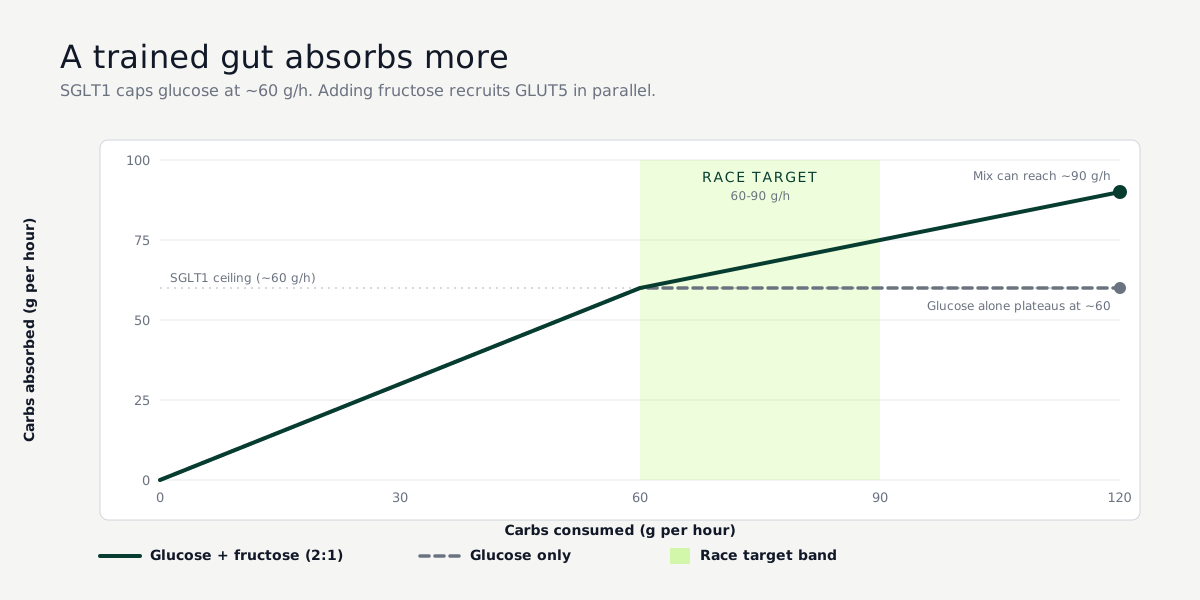
- SGLT1 moves glucose (and the closely related maltodextrin). It saturates at roughly 60 grams per hour. Above that intake rate, glucose-only products sit in your gut and pull water in, which causes bloating, nausea, and the dreaded mid-race urge to find a portable toilet.
- GLUT5 moves fructose. It runs in parallel with SGLT1 and adds capacity on top of it. Products that mix glucose and fructose at ratios around 2:1 (or 1:0.8 for high-end protocols) can deliver up to ~120 g/h in trained athletes.
Both transporters are upregulated by use. The more carbs you ask your gut to process during exercise, the more transporters your gut expresses and the more it can handle. This is the part most athletes miss. They read "you need 90 g/h for a marathon" and try to do that on race day for the first time. Their gut, which has spent the entire training block working with water and the occasional gel, simply can't.
The 4-week protocol
This is a starting framework. Your own progression may be faster or slower depending on your starting tolerance, the products you use, and your training volume. The key principle is progressive overload, same as strength training.
Week 1 - establish your floor
Pick a long training session of 90 minutes or more. Take in carbs at the bottom of your target band - for most athletes that's around 45 g/h. Use the products you intend to use on race day, not new ones. Pay attention to:
- How does your stomach feel 30, 60, 90 minutes in?
- Any bloating, nausea, urgency?
- Are you finishing the session feeling fed or empty?
If you finish the session feeling good, you have a floor to build from. If 45 g/h causes distress, drop to 30 g/h and hold there for an extra week before progressing.
Week 2 - add 10-15 g/h
Same session length, same products, but bump intake to 55-60 g/h. This is the threshold where many athletes start to feel it. Two things to watch for:
- Glucose-only saturation. If your products are all maltodextrin/glucose (no fructose), 60 g/h is where the SGLT1 transporter caps out. Symptoms: bloating, "sloshing," nausea. The fix is not less carbs - it's a product that includes fructose.
- Concentration matters. Mixing your drink too thick (more than ~7-8% carb concentration) slows gastric emptying and pulls water from your bloodstream into your gut. Dilute your drinks and chase gels with water.
Week 3 - push toward your target
Bump again to 70-75 g/h (or stay at 60 if week 2 was rough). Try a session that's closer to race duration. This is the week where you find out whether your race target is realistic. If 75 g/h is the ceiling your gut tolerates today, your race plan should be 75 g/h - not 90.
Pushing the rate is easier when each packet carries more, so you are swallowing fewer of them per hour: gels ranked by carbs per serving shows where the top of the catalogue sits.
Week 4 - race rehearsal
One full-length (or near-full-length) session at your race target. Use the exact products, in the exact sequence, at the exact intervals you'll use on race day. This is also when you test your hydration plan. Many athletes train carbs and water separately; race day is the first time they combine them at race pace, and it's where the wheels come off.
Common mistakes that wreck gut training
- Switching products mid-block. If you trained on Brand X and your race partner hands you Brand Y at an aid station, your gut hasn't trained on Brand Y. Stick with the products you've practiced.
- Going too hard, too fast. Trying to jump from 30 g/h to 90 g/h in two weeks. Your gut needs time to upregulate the transporters; rushing it just means a week of training lost to GI symptoms.
- Underestimating concentration. A "small" 500 ml bottle of drink mix at 80 g carbs is 16% concentration, double what your gut wants. Either dilute it or pair gels with water.
- Caffeine first, food second. Caffeine can irritate the gut on its own. Layer it onto your protocol once carbs are dialed in, not at the same time.
What gut training does not fix
A trained gut still has limits. Heat slows gastric emptying - your race-day tolerance in 30°C will be lower than your training tolerance in 15°C. Pacing matters - at threshold or above, blood is shunted away from the gut to the muscles, and absorption drops. Carbohydrate type matters - even a fully trained gut can't get past 60 g/h on glucose alone.
A trained gut also doesn't fix nutritional mistakes elsewhere in the protocol. If your pre-race breakfast is unfamiliar or too late, no amount of mid-race fueling rescues that.
When to talk to a sports dietitian
If you've completed a structured 4-week protocol and still have GI symptoms at the bottom of the carb band, that's a signal to bring in a specialist. Persistent symptoms can point to fructose malabsorption, lactose intolerance, or other conditions that no amount of gut training will fix on its own. A sports dietitian can help you map a product mix that works with your specific tolerance.
Get a plan for your race
Once you know your tolerance, plug it into the NutriFinder planner along with your weight, sport, distance, and conditions. The planner returns a per-30-minute fueling timeline at your trained rate, including the products to take and when, plus matched sodium and fluid targets. Gut training tells you the ceiling; the planner tells you how to spend the budget on race day.
Research and references
The numbers and protocols in this guide rest on the following peer-reviewed sources. Verify the dose, the side-effect profile, and the contraindications against the primary literature, not against any single source.
- Pfeiffer B, Stellingwerff T, Hodgson AB, et al. 2012. Medicine & Science in Sports & Exercise. Nutritional intake and gastrointestinal problems during competitive endurance events. PMID 21775906
- Jeukendrup AE. 2014. Sports Medicine. A step towards personalized sports nutrition: carbohydrate intake during exercise. PMID 24791914
- Jeukendrup AE. 2017. Sports Medicine. Training the gut for athletes. PMID 28332114
- Costa RJS, Miall A, Khoo A, et al. 2017. Applied Physiology, Nutrition, and Metabolism. Gut-training: the impact of two weeks repetitive gut-challenge during exercise on gastrointestinal status, glucose availability, fuel kinetics, and running performance. PMID 28177715
- Kerksick CM, Arent S, Schoenfeld BJ, et al. 2017. Journal of the International Society of Sports Nutrition. International society of sports nutrition position stand: nutrient timing. PMID 28919842
- Cao W, He Y, Fu R, et al. 2025. Nutrients. A review of carbohydrate supplementation approaches and strategies for optimizing performance in elite long-distance endurance. PMID 40077786