
Guide
Beta-alanine for endurance athletes
Educational content, not medical advice. Long-term safety beyond 12 months of continuous use is not well-characterized; pregnant or lactating athletes and adolescents should consult a doctor before supplementing.
Beta-alanine is an amino acid that, taken daily for weeks, raises muscle carnosine by 40 to 80 percent and buffers the acidosis that limits all-out efforts of one to four minutes. It is a chronic loading supplement, not a race-day intake: the few hundred milligrams in a gel are pharmacologically inert.
The honest caveat, up front
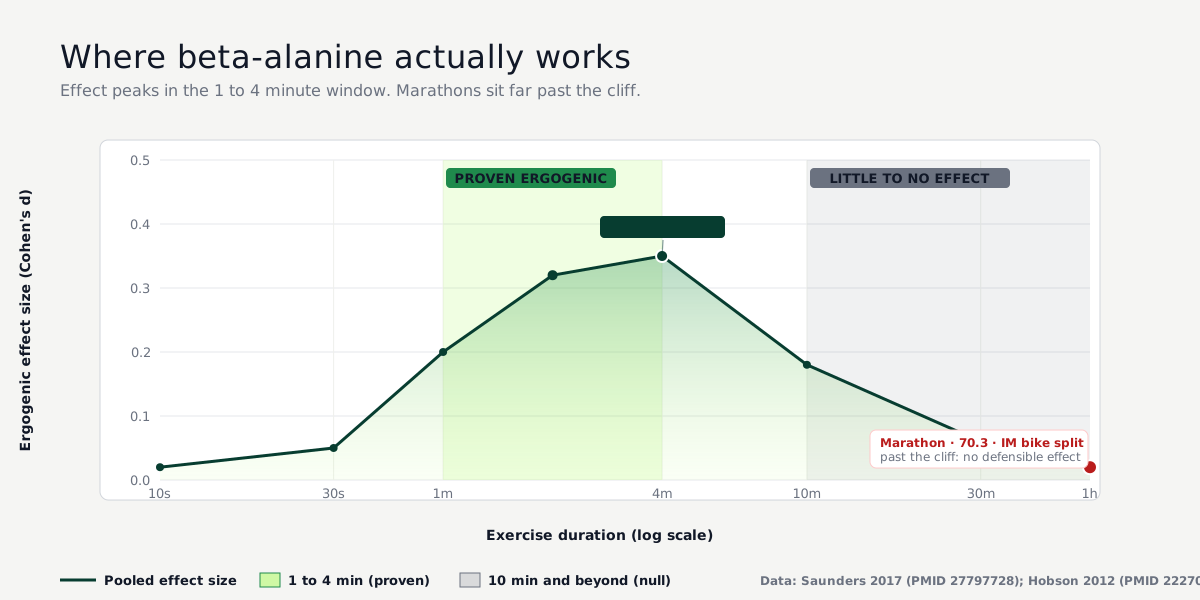
Beta-alanine is one of the few supplements with a real ergogenic effect: a 2017 meta-analysis across 40 studies and 1,461 participants put the average benefit at a small but real effect size of 0.18 (Saunders et al., Br J Sports Med). But that average hides everything that matters. The effect peaks for efforts lasting one to four minutes, declines past four, and collapses past ten. For a marathon, a half-Ironman bike, or a century ride, the evidence base is thin to null. A 100 to 800 milligram dose in a race-day gel is pharmacologically inert. This guide is the why.
Our race-day fueling planner at planner.nutrifinder.it does not currently account for beta-alanine, because for most endurance events there is nothing to schedule. The rest of this guide explains the few cases where you should care, and the protocol if you fit one of them.
What beta-alanine actually does
When you push hard, your muscles produce hydrogen ions (H+) as a byproduct of glycolysis. Those ions drop intramuscular pH, and that acidosis is one of the factors that contributes to fatigue inside the 1-4 minute high-intensity window. Your muscles have a built-in buffer for this: a small molecule called carnosine, which sponges up H+ ions inside the fast-twitch fibres.
The amount of carnosine in your muscles is rate-limited by one thing: how much beta-alanine is available to build it. Taking beta-alanine as a supplement, over weeks, raises muscle carnosine by 40 to 80 percent (Hill et al. 2007, Amino Acids). More carnosine means more buffering capacity, which means slightly longer time-to-fatigue in efforts where H+ buildup is the limit.
Carnosine itself is not useful to swallow: your gut breaks it back into amino acids before it reaches muscle. You have to take the precursor and let your muscles rebuild it from there. This is the entire mechanism.
Where the evidence is strongest: 1 to 4 minutes
The cleanest result in the field is the duration cutoff. Both Hobson et al. 2012 (Amino Acids) and Saunders et al. 2017 (Br J Sports Med) stratified their meta-analyses by event duration. The pattern is consistent enough that you should treat it as the headline:
| Event duration | Meta-analytic result |
|---|---|
| Under 30 seconds | No significant effect (p > 0.3) |
| 60 to 240 seconds | Clear positive effect (p < 0.001), ~2.85% improvement |
| 4 to 10 minutes | Modest effect (effect size ~0.18) |
| Over 10 minutes | No defensible effect in pooled data |
If you race a 1500 metre run, a 2 km erg, a kilo, a 4 km pursuit, a 5-minute climb, a CrossFit-style interval workout, a hill repeat: this is your window. The mechanism (H+ buffering) matches the rate-limiting physiology (lactate accumulation in 1-4 minute glycolytic efforts), and the studies show it lands. Loading beta-alanine is a defensible 2-3% edge.
If you race a 200 metre, a 10 second sprint, a track final: too short for H+ accumulation to matter, and the supplement does nothing.
If you race a marathon, a 70.3, a full Ironman, a century, a gran fondo, a six-hour gravel race: you are past the cliff. The effect is not measurable in the literature.
The endurance angle: thin, with one honest exception
If you came here because beta-alanine is on the ingredient list of your pre-workout or in trace doses in a gel, the honest answer for endurance racing is that the few mg in your scoop or sachet does nothing acutely, and the evidence base for chronic loading in long-duration events does not support a meaningful effect.
The one plausible exception worth flagging: end-of-race anaerobic capacity inside an otherwise aerobic event. The 5-minute climb at hour four of a road race. The breakaway with 20 km to go in a 160 km gran fondo. The final 1500 metres of a 10 km running race. The closing 90 seconds of a criterium. Those efforts move into the 1-4 minute glycolytic window, even if the bulk of the race did not.
Van Thienen et al. 2009 (Med Sci Sports Exerc) tested this directly: trained cyclists rode a 110-minute simulated road race, and beta-alanine loading improved peak power output in the final 30-second sprint. The effect was specific to that closing effort. Howe et al. 2013 in highly trained cyclists was null on a 4-minute TT, illustrating that the effect in trained cyclists is small and inconsistent. The endurance literature on beta-alanine is shallow enough that an n=1 self-test is reasonable if your event has a defining sub-4-minute closing effort.
For pure steady-state endurance racing with no anaerobic closing demand, there is no defensible claim to make. The supplement industry continues to market it for this anyway. Treat that marketing the way you treat the claim that a fitness watch makes you fitter.
How the loading actually works
This is the most-misunderstood part. Beta-alanine works through chronic carnosine accumulation, not acute pre-race dosing. A 100 mg, 500 mg, or even 1.6 g dose in a race-day gel cannot affect intramuscular buffering capacity that day. The biology runs on weeks, not minutes.
The consensus protocol, per the ISSN Position Stand (Trexler et al. 2015, J Int Soc Sports Nutr):
- Loading: 4 to 6 grams per day, for 4 to 12 weeks
- Total cumulative dose: around 179 grams across the loading block (Hobson 2012)
- Splitting: 4 doses of 1 to 1.6 g across the day, not one big dose
- Co-ingest with carbs: a small carb meal modestly improves uptake into muscle (Stellingwerff 2012a, Amino Acids)
- Maintenance: roughly 1.2 g/day sustains elevated carnosine after loading (Stellingwerff 2012b, Amino Acids)
- Washout: about 2% loss per week after stopping, so the loaded state persists for months
Practical translation: if your A-race is in eight weeks and you want beta-alanine on board, start loading now. If your A-race is in two weeks, it is too late. There is no race-week protocol that works.
Side effects: the harmless tingle
The only clinically documented side effect is paraesthesia: a transient skin tingle, usually on the face, scalp, hands, or upper torso, lasting 60 to 90 minutes after a dose larger than ~0.8 to 1.0 g. It is histamine-receptor-mediated, harmless, and dose-dependent. Two ways to deal with it:
- Split dosing: four servings of 1.0 to 1.6 g across the day instead of one 4 to 6 g bolus. This is the cheap fix and is also what the loading protocols recommend.
- Sustained-release formulations: Décombaz et al. 2012 (Amino Acids) showed slow-release beta-alanine tablets flatten the plasma peak and eliminate paraesthesia while preserving the same total dose and the same carnosine accumulation. Useful if you find the tingle intolerable.
Dolan et al. 2019 (Adv Nutr) ran the largest safety meta-analysis to date: 101 human studies and 50 animal studies. Paraesthesia was the only adverse event with a significant signal versus placebo. No evidence of harm at any studied dose. The honest caveat: there is no controlled safety data for more than 12 months of continuous use, for pregnant or lactating athletes, or for adolescents. Stick to the studied range.
The decision matrix
| Your event | Beta-alanine verdict |
|---|---|
| 1500 m / 2 km erg / kilo / 4 km pursuit / 5 min climb / CrossFit intervals | Yes. Load 4-6 g/day for 4-12 weeks before peak event. Split dosed. |
| Criterium, hill-climb, track racing 1-10 min | Yes. Same protocol. |
| 10 km running with a strong closing kick | Maybe. Defensible n-of-1 trial. |
| Road cycling / gran fondo with anaerobic closing efforts (breakaway, climb, sprint finish) | Maybe. Van Thienen 2009 supports it for closing sprint power specifically. Self-test. |
| Marathon, 70.3, full Ironman, century, ultra, gravel epic | No. No defensible evidence. Save the money. |
| 100 m, 200 m sprint, 10 s power test | No. Too short for H+ to matter. |
What this means for our product catalog
You will see "beta-alanine" on the ingredient list of some endurance products. For two reasons:
- Pre-workout-style "energy" gels and drinks containing 100 to 800 mg per serving. The dose is below the threshold for acute paraesthesia and far below what would matter chronically. It is on the label because the label sells. Ignore it for your purchase decision.
- Loading powders at 4-6 g per serving, sold separately from race-day fueling. These are the only products doing the actual pharmacology. They are also not what you race on; they are what you take with breakfast and dinner for two months before the race.
Two cleanly separated categories. Our planner only deals with race-day fueling, so beta-alanine is not currently a planner input. If your event is in the "yes" or "maybe" tier above, source bulk beta-alanine powder (cheap, around €15-25 per month at loading dose), pick a slow-release option if the tingle annoys you, and start the protocol on a calendar that finishes loading at least two weeks before your peak race.
For everyone else: skip it. Your half marathon performance is a hydration, carb-per-hour, gut-training, and pacing problem. None of those are solved with carnosine.
Research and references
The numbers and protocols in this guide rest on the following peer-reviewed sources. Verify the dose, the side-effect profile, and the contraindications against the primary literature, not against any single source.
- Trexler ET, Smith-Ryan AE, Stout JR, et al. 2015. Journal of the International Society of Sports Nutrition. International society of sports nutrition position stand: Beta-Alanine. PMID 26175657
- Saunders B, Elliott-Sale K, Artioli GG, et al. 2017. British Journal of Sports Medicine. β-alanine supplementation to improve exercise capacity and performance: a systematic review and meta-analysis. PMID 27797728
- Hobson RM, Saunders B, Ball G, Harris RC, Sale C. 2012. Amino Acids. Effects of β-alanine supplementation on exercise performance: a meta-analysis. PMID 22270875
- Harris RC, Tallon MJ, Dunnett M, et al. 2006. Amino Acids. The absorption of orally supplied β-alanine and its effect on muscle carnosine synthesis in human vastus lateralis. PMID 16554972
- Hill CA, Harris RC, Kim HJ, et al. 2007. Amino Acids. Influence of β-alanine supplementation on skeletal muscle carnosine concentrations and high intensity cycling capacity. PMID 16868650
- Van Thienen R, Van Proeyen K, Vanden Eynde B, et al. 2009. Medicine & Science in Sports & Exercise. β-alanine improves sprint performance in endurance cycling. PMID 19276843
- Howe ST, Bellinger PM, Driller MW, Shing CM, Fell JW. 2013. International Journal of Sport Nutrition and Exercise Metabolism. The effect of beta-alanine supplementation on isokinetic force and cycling performance in highly trained cyclists. PMID 23630052
- Stellingwerff T, Decombaz J, Harris RC, Boesch C. 2012. Amino Acids. Optimizing human in vivo dosing and delivery of β-alanine supplements for muscle carnosine synthesis. PMID 22358258
- Stellingwerff T, Anwander H, Egger A, et al. 2012. Amino Acids. Effect of two β-alanine dosing protocols on muscle carnosine synthesis and washout. PMID 21847611
- Décombaz J, Beaumont M, Vuichoud J, et al. 2012. Amino Acids. Effect of slow-release β-alanine tablets on absorption kinetics and paresthesia. PMID 22139410
- Dolan E, Swinton PA, Painelli VS, et al. 2019. Advances in Nutrition. A systematic risk assessment and meta-analysis on the use of oral β-alanine supplementation. PMID 30980076