
Guide
Citrulline malate for endurance athletes
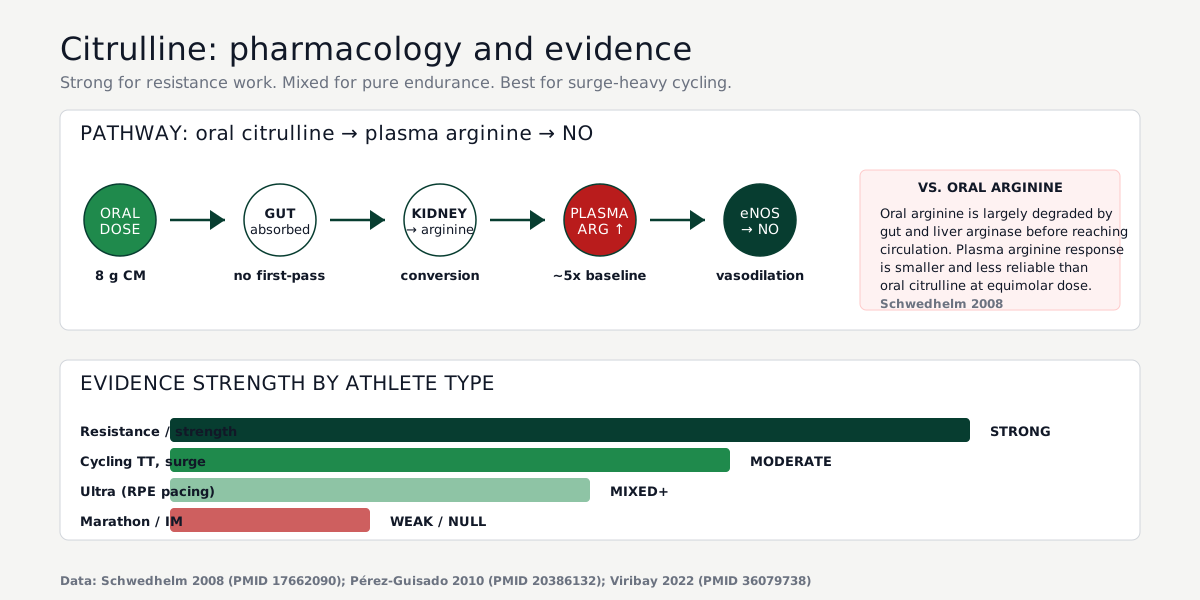
Educational content, not medical advice. Athletes on antihypertensives, PDE5 inhibitors, or nitrates should consult a doctor before citrulline supplementation due to potential additive hypotensive effects.
L-citrulline is a non-proteinogenic amino acid that raises plasma arginine more reliably than oral arginine itself, feeding nitric-oxide production and vasodilation in working muscle. Citrulline malate pairs it with malic acid; the best-supported protocol is 8 g of citrulline malate, which contains roughly 4.5 g of free L-citrulline.
The honest caveat, up front
Citrulline malate sits in an odd evidentiary position: the resistance-training literature is strong (Pérez-Guisado's 8 g protocol improves bench-press reps and reduces post-workout soreness reliably), but the pure-endurance literature is genuinely mixed. The 2022 aerobic-specific meta-analysis (Viribay et al., Nutrients) is null on aerobic performance, VO2 kinetics, RPE, and lactate. Other individual cycling trials (Suzuki 2016, Bailey 2015) show small positive signals. If you're a marathon runner asking "should I take this for my next race," the honest answer is: probably not for the finish-time gain, maybe for the perceived-effort reduction if you respond, definitely not the strongest item on your supplement shopping list. If you're a crit racer or a cyclocross athlete, the calculus tilts toward yes.
Our race-day fueling planner at planner.nutrifinder.it doesn't currently include citrulline, because it's a 1-7 day pre-load decision, not a race-day intake. The rest of this guide is the honest read.
What it is and how it works
L-citrulline is a non-proteinogenic amino acid produced endogenously in the urea cycle and small intestine. The pharmacology is what makes it interesting compared to oral arginine: L-citrulline raises plasma L-arginine more reliably than equimolar oral L-arginine itself. Schwedhelm et al. 2008 demonstrated this directly. The reason: oral arginine is heavily metabolized by intestinal and hepatic arginase on first-pass, so most of it never reaches circulation. Citrulline bypasses this by traveling to the kidney first, where it's converted to arginine and released into circulation.
Once plasma arginine is elevated, it serves as substrate for endothelial nitric oxide synthase (eNOS). eNOS converts arginine to nitric oxide (NO), which drives vasodilation in working muscle. The theoretical chain: more arginine → more NO → better blood flow → better O2 and substrate delivery → better performance and recovery.
Citrulline malate pairs L-citrulline with malic acid (a Krebs cycle intermediate) at typically a 1:1 or 2:1 ratio. The malate component is proposed to support aerobic ATP regeneration via TCA anaplerosis and lactate buffering, though direct human evidence for an independent malate effect is thin. An 8 g serving of 1:1 citrulline malate contains roughly 4.5 g of free L-citrulline.
Evidence base
Resistance training and high-rep strength (the strongest case):
- Pérez-Guisado & Jakeman 2010 (J Strength Cond Res): 8 g citrulline malate produced +8 additional bench-press reps across 8 sets and 40% less DOMS at 24-48 hours.
- Trexler et al. 2019 (J Strength Cond Res) meta-analysis: small but significant ergogenic effect on high-intensity strength/power performance.
- Rhim et al. 2020 (J Sport Health Sci) meta-analysis of 13 trials: reduced RPE and 24/48 h muscle soreness; no effect on blood lactate.
Cycling time trial (mixed):
- Suzuki et al. 2016: 2.4 g/day L-citrulline for 7 days improved 4 km TT by ~1.5% in trained men.
- Bailey et al. 2015: 6 g/day L-citrulline for 7 days sped VO2 mean response time (59 → 53 s) and extended severe-intensity time-to-exhaustion by ~12%.
- Cunniffe et al. 2016: 12 g acute citrulline malate, null for repeated high-intensity cycling and subsequent aerobic capacity.
Pure aerobic endurance (the honest read):
- Viribay et al. 2022 (Nutrients) - the most rigorous synthesis specific to aerobic outcomes - found no significant effect on aerobic performance (SMD 0.15, p=0.08), no effect on RPE, no effect on VO2 kinetics, no effect on lactate. A non-significant positive trend appeared for chronic over acute dosing.
The 2022 aerobic meta-analysis is the load-bearing evidence point. It's null. Single positive trials in cycling are real but underpowered to overturn the synthesis.
For endurance specifically
The honest summary by event type:
- Pure steady-state aerobic (marathon, 70.3, Ironman, century, gravel epic): evidence is weak. Don't make this your top supplement purchase for race-day finish time.
- Cycling time trials and surge-heavy endurance (crit, cyclocross, MTB XC, breakaway-prone road racing): the positive signal in Suzuki 2016 lands here. Defensible n-of-1 trial. The mechanism (vasodilation, better O2 delivery during anaerobic surges) is mechanistically coherent.
- Resistance training, CrossFit, hybrid athletes: strongest evidence base. Reasonable purchase.
- Recovery and perceived effort across any endurance event: the most reproducible finding (Rhim 2020) is reduced RPE and reduced post-exercise soreness, not raw performance gain. For ultras where pacing is dictated by RPE, that may matter.
Dose and protocol
Citrulline malate (1:1): 6-8 g, 60 minutes pre-exercise. Pérez-Guisado used 8 g; Rhim's meta-analysis endorses 8 g acutely. Note that 8 g of 1:1 CM ≈ 4.5 g free citrulline, so dosing equivalence with pure L-citrulline is not gram-for-gram.
Free L-citrulline: 3-6 g, 60 minutes pre-exercise. Bailey 2015 used 6 g/day; Suzuki 2016 used 2.4 g/day chronically.
Acute vs chronic loading: positive endurance studies (Bailey, Suzuki) used 7-day loading rather than acute pre-event dosing. Viribay 2022 noted a non-significant positive trend favoring chronic protocols in aerobic outcomes. If you're going to try it for an endurance event, load for at least a week before the target session, not just take a single dose pre-race.
Timing: 60 minutes pre-exercise aligns with plasma arginine Cmax following oral citrulline.
Side effects
Benign safety profile. No serious adverse events documented in the literature. The two issues worth knowing:
- Mild GI discomfort at single doses above 10 g. The malate component is acidic, which contributes.
- Mild transient blood pressure reduction, relevant only for athletes on antihypertensives, PDE5 inhibitors (sildenafil, tadalafil), or nitrates. Additive hypotension is plausible. Otherwise harmless.
Citrulline is not on the WADA prohibited list. No interaction with caffeine or beta-alanine at typical pre-workout doses.
Practical bottom line
| Your profile | Citrulline verdict |
|---|---|
| Marathon, 70.3, IM, century at steady state | Skip / low priority. Viribay 2022 is null on aerobic performance. |
| Cycling time trial, criterium, cyclocross | Maybe. Best n-of-1 candidate among endurance disciplines; positive cycling signal in Suzuki 2016. |
| CrossFit, hybrid, high-rep resistance | Yes. Strongest evidence base; 8 g citrulline malate 60 min pre-session. |
| Ultra-distance with RPE-managed pacing | Maybe. Strongest cross-study finding is RPE reduction; load 7 days pre-event. |
| Already on antihypertensives or PDE5 inhibitors | Consult a doctor. Additive hypotension is plausible. |
Cost: bulk citrulline malate runs ~€30-50/month at 8 g/day; free L-citrulline slightly cheaper per effective gram. Not extreme, but harder to justify than creatine or beta-alanine on a fixed supplement budget if you're a pure endurance athlete.
Research and references
The numbers and protocols in this guide rest on the following peer-reviewed sources. Verify the dose, the side-effect profile, and the contraindications against the primary literature, not against any single source.
- Schwedhelm E, Maas R, Freese R, et al. 2008. British Journal of Clinical Pharmacology. Pharmacokinetic and pharmacodynamic properties of oral L-citrulline and L-arginine: impact on nitric oxide metabolism. PMID 17662090
- Pérez-Guisado J, Jakeman PM. 2010. Journal of Strength and Conditioning Research. Citrulline malate enhances athletic anaerobic performance and relieves muscle soreness. PMID 20386132
- Bailey SJ, Blackwell JR, Lord T, Vanhatalo A, Winyard PG, Jones AM. 2015. Journal of Applied Physiology. L-citrulline supplementation improves O2 uptake kinetics and high-intensity exercise performance in humans. PMID 26023227
- Suzuki T, Morita M, Kobayashi Y, Kamimura A. 2016. Journal of the International Society of Sports Nutrition. Oral L-citrulline supplementation enhances cycling time trial performance in healthy trained men. PMID 26900386
- Cunniffe B, Papageorgiou M, O'Brien B, Davies NA, Grimble GK, Cardinale M. 2016. Journal of Strength and Conditioning Research. Acute citrulline-malate supplementation and high-intensity cycling performance. PMID 26808848
- Trexler ET, Persky AM, Ryan ED, Schwartz TA, Stoner L, Smith-Ryan AE. 2019. Sports Medicine. Acute effects of citrulline supplementation on high-intensity strength and power performance: a systematic review and meta-analysis. PMID 30895562
- Rhim HC, Kim SJ, Park J, Jang KM. 2020. Journal of Sport and Health Science. Effect of citrulline on post-exercise rating of perceived exertion, muscle soreness, and blood lactate levels: a systematic review and meta-analysis. PMID 33308806
- Viribay A, Burgos J, Fernández-Landa J, Seco-Calvo J, Mielgo-Ayuso J. 2022. Nutrients. Effects of arginine supplementation on athletic performance based on energy metabolism: a systematic review and meta-analysis. PMID 36079738