
Guide
Creatine for endurance athletes
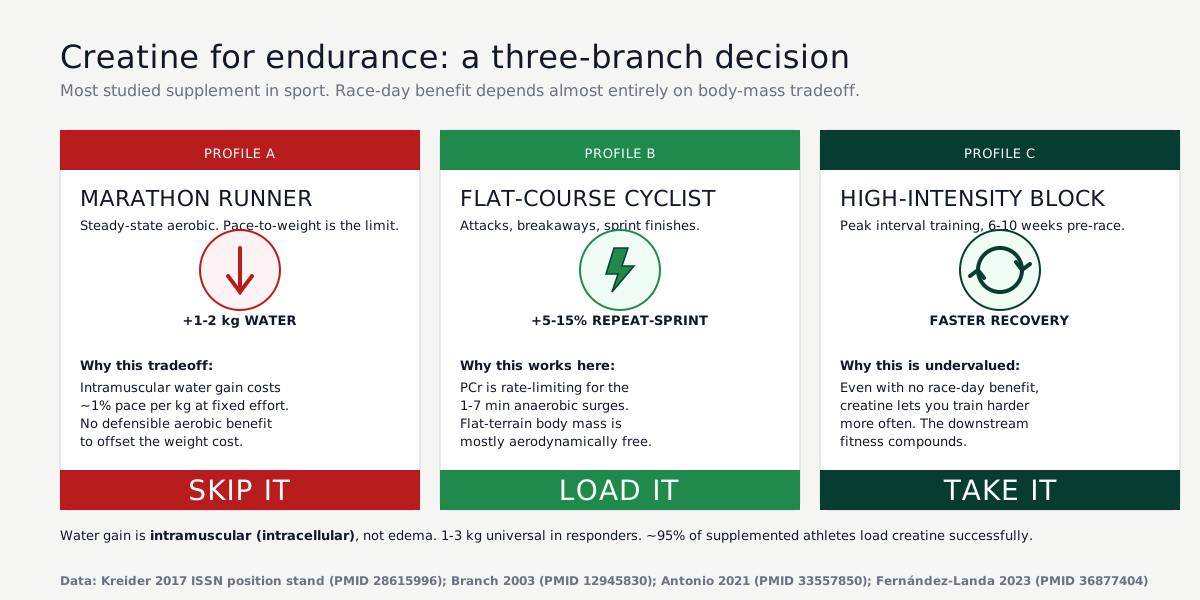
Educational content, not medical advice. Athletes with kidney disease, pregnancy, or under 18 should consult a doctor before starting any creatine protocol.
Creatine is a nitrogenous compound stored in muscle mostly as phosphocreatine, the immediate energy source for all-out efforts of about 10 seconds; supplementing raises muscle stores by 20 to 40 percent. Its main cost for endurance racing is 1 to 3 kg of intramuscular water retention.
The honest caveat, up front
Creatine monohydrate is the most-studied ergogenic aid in sports nutrition. More than 500 peer-reviewed trials. ISSN position stand calling it "the most effective ergogenic nutritional supplement currently available to athletes." Decades of safety data dismantling persistent myths about kidney damage, hair loss, and dehydration. And for the steady-state endurance athlete asking "should I take this for my marathon," the honest answer is mostly no, and not for any of the reasons usually given. The reason is body mass: creatine causes 1 to 3 kg of intramuscular water retention, which for a runner at sub-3-hour marathon pace translates directly to a slower finish at the same metabolic effort. The picture changes for cyclists on flat terrain, for triathletes whose run leg is short, and for athletes in high-intensity training blocks where the recovery benefit matters more than race-day weight. This guide is the nuanced read.
Our race-day fueling planner at planner.nutrifinder.it doesn't currently model creatine, because creatine is a months-long preparation, not a race-day intake. The rest of this guide is when to invest in that preparation and when to skip.
What it is and how it works
Creatine is a small nitrogenous organic acid naturally present in skeletal muscle. About 95 percent of total body creatine sits in muscle, mostly as phosphocreatine (PCr) rather than free creatine. PCr is the immediate-energy currency for very short, very intense efforts: it rephosphorylates ADP back to ATP in about 10 seconds of all-out work, supplying the energy demand before glycolysis spins up.
Oral supplementation with creatine monohydrate raises intramuscular total creatine by 20 to 40 percent, with most of the increase deposited as PCr. Foundational work: Harris, Söderlund, and Hultman 1992 (Clin Sci) - the paper that established that exogenous creatine could meaningfully load human muscle. Hultman et al. 1996 (J Appl Physiol) defined the loading protocols still used today.
Non-responders exist: athletes already creatine-replete (high-meat diets, especially fish-heavy diets) show smaller percentage gains because their baseline is already near the ceiling. Vegetarians and vegans show the largest absolute response.
The evidence base: large, consistent, durable
Kreider et al. 2017 (J Int Soc Sports Nutr) is the ISSN position stand and the single best citation anchor. It synthesizes 500+ studies and answers nearly every practical question about creatine. Cite this when in doubt.
Branch 2003 (Int J Sport Nutr Exerc Metab) meta-analyzed roughly 100 studies across exercise modes. Effects are concentrated in high-intensity exercise under 30 seconds, with 5-15 percent improvement in vertical jump, 30-second sprint, repeated 6-second sprints, and 1RM strength. Effects on running and swimming were described as minimal.
Lanhers et al. 2015 and 2017 (Sports Medicine) ran separate meta-analyses on lower-limb and upper-limb strength outcomes. Robust positive effects in both, consistent across populations.
For endurance specifically: Fernández-Landa et al. 2023 (Sports Medicine) pooled 13 trials of creatine in trained endurance athletes and concluded creatine is ineffective on endurance performance, with a trivial negative point estimate. Gras et al. 2023 found no meaningful VO2max effect.
The endurance angle: three subtle exceptions
The headline "no endurance benefit" is true for continuous, steady-state aerobic work. But the modern endurance racing landscape isn't only continuous steady-state work. Three endurance-adjacent mechanisms have real evidence:
1. Glycogen storage augmentation. Roberts et al. 2016 (Amino Acids) showed creatine co-ingested with carbohydrates produces roughly 17 percent more muscle glycogen supercompensation in the first 24 hours post-exhaustive exercise versus carbohydrates alone. Mechanism likely involves increased cell volume and insulin-mediated uptake. Relevant for the standard carb-load window before a marathon or Ironman, though no published trial has yet isolated whether this translates to faster race-day performance.
2. Repeat-sprint capacity within endurance events. Branch 2003 and Kreider 2017 both document creatine's well-evidenced effect on repeated-sprint performance. For road cycling with attacks, breakaways, and climbing surges, this is the most defensible benefit. The breakaway with 20 km to go in a 160 km gran fondo, the 5-minute climb at hour four of a road race, the closing 90-second sprint of a criterium - all sit in the window where PCr is rate-limiting and where creatine actually helps.
3. Recovery between training sessions. The ISSN position stand documents accelerated recovery from high-intensity interval blocks, reduced muscle damage markers (creatine kinase, lactate dehydrogenase), and faster glycogen replenishment. This isn't a race-day effect, it's a training-block effect: you can train harder more often. For an athlete doing a peak interval block 6-10 weeks out from an A-race, this is meaningful.
The body mass tradeoff: the deciding factor
Creatine causes 1 to 3 kg of water weight gain within the first week of loading. The water is intramuscular (intracellular), not edema. It is not bloating. It is more muscle volume because each saturated PCr-loaded muscle cell holds more water.
For a runner, the consequence is direct: at the same metabolic effort, you carry more mass per stride. Running economy literature is consistent: roughly 1 percent pace cost per kilogram of additional body mass at the same VO2. A 70 kg male marathoner gaining 2 kg of creatine water at a 3:30 race pace pays roughly 4 minutes at the finish for the same effort. No documented endurance benefit from creatine will repay that 4-minute hit.
For a flat-course cyclist, body mass is mostly irrelevant. Watts-per-kilogram only matters on climbs. On a flat 100 km TT, 2 kg of water weight costs essentially nothing aerodynamically and you keep the sprint capacity gains.
For a triathlete, the calculus is event-specific. The swim and bike legs largely don't pay for the weight. The marathon leg of an Ironman does. Net is positive for sprint and Olympic distance; net is sport-mix-dependent for 70.3 and full Ironman.
Loading, dosing, form
Rapid loading: 20 g/day split into 4 × 5 g servings for 5 to 7 days, then 3 to 5 g/day maintenance. Reaches saturation fast; produces the largest acute mass spike and the highest rate of mild GI distress.
Slow loading: 3 to 5 g/day for ~28 days. Reaches the same saturation; avoids GI upset; spreads the body-mass increase over a month. Most athletes (especially endurance athletes) should default to slow loading.
Maintenance: 3 to 5 g/day, or approximately 0.1 g/kg body weight. Higher doses don't help.
Form: monohydrate is the gold standard. Kreider 2017 explicitly states no alternative form (HCl, ethyl ester, buffered, liquid) shows superior bioavailability or efficacy. Most alternatives are more expensive and less evidenced. Look for Creapure-certified powder. Typical cost: €10-20 per kilogram, which lasts months.
Co-ingestion: with carbohydrate or protein meals improves uptake modestly via insulin (Kreider 2017). Skip the empty-stomach approach.
Washout: about 4 to 6 weeks to baseline intramuscular stores after stopping. Long enough that cycling on and off across a season is largely pointless.
Cycling on/off is not required. The "load, cycle off" pattern is bro-science folklore, not evidence-based.
Side effects and safety
Water weight gain: universal, 1 to 3 kg, intramuscular. Not edema. Cosmetic concern in some endurance athletes (the scale lies for the first month). Real performance concern only when body mass is the race-day limiter.
GI distress: occurs at single doses above ~10 g. Resolved by splitting into 5 g servings.
Renal function: no documented impairment in healthy adults across decades of trials. Poortmans & Francaux 1999 showed normal GFR and tubular function after long-term use. Antonio et al. 2021 (the modern systematic review of common questions) and Kreider 2017 both reaffirm. The persistent kidney-damage myth derives from elevated serum creatinine, a downstream metabolite, not actual nephrotoxicity. Lab tests after creatine supplementation will show higher serum creatinine; this is expected and does not indicate kidney damage.
Caveats: pre-existing renal disease, pregnancy, and under-18 athletes have limited data. Default to caution. Hair loss and dehydration claims are not supported by evidence (Antonio 2021).
Practical bottom line by athlete profile
| Profile | Verdict |
|---|---|
| Marathon / half-marathon runner where pace-to-weight is the limiter | Skip. The 1-2 kg water gain likely erases any marginal benefit. |
| Road cyclist racing flat or rolling courses with attacks, breakaways, sprints | Load it. Repeat-sprint and peak-power gains are well-evidenced; flat-terrain body mass is mostly irrelevant. |
| Climber / GC cyclist on mountainous courses | Skip / marginal. Watts-per-kilogram penalty from water weight likely exceeds sprint gains. |
| Triathlete, sprint or Olympic distance | Yes. Swim/bike fully benefit; the short run leg doesn't pay much for the weight. |
| Triathlete, 70.3 or full IM | Sport-mix dependent. The marathon leg pays the weight cost; if your engine is bike-biased, take it; if run-biased, skip. |
| Athletes in heavy interval training blocks | Take it for recovery and training quality, even if race-day benefit is unclear. The training-block effect compounds. |
| Ultra runners, gravel epics, granfondos at sub-threshold pace | Marginal. Steady-state aerobic work doesn't tap PCr. |
| Athletes with kidney issues, pregnancy, under 18 | Consult a doctor. Limited data; default to caution. |
Practical: 3 to 5 g/day Creapure-certified monohydrate with breakfast carbs. Skip the loading phase unless you need rapid saturation. Expect 1 to 2 kg of scale weight that is muscle water, not fat. €10-20 of powder lasts you several months.
Research and references
The numbers and protocols in this guide rest on the following peer-reviewed sources. Verify the dose, the side-effect profile, and the contraindications against the primary literature, not against any single source.
- Harris RC, Söderlund K, Hultman E. 1992. Clinical Science. Elevation of creatine in resting and exercised muscle of normal subjects by creatine supplementation. PMID 1327657
- Hultman E, Söderlund K, Timmons JA, Cederblad G, Greenhaff PL. 1996. Journal of Applied Physiology. Muscle creatine loading in men. PMID 8828669
- Poortmans JR, Francaux M. 1999. Medicine & Science in Sports & Exercise. Long-term oral creatine supplementation does not impair renal function in healthy athletes. PMID 10449011
- Branch JD. 2003. International Journal of Sport Nutrition and Exercise Metabolism. Effect of creatine supplementation on body composition and performance: a meta-analysis. PMID 12945830
- Lanhers C, Pereira B, Naughton G, et al. 2015. Sports Medicine. Creatine supplementation and lower limb strength performance: a systematic review and meta-analyses. PMID 25946994
- Roberts PA, Fox J, Peirce N, Jones SW, Casey A, Greenhaff PL. 2016. Amino Acids. Creatine ingestion augments dietary carbohydrate mediated muscle glycogen supercompensation during the initial 24 h of recovery following prolonged exhaustive exercise in humans. PMID 27193231
- Lanhers C, Pereira B, Naughton G, et al. 2017. Sports Medicine. Creatine supplementation and upper limb strength performance: a systematic review and meta-analysis. PMID 27328852
- Kreider RB, Kalman DS, Antonio J, et al. 2017. Journal of the International Society of Sports Nutrition. International Society of Sports Nutrition position stand: safety and efficacy of creatine supplementation in exercise, sport, and medicine. PMID 28615996
- Antonio J, Candow DG, Forbes SC, et al. 2021. Journal of the International Society of Sports Nutrition. Common questions and misconceptions about creatine supplementation: what does the scientific evidence really show? PMID 33557850
- Gras D, et al. 2023. Critical Reviews in Food Science and Nutrition. Effects of creatine supplementation on cardiorespiratory fitness in adults: a systematic review with meta-analysis. PMID 34859731
- Fernández-Landa J, Santibañez-Gutierrez A, Todorovic N, Stajer V, Ostojic SM. 2023. Sports Medicine. Effects of creatine monohydrate on endurance performance in trained athletes: a systematic review and meta-analysis. PMID 36877404