
Guide
MCT oil for endurance athletes
Educational content, not medical advice. The keto-adaptation discussion in this guide is contextual; individual decisions about ketogenic diets for athletic performance should involve a sports dietitian.
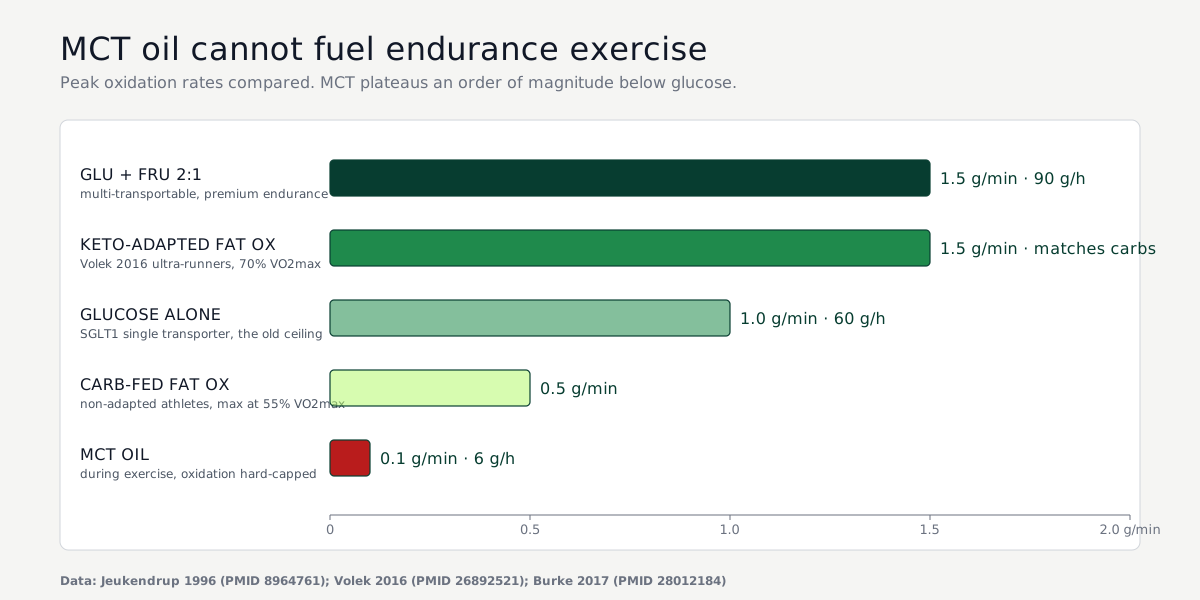
MCT oil is a concentrate of medium-chain triglycerides, saturated fats 6 to 12 carbons long (mainly C8 and C10) that absorb via the portal vein and reach mitochondria without the carnitine shuttle. During exercise its oxidation is hard-capped around 0.1 g per minute, roughly 6 g/h, an order of magnitude below glucose - it cannot fuel endurance racing.
The honest caveat, up front
MCT oil sits in a curious position in the supplement world: heavily hyped in keto and "fat-adapted" endurance content, almost never used by elite endurance athletes following high-carb fueling. The reason is mundane and important: MCT oxidation during exercise is hard-capped around 0.1 grams per minute (~6 g/h), an order of magnitude below glucose. You cannot fuel a marathon on MCTs no matter how much you swallow. Past about 30 g/h, you stop fueling at all and start dealing with GI distress instead. In carb-fed athletes (the dominant racing protocol globally), MCT oil during exercise is null at best and counterproductive at worst. The one honest exception is keto-adapted ultra-endurance athletes, whose entire fuel system has been reprogrammed - and the bigger question for those athletes is whether keto adaptation itself serves their event.
Our race-day fueling planner at planner.nutrifinder.it doesn't include MCT oil because for the vast majority of our audience (carb-fed endurance athletes), it doesn't fuel and it doesn't help. The rest of this guide is the honest read.
What it is
Medium-chain triglycerides (MCTs) are saturated fatty acids 6 to 12 carbons long. Commercial MCT oil contains primarily caprylic acid (C8) and capric acid (C10); the longer lauric acid (C12) is sometimes excluded from "premium" products because it behaves more like a long-chain triglyceride. Source: fractionated coconut oil or palm kernel oil.
The pharmacology is the entire basis for the endurance pitch. Unlike long-chain triglycerides (LCT), MCTs:
- Are water-soluble enough to bypass chylomicron packaging
- Absorb directly into the portal vein, reaching the liver within minutes
- Are oxidized in mitochondria without requiring the carnitine shuttle that LCTs need
- Can be partially converted to ketone bodies in the liver
The pitch: rapid exogenous fat fuel, spares muscle glycogen, "clean" energy. The reality, in carb-fed athletes, has not matched the pitch.
The evidence: mostly null, sometimes negative
Van Zyl et al. 1996 showed cyclists ingesting 86 g of MCT with carbohydrate improved 40 km time trial vs carb alone. This is the foundational positive paper - and a notable outlier. Subsequent replication attempts in well-controlled trials largely failed.
Jeukendrup et al. 1996 measured MCT oxidation kinetics directly: the rate plateaus around 0.1 g/min regardless of glycogen status or ingestion rate.
Jeukendrup et al. 1996 (Metabolism paper, separate from the kinetics paper above): 180 minutes of cycling with carbohydrate + MCT vs carbohydrate alone. No glycogen-sparing benefit.
Jeukendrup et al. 1998 (the definitive negative trial): 85 g MCT + carbohydrate during cycling caused severe GI distress and impaired subsequent time-trial performance versus carbohydrate alone.
Goedecke et al. 2005: MCT + CHO during ultra-endurance cycling produced no substrate-metabolism change, slower sprint performance at the end of the bike, and GI distress in 50 percent of subjects.
The pattern: in carb-fed athletes, when MCT is dosed high enough to be metabolically relevant (50-86 g), it causes GI distress and slows you down. When dosed low enough to be tolerable (10-20 g), it doesn't move the needle.
The keto-adapted exception
This is where the honest read gets nuanced. The literature on long-term ketogenic adaptation in endurance athletes shows real metabolic plasticity:
Volek et al. 2016 (the FASTER study): keto-adapted ultra-endurance runners showed peak fat oxidation of 1.54 g/min vs 0.67 g/min in carb-fed controls - 2.3× higher fat oxidation. At higher percentages of VO2max (70% vs 55%). This is the strongest demonstration that the metabolic infrastructure for high-rate fat oxidation exists after long-term ketogenic adaptation.
In that context, MCTs become more mechanistically coherent: you're not asking the liver and mitochondria to burn fat in a system primarily set up to burn glucose; you're feeding fat-substrate to a system that's reprogrammed to use it.
But there's a catch. Burke et al. 2017 ran elite race walkers through a 3-week LCHF ketogenic intervention. Peak fat oxidation reached 1.57 g/min, confirming the Volek pattern. But the same athletes showed:
- Increased oxygen cost of race-pace walking
- -1.6% change in 10 km time trial performance vs +6.6% in the high-carb group
In other words: keto-adaptation gives you better fat oxidation and worse race-pace performance, because the metabolic cost of converting fat to ATP at high effort exceeds the cost of using glucose. For events where race pace is sustained for hours, the carb group wins.
The honest framing: keto-adaptation is plausibly viable for select athletes in ultra-endurance events at sub-threshold pace (8+ hours), and questionable for marathon-and-shorter at race pace. MCT oil rides on top of that bigger decision; it's not the decision.
Dose and GI tolerance
- Studied doses: 25 to 86 grams during exercise
- Practical GI tolerance ceiling: roughly 30 g/h; many athletes fail at 20 g
- Pre-exercise: 10-20 g 60 minutes prior is tolerable; no demonstrated performance benefit
- Mid-exercise: not recommended for non-keto-adapted athletes; the GI risk outweighs the ~6 g/h oxidation cap
- Post-exercise / recovery: irrelevant; carbs and protein dominate recovery
Side effects
GI distress is the headliner: cramping, urgency, osmotic diarrhea, nausea. Dose-dependent and well-documented across the Jeukendrup 1998 and Goedecke 2005 trials.
Cholesterol: chronic high-dose MCT (>50 g/day) can modestly raise LDL cholesterol. Not a concern at typical sports-supplement doses.
No serious safety signals at moderate doses. No medication interactions of clinical relevance. Pregnancy and lactation: limited data; default to caution.
Practical bottom line
| Your profile | MCT verdict |
|---|---|
| Carb-fueled endurance athletes (marathon, IM, most cycling) | Skip. Carbs work. MCT doesn't add and often subtracts via GI. |
| Keto-adapted ultra-endurance | Reasonable component of the stack. The bigger decision is keto-adaptation itself. |
| "Try MCT for energy" recreational athletes | Not worth the GI lottery for ~6 g/h of oxidizable fuel. |
| Bulletproof coffee before training | Harmless ritual with essentially no during-exercise ergogenic effect. |
| Athletes on weight loss / appetite-management protocols | Possibly useful for satiety effects, but that's not why this guide exists. |
Cost: ~€20-30 for a 500 mL bottle; lasts a long time at functional doses. Cheap per serving, but value is bounded by whether you should be using it at all.
The honest position
For our audience (endurance athletes on standard high-carb fueling protocols): MCT oil during exercise is not a useful supplement. The oxidation rate is too low to fuel anything meaningful, and the GI ceiling kicks in well below the dose where the oxidation rate would matter. Save the money for more gels, better shoes, or a coach.
For athletes in the keto/fat-adapted camp: the conversation is bigger than MCT oil. Read Volek 2016 and Burke 2017 together, accept that race pace is the variable that probably matters most, and make the keto adaptation decision first. MCT oil is then a detail inside the bigger framework.
Research and references
The numbers and protocols in this guide rest on the following peer-reviewed sources. Verify the dose, the side-effect profile, and the contraindications against the primary literature, not against any single source.
- Van Zyl CG, Lambert EV, Hawley JA, Noakes TD, Dennis SC. 1996. Journal of Applied Physiology. Effects of medium-chain triglyceride ingestion on fuel metabolism and cycling performance. PMID 8806933
- Jeukendrup AE, Saris WHM, Schrauwen P, Brouns F, Wagenmakers AJM. 1996. Journal of Applied Physiology. Metabolic availability of medium-chain triglycerides coingested with carbohydrates during prolonged exercise. PMID 8964761
- Jeukendrup AE, Saris WHM, Van Diesen R, Brouns F, Wagenmakers AJM. 1996. Metabolism. Effect of endogenous carbohydrate availability on oral medium-chain triglyceride oxidation during prolonged exercise. PMID 8692031
- Jeukendrup AE, Thielen JJHC, Wagenmakers AJM, Brouns F, Saris WHM. 1998. American Journal of Clinical Nutrition. Effect of medium-chain triacylglycerol and carbohydrate ingestion during exercise on substrate utilization and subsequent cycling performance. PMID 9497182
- Décombaz J, Arnaud MJ, Milon H, et al. 1983. European Journal of Applied Physiology and Occupational Physiology. Energy metabolism of medium-chain triglycerides versus carbohydrates during exercise. PMID 6360681
- Goedecke JH, Clark VR, Noakes TD, Lambert EV. 2005. International Journal of Sport Nutrition and Exercise Metabolism. The effects of medium-chain triacylglycerol and carbohydrate ingestion on ultra-endurance exercise performance. PMID 15902986
- Volek JS, Freidenreich DJ, Saenz C, et al. 2016. Metabolism. Metabolic characteristics of keto-adapted ultra-endurance runners. PMID 26892521
- Burke LM, Ross ML, Garvican-Lewis LA, et al. 2017. Journal of Physiology. Low carbohydrate, high fat diet impairs exercise economy and negates the performance benefit from intensified training in elite race walkers. PMID 28012184