
Guide
Omega-3 (EPA + DHA) for endurance athletes
Educational content, not medical advice. Athletes on anticoagulants, with bleeding disorders, or planning surgery should consult a doctor before high-dose omega-3 supplementation.
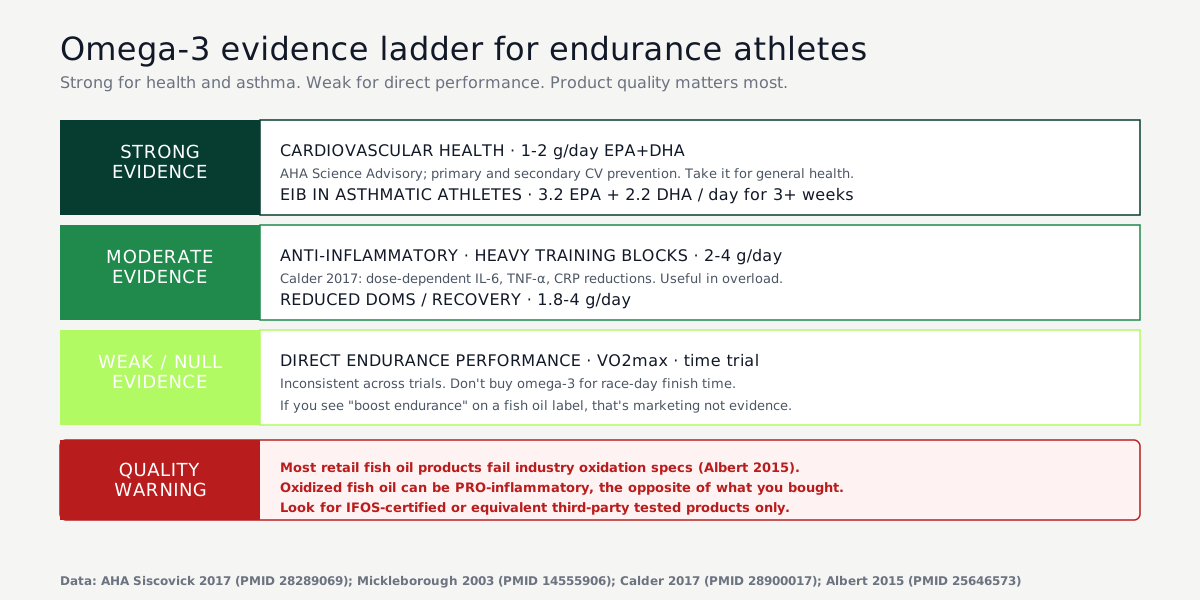
Omega-3 fatty acids are polyunsaturated fats in three nutritionally relevant forms: plant-derived ALA and marine EPA and DHA. The evidence for general health benefits at 1-2 g/day of combined EPA+DHA is strong; the evidence that they directly improve endurance performance is much weaker.
The honest caveat, up front
Omega-3 fatty acids are one of the few supplements with strong evidence for general health benefits (cardiovascular protection, anti-inflammatory effects in overload states) and weak evidence for direct endurance performance. The American Heart Association recommendation of 1-2 g/day combined EPA+DHA is well-supported regardless of athletic context. The case for omega-3 making your marathon faster, your IM swim stronger, or your VO2max higher is much thinner than the supplement marketing suggests. Two specific cases where the evidence is strongest: asthmatic athletes with exercise-induced bronchoconstriction, and athletes in heavy training overload blocks where the anti-inflammatory effect compounds. For everyone else, the right framing is "this is a health supplement that happens to be useful for athletes," not "this is a performance enhancer."
Our race-day fueling planner at planner.nutrifinder.it doesn't model omega-3 because it's a chronic daily supplement, not a race-day variable. The rest of this guide is on the right dose, the right source, and (importantly) the right product quality.
What they are
Omega-3 polyunsaturated fatty acids (PUFAs) come in three nutritionally relevant forms:
- ALA (alpha-linolenic acid, 18:3 n-3): plant-derived (flax, chia, walnuts, canola). Essential fatty acid; must come from diet.
- EPA (eicosapentaenoic acid, 20:5 n-3): marine-derived (fatty fish, fish oil, algae).
- DHA (docosahexaenoic acid, 22:6 n-3): marine-derived (same sources).
Endogenous conversion of ALA to EPA is around 5-10 percent, and to DHA is under 1 percent (Burdge & Calder 2005). The conversion is further depressed by typical Western omega-6 intake (high seed oil consumption). For therapeutic doses relevant to athletes, marine sources (fish or algae oil) are the only practical route. Flax oil alone, regardless of how much you take, will not deliver functionally relevant EPA+DHA.
Mechanisms
EPA and DHA incorporate into cell membranes (muscle, mitochondrial, vascular endothelial), where they shift downstream eicosanoid signaling toward less inflammatory mediators. The result is:
- Reduced systemic inflammation: well-characterized at clinically meaningful doses (Calder 2017).
- Resolvin and protectin synthesis: active resolution of inflammation, not just suppression.
- Membrane fluidity: may modestly improve red blood cell deformability and microvascular O2 delivery.
- Anti-platelet effect: cardiovascular benefit; mild bleeding risk at very high doses.
- Anabolic sensitization: 4 g/day EPA+DHA augments the muscle protein synthesis response to amino acids and insulin (Smith et al. 2011).
The evidence by application
Cardiovascular health: strong. The AHA Science Advisory (Siscovick et al. 2017) endorses 1-2 g/day combined EPA+DHA for primary and secondary CV prevention. Relevant for masters athletes regardless of the performance question.
Anti-inflammatory effect during heavy training: well-evidenced. Calder 2017 documents dose-dependent reductions in IL-6, TNF-alpha, and CRP at 2-4 g/day. Most useful during overload phases, less so for already-recovered athletes.
Exercise-induced bronchoconstriction (EIB): the strongest endurance-relevant indication. Mickleborough et al. 2003 showed 3.2 g EPA + 2.2 g DHA per day for 3 weeks reduced post-exercise FEV1 drop by ~80 percent in elite athletes with EIB. Follow-up work in 2006 confirmed in asthmatic populations. If you're an asthmatic endurance athlete, this is the specific case where omega-3 has a clear protocol and strong evidence.
Recovery and DOMS: moderate evidence. Tartibian et al. 2009 reported reduced perceived soreness and ROM loss after eccentric exercise with 1.8 g/day EPA+DHA. Multiple subsequent studies have replicated the general pattern. Effects on CK markers are inconsistent.
Anabolic sensitization (MPS): Smith et al. 2011 showed 4 g/day EPA+DHA enhanced MPS response to hyperaminoacidemia and hyperinsulinemia in older adults. Replicated in younger adults in companion work. Practical implication: for endurance athletes doing strength work, omega-3 modestly amplifies the protein-feeding anabolic response.
Direct performance (VO2max, time trial, exercise economy): weak and inconsistent. Systematic reviews find small, unreliable effects in trained endurance athletes. No reliable signal that omega-3 raises VO2max or shortens time-trial finish in well-trained populations.
Dose and protocol
| Application | EPA+DHA dose | Duration | Anchor |
|---|---|---|---|
| Cardiovascular / general health | 1-2 g/day combined | Chronic, ongoing | AHA Siscovick 2017 |
| Anti-inflammatory / heavy training recovery | 2-4 g/day | 4+ weeks loading | Calder 2017 |
| MPS sensitization for endurance + strength | 4 g/day | 8 weeks | Smith 2011 |
| Exercise-induced bronchoconstriction | 3.2 EPA + 2.2 DHA g/day | 3+ weeks | Mickleborough 2003/2006 |
Form: triglyceride or re-esterified TG forms are better absorbed than ethyl esters at equal labeled dose. Look for "TG form" or "rTG" on the label.
Timing: with a fat-containing meal (improves absorption). Daily chronic dosing, not acute pre-race.
ALA-only is not equivalent at any of these doses due to the poor conversion rate. Flax/chia/walnut consumption is healthy but does not substitute for fish or algae oil at therapeutic doses.
The product quality problem
This deserves its own section because it's often the difference between a useful supplement and an actively counterproductive one.
Omega-3 fatty acids are highly prone to oxidation. Once oxidized, fish oil can become pro-inflammatory rather than anti-inflammatory - the opposite of what you bought it for. Albert et al. 2015 tested commercial fish oil products in New Zealand and found that most retail products failed industry oxidation specs (peroxide value, anisidine value, TOTOX score). Many products that label themselves as anti-inflammatory health supplements contain rancid oil.
Practical quality checklist:
- IFOS (International Fish Oil Standards) certified or equivalent third-party tested
- Stored refrigerated at the retailer if possible
- Capsules sealed, not in a re-sealable plastic bag
- No fishy aftertaste/burps beyond mild; strong fishy reflux suggests oxidation
- Smell test: open a capsule. A faint marine smell is fine; a strong rancid or "cardboard" smell means discard the bottle.
For source: small fish (anchovy, sardine, mackerel) and algae oil are lower-risk for heavy metal contamination than large predatory fish (tuna, swordfish-derived). Vegan athletes: algae oil is the only practical source of EPA+DHA at meaningful doses.
Side effects
- Fishy reflux / aftertaste: common; mitigated by enteric-coated capsules, refrigeration, taking with food.
- Bleeding risk: theoretical at high doses (>3-4 g/day); relevant if combined with anticoagulants, NSAIDs, or before surgery.
- Oxidized product harm: discussed above; choose quality.
- Heavy metals: minimal at typical commercial product purity standards; small-fish or algae sources are safest.
Practical bottom line
| Your profile | Omega-3 verdict |
|---|---|
| General cardiovascular health, masters athletes | Yes. 1-2 g/day is a well-evidenced health supplement. |
| Heavy training overload blocks | Yes, 2-4 g/day for 4+ weeks. Real anti-inflammatory effect; helps recovery. |
| Asthmatic / EIB endurance athletes | Yes, the specific Mickleborough protocol (3.2 EPA + 2.2 DHA / day for 3+ weeks). Strongest indication. |
| "Better marathon time" pitch | No clear evidence. Don't buy it for direct performance. |
| Vegan / vegetarian athletes | Algae oil is the only practical source at therapeutic doses. |
| Already eating 2-3 servings/week of fatty fish | Probably enough; supplementation is optional. |
| Athletes on anticoagulants or planning surgery | Consult a doctor. Additive bleeding risk. |
Cost: ~€20-40/month at 2-4 g/day therapeutic doses. Higher for IFOS-certified or algae oil. Food sources (sardines, anchovies, salmon 2-3 times per week) are usually cheaper and avoid the oxidation problem entirely.
The honest position
Omega-3 is unusual in our ingredient series in that we're saying yes, take it for most readers - just not for the reasons the marketing suggests. The cardiovascular and anti-inflammatory cases are real and well-evidenced. The direct-performance pitch is much thinner than the bottle implies. Buy it for health and recovery, not for race-day pace. And buy a quality product - rancid fish oil is worse than no fish oil.
For our planner: omega-3 doesn't show up in race-day fueling protocols. It belongs in your daily routine alongside vitamin D, sleep, and 1.4-1.8 g/kg of protein.
Research and references
The numbers and protocols in this guide rest on the following peer-reviewed sources. Verify the dose, the side-effect profile, and the contraindications against the primary literature, not against any single source.
- Burdge GC, Calder PC. 2005. Reproduction Nutrition Development. Conversion of α-linolenic acid to longer-chain polyunsaturated fatty acids in human adults. PMID 16188209
- Smith GI, Atherton P, Reeds DN, et al. 2011. American Journal of Clinical Nutrition. Dietary omega-3 fatty acid supplementation increases the rate of muscle protein synthesis in older adults: a randomized controlled trial. PMID 21159787
- Smith GI, Atherton P, Reeds DN, et al. 2011. Clinical Science. Omega-3 polyunsaturated fatty acids augment the muscle protein anabolic response to hyperinsulinaemia-hyperaminoacidaemia in healthy young and middle-aged men and women. PMID 21501117
- Mickleborough TD, Murray RL, Ionescu AA, Lindley MR. 2003. American Journal of Respiratory and Critical Care Medicine. Fish oil supplementation reduces severity of exercise-induced bronchoconstriction in elite athletes. PMID 14555906
- Mickleborough TD, Lindley MR, Ionescu AA, Fly AD. 2006. Chest. Protective effect of fish oil supplementation on exercise-induced bronchoconstriction in asthma. PMID 16415413
- Tartibian B, Maleki BH, Abbasi A. 2009. Clinical Journal of Sport Medicine. The effects of ingestion of omega-3 fatty acids on perceived pain and external symptoms of delayed onset muscle soreness in untrained men. PMID 19451765
- Calder PC. 2017. Biochemical Society Transactions. Omega-3 fatty acids and inflammatory processes: from molecules to man. PMID 28900017
- Siscovick DS, Barringer TA, Fretts AM, et al. 2017. Circulation. Omega-3 polyunsaturated fatty acid (fish oil) supplementation and the prevention of clinical cardiovascular disease: a science advisory from the American Heart Association. PMID 28289069
- Albert BB, Derraik JGB, Cameron-Smith D, et al. 2015. Scientific Reports. Fish oil supplements in New Zealand are highly oxidised and do not meet label content of n-3 PUFA. PMID 25646573