
Guide
Sweat rate, sodium, and why estimates have ±35% error
Educational content, not medical advice. Severe cramping, hyponatremia symptoms, or any racing-related medical concern should be reviewed by a doctor or sports dietitian - not a planner.
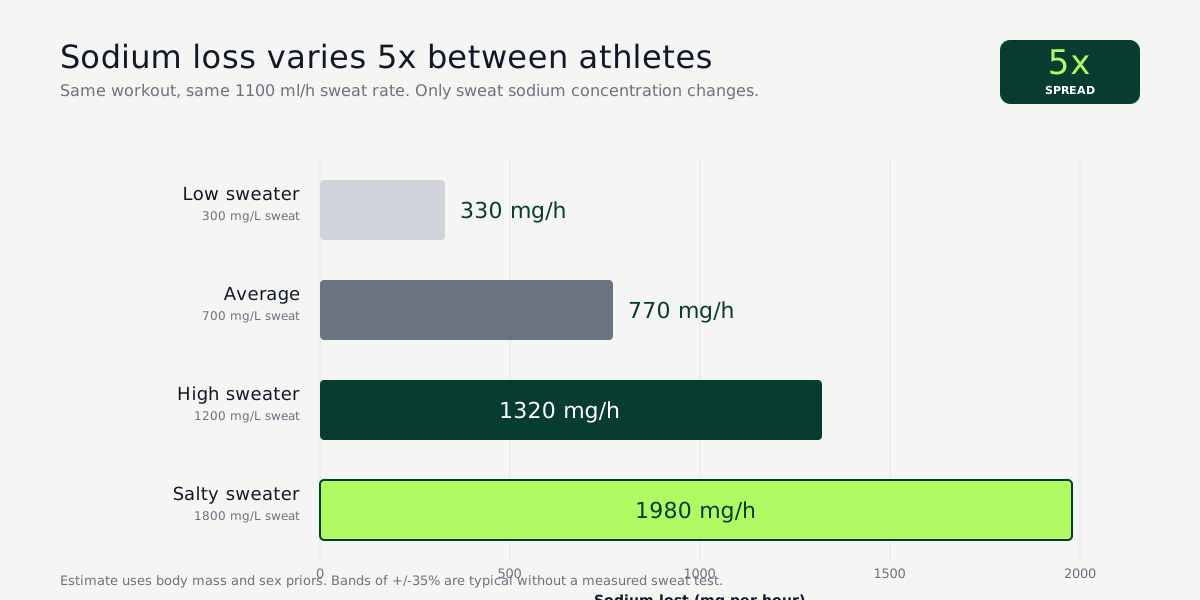
Sweat rate is the volume of fluid you lose per hour of exercise, in ml/h; sweat sodium concentration is how much sodium each litre of that sweat carries, in mg/L. Multiplied together they give your hourly sodium loss, the number a hydration plan has to replace.
The single biggest source of error in any fueling plan is the sweat-rate estimate. Carb-per-hour bands are well-validated and only vary modestly across published guidance. Sweat rate, by contrast, can vary 5× between athletes of similar size doing the same workout in the same conditions. There is no formula that gets it right for everyone, and the planner is honest about that.
This guide explains why the estimate has a ±35% confidence band, how to measure your real number in 30 minutes, and when "estimated is good enough" versus when you really need the lab data. Our race-day planner at planner.nutrifinder.it uses the model described here; once you measure your real number and enter it, the confidence band drops from ±35% to ±10% and your fluid + sodium plan gets meaningfully more accurate.
What the planner is doing under the hood
When you don't enter a measured sweat rate, the planner uses a closed-form model:
sweat_ml_per_h = BASE(sport, sex) × mass_kg^0.6 × f_intensity × f_heat × f_humidity
This is the standard allometric approach used in most commercial planners. The BASE values are calibrated on published whole-body sweat-rate studies; mass scales sub-linearly because larger athletes have proportionally more surface area for evaporation; the multipliers shift the result for intensity, heat, and humidity.
It captures most of the average variance. It does not capture the four big sources of individual variance:
- Acclimation. A heat-acclimated athlete sweats sooner and more dilutely than a deconditioned one. The planner has no way to know your acclimation state.
- Genetics. Some athletes are intrinsically heavier sweaters. This is independent of fitness, body mass, and training history.
- Apparel and pacing. A breathable kit and an even pace produces very different sweat losses than a vest-and-sleeves outfit pushed hard early.
- Hydration status going in. A dehydrated athlete sweats less (which sounds protective but is actually a problem - it reduces evaporative cooling).
This is why the planner shows a ±35% band on the estimate. It's the honest answer for "I haven't measured."
How to measure your sweat rate (it takes 30 minutes)
This is the gold-standard protocol. You'll need a scale that reads in 0.1 kg increments, a water bottle, and 30-60 minutes.
- Empty your bladder. Sweat is the variable we want; bladder volume is noise.
- Weigh yourself naked to the nearest 0.1 kg. Record
weight_before. - Train for 60 minutes at race pace (or as close as you can on the day). Run, ride, or row at the effort you'll do in your event. Drink a known volume of water from a bottle - measure it before, measure leftover after. Record
water_drunk_ml. - Don't pee, poop, or sweat into a towel during the session. If you go to the toilet, the test is invalid. If you wipe sweat off, you've lost the water you're trying to measure.
- Towel off briefly (5 seconds), strip naked again, weigh. Record
weight_after. - Compute:
sweat_loss_kg = (weight_before - weight_after) + (water_drunk_ml / 1000)
sweat_rate_ml_per_h = (sweat_loss_kg × 1000) / hours_trained
A 60-minute session that drops you 0.8 kg with 500 ml of water drunk gives (0.8 + 0.5) × 1000 / 1 = 1300 ml/h. That's your number for these conditions and this intensity. Repeat the protocol in different conditions (cool/warm, low/high intensity) to build out a personal table.
Once you have a measured number, the planner lets you enter it. The confidence band drops from ±35% to ±10% (the residual measurement noise), and your fluid plan becomes meaningfully more accurate.
Sodium: the bigger variance lives here
Sweat sodium is even harder to estimate than sweat volume. The literature reports a normal range of 300-1500 mg per litre of sweat, with some "salty sweaters" testing as high as 2000+. That's a 5-7× spread. The planner uses a body-mass × sex prior, but the prior is wide by design.
You can get a rough idea without a lab test:
- White salt stains on your kit after a long session = likely salty sweater (sodium > 1000 mg/L).
- No salt residue, even on long sweaty days = likely low-end sweater (sodium < 500 mg/L).
- A "metallic" or strongly salty taste in your sweat or on your lips during long sessions = another rough flag for higher sodium loss.
A note on cramps: current evidence (Schwellnus et al. 2011, Br J Sports Med; Miller et al. 2010) attributes Exercise-Associated Muscle Cramps mostly to neuromuscular fatigue from going harder than you've trained, not to sodium depletion. Sodium is for hydration and EAH prevention; treating cramps as a "low sodium" signal will mislead you. Train pacing and specificity first; size sodium to your sweat losses.
For a real number, you need a sweat sodium test. Two routes:
- Lab test - companies like Precision Fuel & Hydration run a patch-based test in the field. Cost is roughly €100-150. You wear a small patch during exercise, send it back, get a number. The number is stable across most conditions for an athlete (sodium loss is much less weather-dependent than sweat volume).
- Trial and error - log your sodium intake during long sessions and watch for headaches, dizziness, or that "metallic taste" that signals over-replacement. This is slower but free. Don't use cramping as your tuning signal: cramps track training load and pacing more than sodium intake (see the note above).
How much sodium to actually take in
Once you know your sweat rate and sodium concentration, the maths is straightforward:
sodium_loss_mg_per_h = sweat_ml_per_h × sodium_mg_per_L / 1000
A 1100 ml/h sweater with 600 mg/L sodium loses 660 mg sodium per hour. The planner targets replacing this. Most athletes do well replacing 50-100% of loss; full replacement is rarely necessary for sessions under 4 hours.
Turning that number into products means knowing what each one actually carries, and the spread is wide. Compare electrolyte tabs ranked by sodium and powders ranked by sodium; if you take much of your sodium through fuel rather than drink, gels ranked by sodium is the equivalent list.
When you should be careful
- Sessions longer than 4-5 hours combined with low sodium intake and a lot of plain water = hyponatremia risk. This is medically serious. Symptoms include nausea, confusion, headache, and worse - and they overlap with dehydration symptoms, which can lead to athletes drinking more water and making it worse. Sodium matters more in long events than short ones.
- Hot-weather events when you haven't trained in the heat. Sweat rate goes up, sodium concentration can change with acclimation, and your tolerance is unknown.
- GI symptoms during fueling. Some hydration products are too concentrated and pull water into the gut, causing nausea. If you feel "sloshy," dilute more.
What to do with all this
If you're new to the planner: use the estimate, train with it, and pay attention to how you feel. If you finish long sessions feeling depleted, foggy, or markedly salt-crusted on your kit, that's the signal to invest in a sweat test.
If you're racing something long (marathon, 70.3, anything 4+ hours): measure your sweat rate at least once in conditions similar to your event. The planner is a tool; your own data turns it from a guess into a plan.
Get a plan for your race
Open the NutriFinder planner, enter your weight, race, and conditions, and (if you have it) your measured sweat rate. You'll get a per-hour fluid target, a per-hour sodium target, and a per-30-minute timeline that pairs the two so you're not chasing sodium with plain water or vice versa. The planner runs on the exact model and bands cited above, no black box.
Frequently asked questions
How do I measure my sweat rate?
Weigh yourself naked, train for 60 minutes at race effort while drinking a measured volume of water, towel off, and weigh again. Sweat loss is the weight drop plus the water drunk; divide by the hours trained to get ml/h. A 0.8 kg drop with 500 ml drunk over one hour is a 1,300 ml/h sweat rate, valid for those conditions and that intensity.
How much sodium should I take per hour?
Multiply your sweat rate (ml/h) by your sweat sodium concentration (mg/L) and divide by 1,000. An athlete sweating 1,100 ml/h at 600 mg/L loses about 660 mg of sodium per hour; replacing 50-100 percent of that loss is the working target, and full replacement is rarely necessary for sessions under four hours.
How do I know if I am a salty sweater?
White salt stains on your kit after long sessions and a strongly salty or metallic taste in your sweat are rough flags for sodium above roughly 1,000 mg/L. Sweat sodium spans 300-1,500 mg/L across athletes, with some testing over 2,000, so for a real number you need a patch-based sweat sodium test, around 100-150 euros.
Do salt tablets prevent muscle cramps?
Mostly no. Current evidence attributes exercise-associated muscle cramps mainly to neuromuscular fatigue from going harder than you have trained, not to sodium depletion. Sodium replacement is for hydration and hyponatremia prevention; treat cramps as a pacing and training-specificity signal, not a salt deficit.
What is hyponatremia and when am I at risk?
Exercise-associated hyponatremia is dangerously low blood sodium, typically from drinking large volumes of plain water while losing salty sweat over many hours. The risk window is sessions beyond 4-5 hours with low sodium intake; symptoms (nausea, confusion, headache) overlap with dehydration, which tempts athletes to drink more water and make it worse.
Research and references
The numbers and protocols in this guide rest on the following peer-reviewed sources. Verify the dose, the side-effect profile, and the contraindications against the primary literature, not against any single source.
- Schwellnus MP, Drew N, Collins M. 2011. British Journal of Sports Medicine. Increased running speed and previous cramps rather than dehydration or serum sodium changes predict exercise-associated muscle cramping: a prospective cohort study in 210 Ironman triathletes. PMID 21148567
- Miller KC, Stone MS, Huxel KC, Edwards JE. 2010. Sports Health. Exercise-associated muscle cramps: causes, treatment, and prevention. PMID 23015948
- Jay O, Périard JD, Clark B, et al. 2024. Journal of Applied Physiology. Whole body sweat rate prediction: outdoor running and cycling exercise. PMID 38695357
Practical resources
- Precision Fuel & Hydration sweat-rate test protocol - free at-home test instructions
- TrainingPeaks, "How to Calculate Your Sweat Rate" - short walkthrough article