
Guide
How to fuel a HYROX race
Educational content, not medical advice. Test every food, drink, caffeine dose and electrolyte on training days first; race day is the worst possible time to try something new.
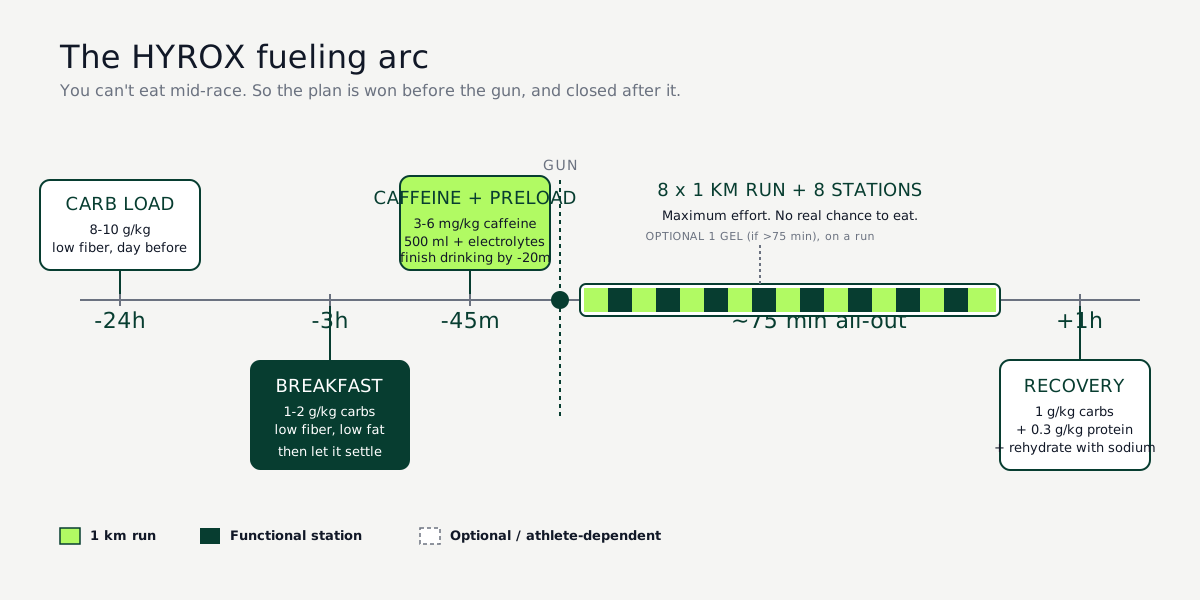
HYROX is a 60 to 110 minute, near-maximal hybrid race where you physically cannot stop to eat, so the fuelling that decides your result is almost all done before the start: a carb load the day before, a race-morning meal, a single rehearsed caffeine dose, and a sodium preload. During the race, at most one gel on a run. After it, a proper recovery block.
What makes HYROX a different fuelling problem
A HYROX race is a fixed sequence: eight 1 km runs, each followed by a functional station, in the same order at every venue.
- SkiErg 1000 m
- Sled Push 50 m
- Sled Pull 50 m
- Burpee Broad Jumps 80 m
- Rowing 1000 m
- Farmers Carry 200 m
- Sandbag Lunges 100 m
- Wall Balls 100 reps
Elite men finish in roughly 55 minutes and elite women around 60; competitive age-groupers land in the 75 to 90 minute range, and first-timers commonly take 90 to 120 minutes. Running is about half the total time; the stations are where the effort spikes.
Two things follow from that. First, it is near-maximal and glycogen-depleting the whole way, unlike a steady long run where you cruise below threshold. Second, and this is the part every marathon-fuelling habit gets wrong for HYROX: you cannot fuel mid-race in any meaningful way. You cannot chew a gel while pushing a sled or throwing 100 wall balls, and your gut shuts down at that intensity anyway. The only feasible in-race window is a few seconds mid-run, and even that is a stretch.
So the entire fuelling strategy shifts backward in time. This is exactly the shape our race-day planner produces in HYROX mode: pick HYROX as your sport at the planner and it locks the 8 km + 8 stations race shape, seeds a hard effort, and front-loads the plan into the pre-race arc, closing with recovery - which is precisely what this guide describes.
The day before: carb load
For a max-effort event this short, the single biggest lever is starting with full muscle glycogen. Aim for 8 to 10 g of carbohydrate per kilogram of bodyweight across the day before, from low-fibre, low-fat sources so you are not carrying bloat or racing GI risk to the start line. For a 75 kg athlete that is roughly 600 to 750 g of carbs across the day: white rice, pasta, potatoes, bread, ripe bananas, sports drink, honey. Do not add fibre or fat volume you would not normally handle.
This is worth stating plainly because it contradicts the usual "under 90 minutes, no need to carb load" rule you will read for a steady run. HYROX is not a steady run. The intensity empties glycogen fast, and there is no way to refill it during the race.
Race morning: the meal ladder
- 3 hours before: a 1 to 2 g/kg carbohydrate meal, low fibre and low fat. For a 75 kg athlete, ~110 to 150 g of carbs: oats with banana and honey, white toast with jam, a bagel, a rice bowl. Then let it settle.
- -45 minutes: caffeine. 3 to 6 mg/kg at a dose you have used in training. It reduces perceived effort and delays fatigue, and because caffeine has a 4 to 5 hour half-life, one dose covers the whole race. No in-race top-up needed.
- -20 minutes (optional): a small carb top-up (half a gel, ~25 g, or a banana) if your breakfast was on the earlier side and you feel you need it.
During the race: at most one gel
For most athletes finishing under about 75 minutes, no in-race fuel is required if you loaded and ate breakfast properly. Some carry a single gel as insurance and a small central-nervous-system lift; take it on a run segment, not at a station.
If your target time is beyond 75 minutes, plan for one gel (~25 to 30 g of carbs) taken around Run 4 or Run 5, on the run, with a few sips of fluid. That is the realistic ceiling: chasing 30 to 60 g/h with multiple gels sounds right on paper but is not deliverable at HYROX intensity, and forcing it invites GI distress.
Hydration and sodium: the indoor-heat factor
HYROX is indoors, often warm, humid, and crowded with poor airflow, and max effort drives high sweat rates, commonly 1 to 1.5 L/h and up to 2 to 2.5 L/h for heavy sweaters. You will not replace that during the race, so the goal is to start topped up and limit the deficit:
- Night before and ~90 minutes out: an electrolyte drink (roughly 500 ml each), finishing the pre-race one about 20 minutes before the gun. Preloading beats gulping plain water, which can dilute your blood sodium.
- During: sip water or a light electrolyte drink at transitions; a 500 ml flask with ~300 to 500 mg of sodium is plenty for heavy sweaters.
- Salty sweater? If you finish sessions caked in white salt or cramp late, bias your preload and in-race mix to the higher end of the sodium range. Our sweat and sodium guide walks through estimating this.
Keep total fluid loss under about 2 percent of bodyweight and you have hydrated well for an event this length.
After the finish: recovery
You emptied the tank, so refill it. In the first hour after finishing, take ~1 g/kg of carbohydrate plus ~0.3 g/kg of protein (for a 75 kg athlete, roughly 75 g carbs and 20 to 25 g protein), and rehydrate with sodium to replace what you sweated out. A recovery shake plus a real meal within a couple of hours covers it. If you are racing again the same day (doubles heats, relays, a second attempt), this window matters even more.
The one-line version
Carb load the day before, eat a real breakfast, take your rehearsed caffeine and a sodium preload before the gun, carry one gel only if you'll be out past 75 minutes, and recover hard afterwards. HYROX rewards the athlete who arrives topped up, not the one with the fullest gel flask.
Frequently asked questions
Do you need to eat during a HYROX race?
For most athletes, no. It is 60 to 110 minutes of maximum effort and you cannot chew or digest during a sled push or wall balls. The single feasible option is one gel on a run segment, and only if you will be racing longer than about 75 minutes. The real fuelling is done before the start.
Should you carb load for HYROX even though it is under 90 minutes?
Yes. It is a near-maximal, glycogen-depleting effort, so starting with full muscle glycogen is the biggest lever. Aim for 8 to 10 g/kg of carbohydrate in the 24 hours before, low fibre and low fat. This matters more than anything you could take mid-race.
How much caffeine should you take before HYROX?
3 to 6 mg/kg about 45 minutes before the start, at a dose you have rehearsed. A single pre-race dose covers the whole race.
How should you hydrate for HYROX?
Start topped up: electrolytes the night before and a 500 ml electrolyte drink about 90 minutes out, finishing 20 minutes before the gun. During the race, sip at transitions and keep fluid loss under about 2 percent of bodyweight. Salty sweaters should bias toward a higher-sodium mix.
Research and references
General carbohydrate, caffeine and hydration figures rest on mainstream sports-science consensus; HYROX-specific application is drawn from coaching and practitioner guidance and should be treated as sensible consensus rather than event-specific trial data. Test everything in training.
- Burke LM, Hawley JA, Wong SHS, Jeukendrup AE. 2011. Journal of Sports Sciences. Carbohydrates for training and competition. PMID 21660838
- Thomas DT, Erdman KA, Burke LM. 2016. Medicine & Science in Sports & Exercise. ACSM Joint Position Statement: Nutrition and Athletic Performance. PMID 26891166
- Spriet LL. 2014. Sports Medicine. Exercise and sport performance with low doses of caffeine. PMID 25355191
- Jeukendrup AE. 2014. Sports Medicine. A step towards personalized sports nutrition: carbohydrate intake during exercise. PMID 24791914