
Guide
BCAAs for endurance athletes
Educational content, not medical advice. This guide takes a harder editorial line than most of our content. The reason: the gap between BCAA marketing claims and the peer-reviewed evidence is unusually large, and athletes deserve to know.
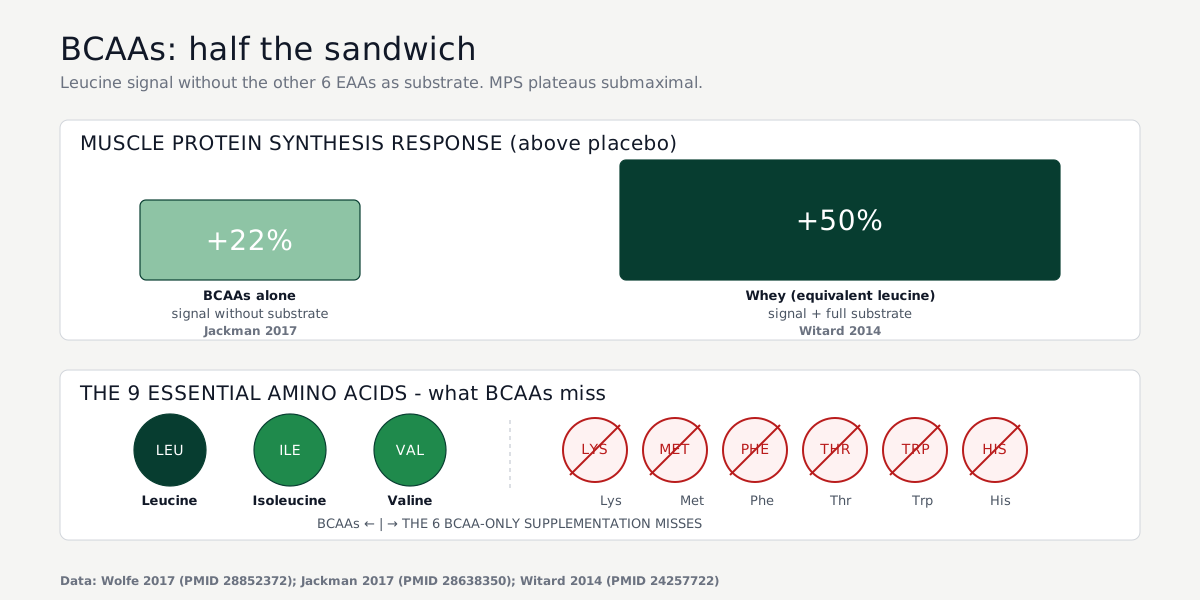
BCAAs (branched-chain amino acids) are three of the nine essential amino acids - leucine, isoleucine, and valine - oxidized mainly in skeletal muscle rather than the liver. They supply the leucine signal that triggers muscle protein synthesis, but only 3 of the 9 substrates needed to actually build muscle, which is why complete protein outperforms them.
The honest caveat, up front
BCAAs are one of the most over-marketed supplements in sports nutrition. "Anti-catabolic during long sessions," "preserves muscle," "accelerates recovery," "boosts endurance performance" - none of these claims survive contact with the modern muscle protein synthesis literature. BCAAs supply the signal for protein synthesis (leucine activating mTOR) but only 3 of the 9 substrates (the other 6 essential amino acids the body needs to actually build new muscle protein). The body can't synthesize what it doesn't have, so MPS plateaus at a submaximal response, capped by the missing substrate. Buy whey. Eat eggs. Save the BCAA budget.
There is exactly one endurance-specific case where BCAAs have defensible (not strong) evidence: reducing muscle damage and DOMS after eccentric-heavy exercise. If you race downhill ultras, hilly marathons, or anything with significant eccentric muscle load, the case is weaker than whey but not zero. This guide is the honest read on both the over-marketing and the one legitimate use.
Our race-day fueling planner at planner.nutrifinder.it does not include BCAAs because they are not a race-day fueling supplement. They are a training-block supplement of disputed value.
What they are
Branched-chain amino acids are three of the nine essential amino acids: leucine, isoleucine, and valine. They share aliphatic side chains with a branch off the beta carbon. Unlike most amino acids, BCAAs are oxidized primarily in skeletal muscle rather than the liver, via branched-chain aminotransferase (BCAT) and branched-chain alpha-keto acid dehydrogenase (BCKDH).
Leucine is the anabolic signal. It activates the mTORC1 pathway via the Sestrin2/GATOR2 complex, driving the translation initiation machinery that builds new muscle protein. This is the entire mechanistic basis for the BCAA marketing pitch.
Marketing pitch vs evidence: the substrate-vs-signal problem
The marketing version: leucine activates mTOR → mTOR drives muscle protein synthesis → therefore taking BCAAs builds muscle.
The actual physiology: leucine activates mTOR → mTOR drives translation initiation → but translation requires the full essential amino acid spectrum as substrate → if the other six EAAs aren't available, the cell has to break down its own existing muscle protein to find them → net MPS gain is capped at a submaximal response.
Wolfe 2017 (J Int Soc Sports Nutr) is the position review that demolished BCAA-only supplementation theoretically and empirically. Jackman et al. 2017 (Front Physiol) showed 5.6 g BCAAs post-resistance exercise raised myofibrillar MPS roughly 22 percent above placebo - real but submaximal, because the prior work from the same Tipton-Witard collaboration showed equivalent leucine in whey produces a roughly 50 percent MPS response. Same leucine, full substrate, doubled effect.
This isn't marginal. This is the central conceptual error in BCAA marketing.
Central fatigue: the one endurance-specific theoretical case
In the early 1990s, Newsholme and Blomstrand proposed a clever endurance-specific mechanism. BCAAs and free tryptophan compete for the same blood-brain barrier transporter (LNAA). During long exercise, plasma BCAAs fall (oxidized in muscle) and free tryptophan rises (free fatty acids displace it from albumin). The BCAA:tryptophan ratio drops, more tryptophan enters the brain, more is converted to serotonin (5-HT), and central fatigue increases. Their proposed fix: take BCAAs during exercise to maintain the ratio.
Blomstrand 1991 showed BCAA supplementation during a 30 km cross-country run improved cognitive performance post-run and produced faster run times in slower (but not faster) marathoners. The mechanism is real and the data is suggestive.
The follow-up evidence is less kind. Replication attempts in adequately fueled athletes consistently failed to find performance benefit. The reason emerged from the carbohydrate literature: adequate carb intake blunts the free fatty acid rise, which prevents tryptophan displacement, which neutralizes the central fatigue mechanism before BCAAs can address it. In other words, the carb drink in your race vest already does what the BCAA was supposed to do.
Practical translation for our audience: if you fuel your race adequately on carbs, the central fatigue argument for BCAAs largely doesn't apply.
Where BCAAs have genuine (modest) evidence
Muscle damage and DOMS reduction. This is the most replicable positive finding in the BCAA literature.
- Coombes & McNaughton 2000: BCAA supplementation significantly reduced serum creatine kinase (CK) and lactate dehydrogenase from 4 hours to 5 days post-exercise.
- Howatson et al. 2012: 20 g/day (~200 mg/kg/day) for 12 days around 100 drop-jumps reduced CK, accelerated maximal voluntary contraction recovery, and lowered DOMS at 24, 48, and 72 hours.
- Khemtong et al. 2021 meta-analysis: in trained males, BCAA supplementation modestly reduced CK and soreness after resistance exercise. Effect strongest with higher dose (>200 mg/kg/day), longer duration (>10 days), and dosing both before and after exercise.
For endurance contexts with significant eccentric load - downhill running, hilly ultras, plyometric training drills - this is the evidence base BCAAs have. For flat steady-state work, the case is weaker.
Dose and protocol (where it might help)
- Muscle damage / DOMS reduction: 200 mg/kg/day (around 14-20 g for a 70-90 kg athlete) for 10+ days, split between AM, pre-exercise, and post-exercise (Howatson 2012 protocol).
- Central fatigue, theoretical: 5-10 g 30-60 minutes pre-event.
- MPS / recovery from training: do not use BCAAs. Use 20-25 g whey protein or a complete EAA blend instead. Same money, better result.
- Ratio: standard 2:1:1 leucine:isoleucine:valine is the default. Higher-leucine ratios (4:1:1, 8:1:1) offer no proven additional benefit.
Side effects and risk
Generally benign. Mild GI distress at high single doses. Bitter taste is the dominant consumer complaint.
One caveat worth knowing: Newgard 2012 showed elevated circulating BCAAs correlate with insulin resistance in obesity (a metabolomic signature). Rodent supplementation studies suggest a mechanistic link. Causality in lean exercising humans is not established, and trained athletes have markedly different BCAA flux than the metabolically compromised populations the correlation comes from. No clear contraindication for healthy endurance athletes, but worth noting for athletes with metabolic concerns.
Practical bottom line
| Your profile | BCAA verdict |
|---|---|
| Pure endurance recovery, normal protein intake | Skip. Eat real protein, use whey if convenient. BCAAs underperform at equivalent cost. |
| Downhill ultra, hilly marathon, eccentric-heavy plyometric block | Maybe. 200 mg/kg/day for 10+ days has modest evidence for reducing CK/DOMS. Not best-in-class, but defensible. |
| Vegetarian / vegan athletes worried about leucine threshold | Use pure leucine (3-5 g) or a complete plant EAA blend. Cheaper than a BCAA tub for the same anabolic signal. |
| "Anti-catabolic during long sessions" pitch | Marketing fiction. Eat carbs, drink water. |
| Mid-race BCAA gels / drinks | Skip. The central-fatigue mechanism is largely neutralized by adequate carb fueling. |
The honest position
BCAAs are the supplement-industry equivalent of buying half a sandwich. The leucine signal is real, but you only get the signal, not the substrate. Whey protein at the same leucine content delivers both - signal AND substrate - at typically lower €/serving than a BCAA tub. For nearly every use case BCAAs are marketed for, intact protein (whey, eggs, dairy, meat, fish) or a complete EAA blend is a better choice.
The one defensible case (muscle damage / DOMS after eccentric load) has moderate evidence. Even there, it's hard to recommend BCAAs over a complete EAA mix or intact protein with the same total leucine.
For our audience: read the EAAs guide instead. If you want the practical decision, see our EAAs guide for the substrate-complete version of what BCAA marketing originally promised.
Research and references
The numbers and protocols in this guide rest on the following peer-reviewed sources. Verify the dose, the side-effect profile, and the contraindications against the primary literature, not against any single source.
- Wolfe RR. 2017. Journal of the International Society of Sports Nutrition. Branched-chain amino acids and muscle protein synthesis in humans: myth or reality? PMID 28852372
- Jackman SR, Witard OC, Philp A, Wallis GA, Baar K, Tipton KD. 2017. Frontiers in Physiology. Branched-chain amino acid ingestion stimulates muscle myofibrillar protein synthesis following resistance exercise in humans. PMID 28638350
- Blomstrand E, Hassmén P, Ekblom B, Newsholme EA. 1991. European Journal of Applied Physiology and Occupational Physiology. Administration of branched-chain amino acids during sustained exercise: effects on performance and on plasma concentration of some amino acids. PMID 1748109
- Newsholme EA, Blomstrand E. 1995. Advances in Experimental Medicine and Biology. Tryptophan, 5-hydroxytryptamine and a possible explanation for central fatigue. PMID 8585461
- Coombes JS, McNaughton LR. 2000. Journal of Sports Medicine and Physical Fitness. Effects of branched-chain amino acid supplementation on serum creatine kinase and lactate dehydrogenase after prolonged exercise. PMID 11125767
- Howatson G, Hoad M, Goodall S, Tallent J, Bell PG, French DN. 2012. Journal of the International Society of Sports Nutrition. Exercise-induced muscle damage is reduced in resistance-trained males by branched chain amino acids: a randomized, double-blind, placebo controlled study. PMID 22569039
- Khemtong C, Kuo CH, Chen CY, Jaime SJ, Condello G. 2021. Nutrients. Does branched-chain amino acids (BCAAs) supplementation attenuate muscle damage markers and soreness after resistance exercise in trained males? A meta-analysis of randomized controlled trials. PMID 34072718
- Newgard CB. 2012. Cell Metabolism. Interplay between lipids and branched-chain amino acids in development of insulin resistance. PMID 22560213