
Guide
EAAs (essential amino acids) for endurance athletes
Educational content, not medical advice. Athletes with phenylketonuria or rare amino acid metabolism disorders should consult a doctor before any EAA supplementation.
EAAs (essential amino acids) are the nine amino acids the body cannot synthesize: the three BCAAs plus lysine, methionine, phenylalanine, threonine, tryptophan, and histidine. A free-form EAA blend supplies the complete substrate set for muscle protein synthesis - the full sandwich that BCAA supplements only half-deliver.
The honest caveat, up front
If BCAAs are the half-sandwich (signal without substrate), EAAs are the full sandwich: all 9 essential amino acids the body needs to actually build muscle protein. Free-form EAA blends are the supplement-form delivery of what BCAA marketing originally promised. The substrate problem is solved. The remaining question is whether you should pay €40-60 a month for free-form EAAs when whey protein delivers the same maximal muscle protein synthesis response at typically lower cost per effective leucine dose. For most omnivorous endurance athletes hitting 1.4-1.8 g protein/kg/day from food plus a daily whey shake, the answer is no. For plant-based athletes, athletes with whey/dairy intolerance, and athletes on calorie-restricted diets where low-volume protein delivery matters, free-form EAAs have a legitimate niche. This guide is the honest read.
Our race-day fueling planner at planner.nutrifinder.it doesn't model EAAs because they're a daily protein-strategy supplement, not a race-day intake. The rest of this guide is about training-block recovery and total daily protein.
What they are
The 9 amino acids the human body cannot synthesize and must obtain from diet or supplementation:
- Branched-chain (BCAAs): leucine, isoleucine, valine
- Other 6 EAAs: lysine, methionine, phenylalanine, threonine, tryptophan, histidine
A complete protein source contains all 9 in proportions sufficient to support muscle protein synthesis. Free-form EAA supplements supply all 9 in pre-digested form, requiring no proteolysis before intestinal absorption - which makes them faster-absorbing than intact protein, though the practical difference for recovery is modest.
EAAs vs BCAAs: the substrate-vs-signal distinction
Read our BCAAs guide for the deep dive. The short version:
- BCAAs (leucine + isoleucine + valine) supply the signal for muscle protein synthesis (leucine activates mTOR) but only 3 of the 9 EAAs needed as substrate to assemble new muscle protein.
- Full EAA blends supply both signal and substrate. The body can actually build new muscle from what you ingested, not from breaking down its own muscle to find the missing amino acids.
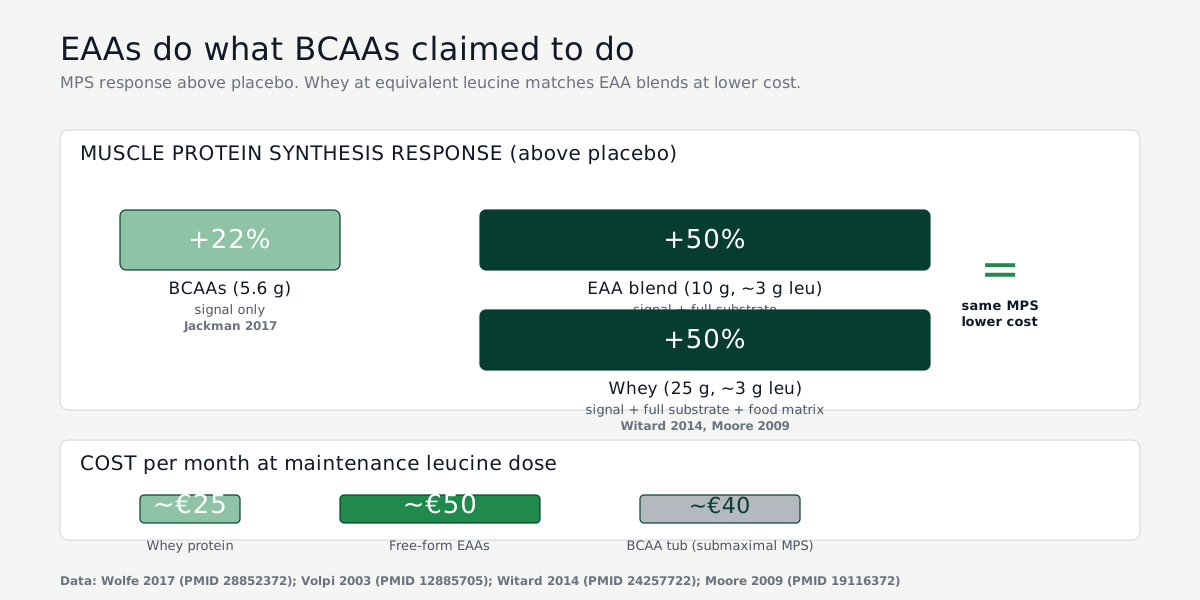
The MPS response comparison is decisive:
| Supplement | MPS response above placebo | Evidence |
|---|---|---|
| BCAAs alone (5.6 g) | ~+22% | Jackman 2017 |
| Full EAA blend (10-12 g, ~3 g leucine) | ~+50% | Volpi 2003, Tipton 1999 |
| Whey protein (20-25 g, ~2.5-3 g leucine) | ~+50% | Moore 2009, Witard 2014 |
EAAs do what BCAAs claim. Whey does the same as EAAs at typically lower cost.
For endurance athletes specifically
Recovery and MPS from training: free-form EAAs work. So does whey. So does intact dietary protein hitting ~0.3 g/kg per meal with ~2.5-3 g leucine. There is no reproducible advantage of free-form EAAs over whey in protein-replete endurance athletes (Pasiakos 2015, Thomas/ACSM 2016).
During exercise: limited and inconsistent evidence. Some trials of EAAs during prolonged endurance show reduced markers of muscle damage (CK, perceived soreness); performance benefits are small and not consistently replicated. Carbs remain the dominant in-session fuel.
Post-exercise recovery window: 20-40 g whey protein is the dominant evidence-backed recommendation. EAA blends matched on leucine content (~3 g) and total EAA mass (~10 g) reach the same MPS plateau at higher cost per serving.
Where free-form EAAs genuinely beat whey
There are four legitimate cases:
1. Whey or dairy intolerance. Lactose intolerance, casein/whey allergy, or self-reported "feels heavy" reactions to whey-based shakes. Free-form EAAs avoid dairy entirely.
2. Plant-based athletes. Plant proteins (rice, pea, hemp, soy) have less complete EAA profiles than animal sources, with specific gaps (lysine in cereals, methionine in legumes). A complete EAA blend corrects for these efficiently. Soy isolate alone is largely sufficient for healthy plant-based athletes; EAAs are an optional optimization for athletes who prefer the blended profile.
3. Calorie-restricted athletes. Pre-race weight cuts, masters athletes managing body composition, athletes recovering from injury without losing muscle. Free-form EAAs deliver maximum anabolic signal in minimum calorie volume (~40 kcal for 10 g EAAs vs ~120 kcal for 30 g whey).
4. Pre-workout pre-loading. Free-form EAAs reach peak plasma in ~30 minutes vs ~60-90 minutes for intact whey. Useful if you want amino acids on board during the workout itself, though the practical advantage is modest for endurance training.
Dose and protocol
Per serving for MPS: 6-10 g EAAs containing ~3 g leucine to clear the leucine threshold for muscle protein synthesis (Churchward-Venne 2012, Witard 2014).
Daily protein target for endurance athletes: 1.2-2.0 g per kg per day per ACSM 2016 (Thomas/Erdman/Burke). Practical range 1.4-1.8 g/kg/day for trained endurance athletes during heavy training blocks. Most of this should come from food.
Distribution: 3-5 feedings of 0.3 g/kg protein each, evenly spaced across the day. Total daily intake matters more than precise timing for endurance athletes.
Form: free-form EAAs vs intact protein is a convenience and substrate-completeness decision; on a per-leucine basis they're roughly equivalent for MPS.
Side effects
Generally benign. Mild GI distress at single doses above 30 g. Bitter taste is the dominant consumer complaint - most products mask with citric acid and sweeteners.
No serious safety signals. No medication interactions of clinical relevance. Theoretical concerns about chronic high-dose amino acid loading have not materialized in healthy athletic populations.
Practical bottom line
| Your profile | EAA verdict |
|---|---|
| Hitting 1.4-1.8 g/kg/day from food + whey shake | Skip free-form EAAs. They add nothing. Save the money. |
| Plant-based / vegan | Reasonable convenience. Soy isolate alone is largely sufficient; EAA blends are an optional optimization. |
| Whey or dairy intolerance | Yes, EAAs are the legitimate fix. Same MPS response, no dairy. |
| Calorie-restricted phase (weight cut, masters, injury recovery) | Yes. Maximum anabolic signal in minimum calories. |
| Struggling to hit daily protein target (1.4-1.8 g/kg) | Reasonable gap-filler. Whey is usually cheaper for the same total daily protein. |
| "EAAs during exercise" pitch | Weaker evidence than the recovery use case. Not a strong buy for typical endurance athletes. |
Cost: effective EAA dosing runs ~€40-60/month vs ~€20-30/month for whey-equivalent leucine delivery. Within reason if you fit one of the four legitimate cases. Hard to justify otherwise.
The honest position
EAAs are unambiguously better than BCAAs for muscle protein synthesis. They solve the substrate-completeness problem that BCAA marketing obscured for two decades. But for the majority of endurance athletes - omnivorous, hitting daily protein targets from food, using a daily whey shake for convenience - free-form EAAs are an expensive way to achieve what cheaper, food-form options already achieve.
If you fit one of the four legitimate cases (plant-based, whey-intolerant, calorie-restricted, struggling to hit daily protein), buy them and don't feel bad about it. If you don't, save the money for more meaningful supplement decisions.
Research and references
The numbers and protocols in this guide rest on the following peer-reviewed sources. Verify the dose, the side-effect profile, and the contraindications against the primary literature, not against any single source.
- Wolfe RR. 2017. Journal of the International Society of Sports Nutrition. Branched-chain amino acids and muscle protein synthesis in humans: myth or reality? PMID 28852372
- Jackman SR, Witard OC, Philp A, Wallis GA, Baar K, Tipton KD. 2017. Frontiers in Physiology. Branched-chain amino acid ingestion stimulates muscle myofibrillar protein synthesis following resistance exercise in humans. PMID 28638350
- Tipton KD, Ferrando AA, Phillips SM, Doyle D, Wolfe RR. 1999. American Journal of Physiology. Postexercise net protein synthesis in human muscle from orally administered amino acids. PMID 10198297
- Volpi E, Kobayashi H, Sheffield-Moore M, Mittendorfer B, Wolfe RR. 2003. American Journal of Clinical Nutrition. Essential amino acids are primarily responsible for the amino acid stimulation of muscle protein anabolism in healthy elderly adults. PMID 12885705
- Moore DR, Robinson MJ, Fry JL, et al. 2009. American Journal of Clinical Nutrition. Ingested protein dose response of muscle and albumin protein synthesis after resistance exercise in young men. PMID 19116372
- Churchward-Venne TA, Burd NA, Mitchell CJ, et al. 2012. Journal of Physiology. Supplementation of a suboptimal protein dose with leucine or essential amino acids: effects on myofibrillar protein synthesis at rest and following resistance exercise in men. PMID 22451437
- Witard OC, Jackman SR, Breen L, Smith K, Selby A, Tipton KD. 2014. American Journal of Clinical Nutrition. Myofibrillar muscle protein synthesis rates subsequent to a meal in response to increasing doses of whey protein at rest and after resistance exercise. PMID 24257722
- Pasiakos SM, McLellan TM, Lieberman HR. 2015. Sports Medicine. The effects of protein supplements on muscle mass, strength, and aerobic and anaerobic power in healthy adults: a systematic review. PMID 25169440
- Thomas DT, Erdman KA, Burke LM. 2016. Medicine & Science in Sports & Exercise. American College of Sports Medicine Joint Position Statement. Nutrition and Athletic Performance. PMID 26891166