
Guide
Cyclodextrin (HBCD / Cluster Dextrin) for endurance athletes
Educational content, not medical advice. Athletes with GI conditions, diabetes, or any chronic gut issues should test new carbohydrate sources in training before racing them.
Cyclodextrin (HBCD, sold as Cluster Dextrin) is a highly branched cyclic glucose polymer made from waxy maize starch, with a very high molecular weight (~160,000 Da) and unusually low osmolality for a given concentration. To your gut it is still glucose: it does not raise the 60 g/h absorption ceiling that only fructose pairing can lift.
The honest caveat, up front
Open the ingredient list on a €5 endurance gel and you'll often see "Cluster Dextrin" or "highly branched cyclic dextrin (HBCD)" listed. The product costs roughly twice what an equivalent maltodextrin-based gel does. The marketing claim is that this premium carbohydrate empties from the stomach faster, sits lighter in the gut at high concentrations, and produces a smoother glycemic curve. The chemistry behind the claim is real. The performance evidence is thin, mostly Japanese, and largely funded by the manufacturer. This guide is the honest assessment of where HBCD actually earns its 2-3× price premium, and where it doesn't.
Our race-day fueling planner at planner.nutrifinder.it recommends products by total carb and sodium content, not by carbohydrate source. The conversation about HBCD vs maltodextrin is a second-order optimization on top of getting your race-day total right.
What it actually is
Highly branched cyclic dextrin, commercially branded as Cluster Dextrin by Ezaki Glico (a Japanese food manufacturer), is a glucose polymer made from waxy maize starch by the action of a branching enzyme (cyclodextrin glucanotransferase). The result is a cyclic core with multiple highly branched outer chains and an unusually high mean molecular weight of around 160,000 Daltons (versus ~1,000 to 10,000 Da for standard maltodextrin).
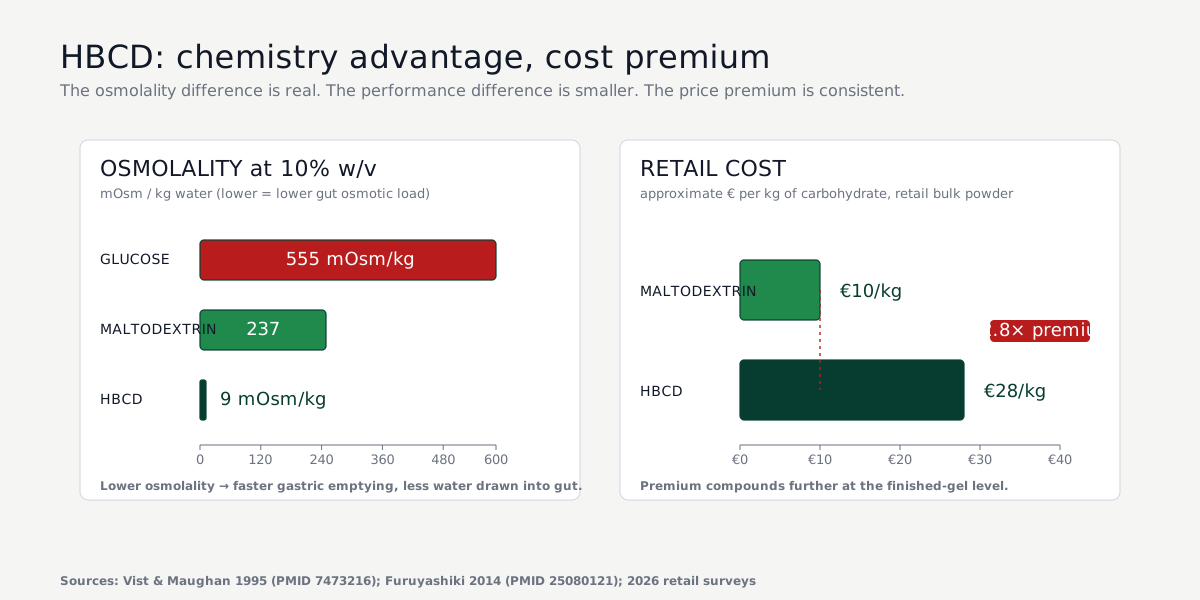
The single defining physicochemical property is low osmolality at a given solution concentration. At 10 percent w/v in water, HBCD registers around 9 mOsm/kg, compared to ~237 mOsm/kg for DE-10 maltodextrin and ~555 mOsm/kg for an equivalent glucose solution. Lower osmolality means less water drawn into the gut lumen, faster gastric emptying, and theoretically better tolerance at high carbohydrate concentrations.
A naming note: HBCD is structurally distinct from the α, β, and γ cyclodextrins used in pharmaceutical formulation as excipients. Those are small cyclic 6-, 7-, or 8-glucose units. HBCD is something else entirely. If someone tries to sell you "cyclodextrin" without specifying which one, ask.
The claims, and the evidence behind them
Claim 1: Faster gastric emptying than glucose. Confirmed. Takii et al. 2005 (Int J Sports Med) showed HBCD beverages emptied faster than glucose at matched concentration in humans. Mechanism follows directly from the osmolality difference. This part is not in dispute.
Claim 2: Faster gastric emptying than maltodextrin. Less clear. Maltodextrin itself is already a polymer with modest osmolality. The HBCD-vs-maltodextrin head-to-head studies are small-n and the delta is small. The chemistry suggests an advantage; the data is thin.
Claim 3: Lower perceived exertion at matched workload. Furuyashiki et al. 2014 (Biosci Biotechnol Biochem) ran a double-blind crossover with 15 g of HBCD vs 15 g of maltodextrin during endurance exercise. The HBCD group reported significantly lower RPE at 30 and 60 minutes. Small sample, all authors employed by the Glico Institute of Health Sciences (the manufacturer's R&D arm). Suggestive, not conclusive.
Claim 4: Better performance. The closest thing to independent corroboration is Suzuki et al. 2014 in 7 male triathletes running a simulated duathlon (5 km run + 40 km bike + 5 km run). The HBCD group showed attenuated stress-hormone and urinary-cytokine response versus glucose, but no clear performance delta. The lead author was based at Waseda University rather than Glico, though co-authors included Glico R&D staff.
Other commonly-cited studies (Takii 1999 in mice, Shiraki 2015 in Food Science and Technology Research) are either animal models or published in non-PubMed-indexed journals with Glico-employed authors. No independent meta-analysis of HBCD versus maltodextrin in endurance performance has been published.
What is not in dispute
HBCD does not change the underlying SGLT1 transporter ceiling. It's still ultimately glucose, broken down by gut enzymes and absorbed via the same single transporter that caps at 60 g/h. To push above 60 g/h you still need fructose (or another GLUT5-utilizing partner), regardless of whether the glucose source is maltodextrin or HBCD.
Most premium endurance products that include Cluster Dextrin also include maltodextrin and fructose. The HBCD is layered in on top of the proven 2:1 glucose-polymer-plus-fructose stack. The HBCD is not doing the heavy lifting; it's at most refining the GI tolerance of the formulation.
The critical read
Stripping out the marketing:
- Osmolality advantage: real and well-characterized by chemistry. The product genuinely behaves differently in the gut from straight glucose or short-chain maltodextrin.
- Gastric emptying advantage vs maltodextrin specifically: small, not robustly replicated.
- RPE advantage: suggestive in one small Glico-funded crossover, otherwise unconfirmed.
- Performance advantage: not established in independent trials at race-relevant carbohydrate intakes (60-90 g/h).
- Cost: HBCD retails at roughly 2-3× maltodextrin per gram of carbohydrate. The premium compounds further at the finished-gel level.
The honest summary: HBCD is a credible premium ingredient with a real chemistry-level advantage. Whether the in-practice benefit justifies the price depends on whether GI tolerance is currently your binding constraint.
Where it might earn its price
- Elite or sub-elite athletes pushing 100+ g/h where every percentage point of GI tolerance compounds across a long race
- Ultra-endurance (8+ hours) where smooth glycemic curve and stomach comfort over many hours genuinely matter
- Athletes with documented sensitivity to high-osmolality drinks or known GI issues with concentrated standard carbs
- Pre-race "topping" drinks in the 30-60 minutes before the gun, where rapid gastric emptying minimizes pre-race fullness
Where it doesn't
- Sub-3-hour events at 60-90 g/h with no current GI complaints
- Recreational athletes whose race-day limiter is training load, pacing, or fueling discipline, not the specific dextrin polymer in their bottle
- Athletes who already tolerate maltodextrin + fructose 2:1 without GI distress
Practical bottom line
If your current product hits your target carb-per-hour without GI distress, switching to an HBCD product is unlikely to make you faster. Save the money, spend it on more product or a coach.
If you currently top out at 60-70 g/h because the gut shuts you down past that, an HBCD-blend product is worth a 4-week training trial before your A-race. So is doing the gut-training work, which is cheaper and better-evidenced.
If you race ultra-distance and have any history of GI distress at hour six onward, an HBCD-blend product is one of the better-evidenced premium upgrades available. Test it in training; do not debut it on race day.
For the planner: HBCD-blend products are already included alongside maltodextrin-based products in our catalog and meet the same carb-per-gram criteria. Pick by total carbs, sodium, caffeine, and price first; pick by carbohydrate source only if you're optimizing for GI tolerance.
Frequently asked questions
What is Cluster Dextrin and is it better than maltodextrin?
Cluster Dextrin is the commercial name for highly branched cyclic dextrin (HBCD), a glucose polymer with much lower osmolality than maltodextrin at the same concentration. The chemistry advantage is real, but the head-to-head performance evidence against maltodextrin is small, largely manufacturer-funded, and not robustly replicated - and HBCD costs roughly 2-3 times more per gram of carbohydrate.
Does Cluster Dextrin let me absorb more carbs per hour?
No. HBCD is still glucose, broken down and absorbed through the same SGLT1 transporter that caps at roughly 60 g/h. To push above 60 g/h you need fructose in the mix, regardless of whether the glucose source is maltodextrin or HBCD.
Is HBCD easier on the stomach?
Compared with straight glucose, yes: its very low osmolality (around 9 mOsm/kg at 10 percent concentration, versus roughly 555 for glucose) means faster gastric emptying, confirmed in human trials. Compared with maltodextrin the difference is small and the supporting data thin.
Is Cluster Dextrin worth the price?
Only if GI tolerance is your binding constraint: athletes pushing 100+ g/h, ultra-endurance racers with a history of gut distress at hour six onward, or athletes sensitive to concentrated standard carbs. If your current product already hits your carb target without GI trouble, switching is unlikely to make you faster - save the money.
Is the research on Cluster Dextrin reliable?
Treat it with caution. The gastric-emptying advantage over glucose is well established, but most performance studies are small and authored or funded by the manufacturer (Ezaki Glico), and no independent meta-analysis of HBCD versus maltodextrin in endurance performance has been published.
Research and references
The numbers and protocols in this guide rest on the following peer-reviewed sources. Verify the dose, the side-effect profile, and the contraindications against the primary literature, not against any single source. Several of the foundational HBCD studies are authored or co-authored by employees of the manufacturer (Ezaki Glico); flagged below.
- Takii H, Ishihara K, Kometani T, Okada S, Fushiki T. 1999. Bioscience, Biotechnology, and Biochemistry. Enhancement of swimming endurance in mice by highly branched cyclic dextrin. PMID 10664836 (Glico-affiliated; animal study.)
- Takii H, Takii Nagao Y, Kometani T, et al. 2005. International Journal of Sports Medicine. Fluids containing a highly branched cyclic dextrin influence the gastric emptying rate. PMID 15900642 (Glico-affiliated.)
- Furuyashiki T, Tanimoto H, Yokoyama Y, Kitaura Y, Kuriki T, Shimomura Y. 2014. Bioscience, Biotechnology, and Biochemistry. Effects of ingesting highly branched cyclic dextrin during endurance exercise on rating of perceived exertion and blood components associated with energy metabolism. PMID 25080121 (Glico Institute of Health Sciences.)
- Suzuki K, Shiraishi K, Yoshitani K, Sugama K, Kometani T. 2014. Journal of Sports Medicine and Physical Fitness. Effect of a sports drink based on highly-branched cyclic dextrin on cytokine responses to exhaustive endurance exercise. PMID 25270782 (Lead author Waseda University; Glico co-authors.)
- Morenas-Aguilar MD, et al. 2025. Clinical Nutrition ESPEN. Effects of highly branched cyclic dextrin on performance, perceived exertion and gastrointestinal symptoms in resistance-trained men and women. PMID 39644922 (Independent; resistance training, not endurance.)
- Jentjens RLPG, Achten J, Jeukendrup AE. 2004. Medicine & Science in Sports & Exercise. High oxidation rates from combined carbohydrates ingested during exercise. PMID 15354037 (Foundational evidence for the maltodextrin + fructose comparator pattern.)
- Vist GE, Maughan RJ. 1995. Journal of Physiology. The effect of osmolality and carbohydrate content on the rate of gastric emptying of liquids in man. PMID 7473216 (Underpins the osmolality-advantage mechanism.)
Practical resources
- Shiraki T, et al. 2015. Evaluation of exercise performance with the intake of highly branched cyclic dextrin in athletes (J-STAGE) — Food Science and Technology Research; not PubMed-indexed; Glico-affiliated.