
Guide
Electrolyte salts for endurance athletes
Educational content, not medical advice. Athletes with hypertension, kidney disease, or on medications affecting electrolyte handling should consult a doctor before changing their electrolyte intake protocol.
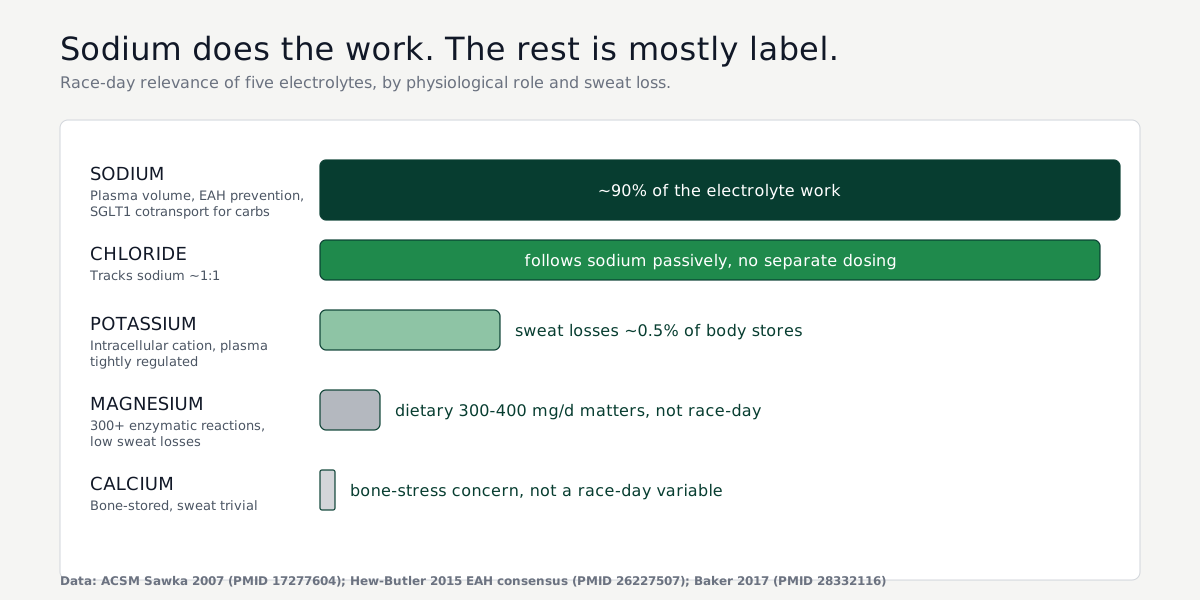
Electrolytes are the charged minerals lost in sweat: sodium, chloride, potassium, magnesium, and calcium. In endurance racing sodium does roughly 90 percent of the work - plasma volume, hyponatremia prevention, and carbohydrate co-transport - while the others are lost in amounts too small to need in-race replacement.
The honest caveat, up front
Open any endurance sports drink and the label lists half a dozen electrolytes: sodium, potassium, magnesium, calcium, sometimes zinc and chloride. The marketing implication is that all of them matter and that more variety equals more thoroughness. The physiology says something different: sodium does roughly 90 percent of the electrolyte work in endurance racing, chloride follows it passively for free, and potassium, magnesium, and calcium are present mostly for marketing. Your body loses negligible amounts of magnesium and potassium relative to sweat sodium, and the dietary intake of those minerals during normal eating dwarfs any race-day supplementation. This guide is the honest read on which electrolytes you actually need to track during racing, and which are noise.
Our race-day fueling planner at planner.nutrifinder.it computes a sodium target based on your sweat rate and sex-weight-tiered sodium concentration. It does not separately model potassium or magnesium - because the evidence does not support that they matter at intake rates achievable from sports drinks during exercise. The rest of this guide is the why.
The five electrolytes, briefly
| Electrolyte | Where it lives | Sweat concentration | Race-day relevance |
|---|---|---|---|
| Sodium (Na+) | Extracellular | 200-1500 mg/L | High. Plasma volume, EAH prevention, SGLT1 cotransport for carb absorption. |
| Chloride (Cl-) | Extracellular | Tracks sodium ~1:1 | Passive. No independent dosing decision. |
| Potassium (K+) | Intracellular | ~200 mg/L | Low. Sweat losses tiny relative to total body stores. |
| Magnesium (Mg++) | Intracellular, bone | ~5-10 mg/L | Negligible. Dietary intake during normal eating swamps any sweat loss. |
| Calcium (Ca++) | Bone | Minimal | Negligible. Not a race-day variable. |
Sodium: the one that actually moves the needle
This is the load-bearing section. The deep dive on sodium specifically lives in our sweat-sodium guide; this is the short version.
Sweat sodium concentration: 200 to 1,500 mg per liter, average around 700-900 mg/L (Baker 2017). Substantial inter-individual variability driven by genetics, heat acclimation status, and training history.
Sweat rate: typically 0.5 to 2.0 L per hour during endurance racing. A 4-hour Ironman bike split at 1 L/h and 750 mg/L = roughly 3 grams of sodium lost via sweat. The salty-sweater tail loses 5+ grams.
Why sodium matters during exercise:
- Plasma volume maintenance. Falling sodium dilutes plasma; severe hyponatremia is life-threatening. The 2015 International Exercise-Associated Hyponatremia Consensus (Hew-Butler et al.) documents the protocols.
- SGLT1 cotransport. The intestinal sodium-glucose cotransporter is what makes 60-90 g/h carbohydrate absorption possible during racing. Sodium is the substrate that powers glucose uptake in the gut.
- Thirst and fluid retention. Maughan 1994 and Shirreffs 1996 demonstrated that post-exercise rehydration is significantly more effective with sodium-containing drinks vs plain water.
Race-day dosing: 300-600 mg/h for typical sweaters in temperate conditions; 600-1,000+ mg/h for known salty sweaters or hot weather. See our planner for individual estimation.
Potassium during exercise: the myth-busting section
This is where most athletes are unnecessarily worried.
Total body potassium: about 140 grams (3,500 mmol). The vast majority is intracellular, with plasma concentration tightly regulated around 4 mmol/L.
Sweat potassium: approximately 200 mg/L, roughly stable across individuals.
The math: a 4-hour race at 1 L/h sweat rate loses about 800 mg of potassium total, equivalent to 0.5 percent of total body stores. The body easily buffers this from intracellular reservoirs. Plasma potassium is tightly regulated by renal handling.
ACSM/IOM framing (Sawka 2007 position stand): dietary potassium adequacy matters - most Western diets fall short of the 3,400-4,700 mg/day recommendation - but acute mid-exercise supplementation has no evidence base for performance or arrhythmia prevention in healthy athletes.
Practical: 50-100 mg/h of potassium on a sports drink label is harmless and fine, but is not a reason to choose one product over another. Hyperkalemia risk from supplementation is theoretical in healthy athletes but real in chronic kidney disease and potassium-sparing diuretic use.
Magnesium during exercise: skip it
Sweat magnesium: roughly 5-10 mg/L. A 4-hour race at 1 L/h sweat rate loses 20-40 mg of magnesium, trivial vs the 310-420 mg/day RDA.
No RCT supports during-exercise magnesium supplementation for performance, cramp prevention, or recovery (Nielsen & Lukaski 2006).
The "magnesium for cramps" claim deserves a separate paragraph: exercise-associated muscle cramps in athletes with normal plasma magnesium are not corrected by magnesium supplementation. Schwellnus 2011 and Miller 2010 demonstrated this clearly. The cramps hypothesis has shifted from electrolyte imbalance to neuromuscular fatigue and altered motor neuron excitability.
Where magnesium does matter: dietary adequacy in chronically training athletes, particularly women (Lukaski 2004). Hit 300-400 mg/day from leafy greens, nuts, whole grains, or modest supplementation around heavy training blocks. This is a kitchen problem, not a sports-drink problem.
The cramps question: it's not electrolytes
This deserves its own section because it's the single most common reason athletes overpay for electrolyte complexity.
Old hypothesis: exercise-associated muscle cramps are caused by dehydration or electrolyte imbalance. This dates from industrial worker case reports in the 1920s-30s. It has not held up in prospective endurance-athlete cohorts.
Modern hypothesis: cramps arise from altered motor neuron excitability driven by muscle fatigue, with disinhibition of alpha-motor neurons from Golgi tendon organ feedback (Schwellnus 2011). The Ironman cohort (n=210) showed that running speed and prior cramp history predicted cramps; serum sodium and hydration status did not.
The pickle juice / mustard finding (Miller 2010): cramp duration shortens within about 85 seconds of ingestion, faster than any plausible electrolyte absorption pathway. The mechanism is a TRP-channel oropharyngeal reflex (the sour or pungent taste triggers a reflex inhibition of the motor neuron firing), not systemic electrolyte correction.
Practical for our audience: if you cramp during races, fix training load, fix race pacing, and acclimate to race-pace efforts. Increasing electrolytes hoping for a fix is the wrong tool. If you want to try the pickle juice trick mid-race, the evidence is suggestive; just don't expect it to be about electrolytes.
Calcium and the trace-mineral noise
Calcium: sweat losses are minimal. Bone calcium turnover dwarfs any sweat output. Bone-stress risk in endurance athletes (RED-S, female athlete triad) is about chronic dietary calcium, vitamin D, and energy availability - not race-day calcium supplementation.
Iron: separate issue. Iron deficiency anemia is real in female endurance athletes and in athletes with frequent foot-strike hemolysis. It's a clinical/dietary issue, not a sports-drink ingredient.
Trace minerals (zinc, manganese, chromium): no defensible during-exercise rationale. Present on labels for marketing.
Practical dosing summary
| Electrolyte | During-race target | Evidence |
|---|---|---|
| Sodium | 300-600 mg/h typical; 600-1,000+ mg/h salty/hot | Strong (Sawka 2007; Hew-Butler 2015) |
| Chloride | Follows sodium | Passive |
| Potassium | 50-100 mg/h optional | Weak - minimal physiological need |
| Magnesium | Skip during exercise; 300-400 mg/d via diet | No RCT support during exercise |
| Calcium | Skip during exercise; address dietarily | No race-day rationale |
Practical bottom line
Read the sodium line on the sports drink or gel label first. The rest is secondary. If two products are matched on sodium, the deciding factor should be carbs and price, not the count of "essential minerals" on the back.
For cramps: don't reach for an electrolyte tablet. Back off training intensity, do race-pace work in your build, and consider the pickle juice reflex trick mid-race if you must do something.
For magnesium: ensure 300-400 mg/day from food during heavy training. A €5/month magnesium glycinate tablet is fine if you struggle to hit it dietarily. Do not buy "magnesium during exercise" products.
For our planner: the sodium target it produces is the one that matters. Hit it. Ignore the other electrolyte numbers on the drink label.
Research and references
The numbers and protocols in this guide rest on the following peer-reviewed sources. Verify the dose, the side-effect profile, and the contraindications against the primary literature, not against any single source.
- Sawka MN, Burke LM, Eichner ER, Maughan RJ, Montain SJ, Stachenfeld NS. 2007. Medicine & Science in Sports & Exercise. American College of Sports Medicine position stand: Exercise and fluid replacement. PMID 17277604
- Hew-Butler T, Loi V, Pani A, Rosner MH. 2015. British Journal of Sports Medicine. Statement of the 3rd International Exercise-Associated Hyponatremia Consensus Development Conference, Carlsbad, California, 2015. PMID 26227507
- Schwellnus MP, Drew N, Collins M. 2011. British Journal of Sports Medicine. Increased running speed and previous cramps rather than dehydration or serum sodium changes predict exercise-associated muscle cramping. PMID 21148567
- Miller KC, Mack GW, Knight KL, et al. 2010. Medicine & Science in Sports & Exercise. Reflex inhibition of electrically induced muscle cramps in hypohydrated humans. PMID 19997012
- Lukaski HC. 2004. Nutrition. Vitamin and mineral status: effects on physical performance. PMID 15212745
- Nielsen FH, Lukaski HC. 2006. Magnesium Research. Update on the relationship between magnesium and exercise. PMID 17172008
- Baker LB. 2017. Sports Medicine. Sweating Rate and Sweat Sodium Concentration in Athletes: A Review of Methodology and Intra/Interindividual Variability. PMID 28332116
- Montain SJ, Cheuvront SN, Lukaski HC. 2007. International Journal of Sport Nutrition and Exercise Metabolism. Sweat mineral-element responses during 7 h of exercise-heat stress. PMID 18156662
- Montain SJ, Cheuvront SN, Sawka MN. 2006. British Journal of Sports Medicine. Exercise associated hyponatraemia: quantitative analysis to understand the aetiology. PMID 16431994
- Maughan RJ, Owen JH, Shirreffs SM, Leiper JB. 1994. European Journal of Applied Physiology and Occupational Physiology. Post-exercise rehydration in man: effects of electrolyte addition to ingested fluids. PMID 8001531
- Shirreffs SM, Taylor AJ, Leiper JB, Maughan RJ. 1996. Medicine & Science in Sports & Exercise. Post-exercise rehydration in man: effects of volume consumed and drink sodium content. PMID 8897383
- Jeukendrup AE. 2010. Current Opinion in Clinical Nutrition and Metabolic Care. Carbohydrate and exercise performance: the role of multiple transportable carbohydrates. PMID 20574242