
Guide
Fructose for endurance athletes
Educational content, not medical advice. Athletes with diagnosed fructose malabsorption, hereditary fructose intolerance, or chronic GI issues should consult a sports dietitian before pushing high-dose fructose intake during exercise.
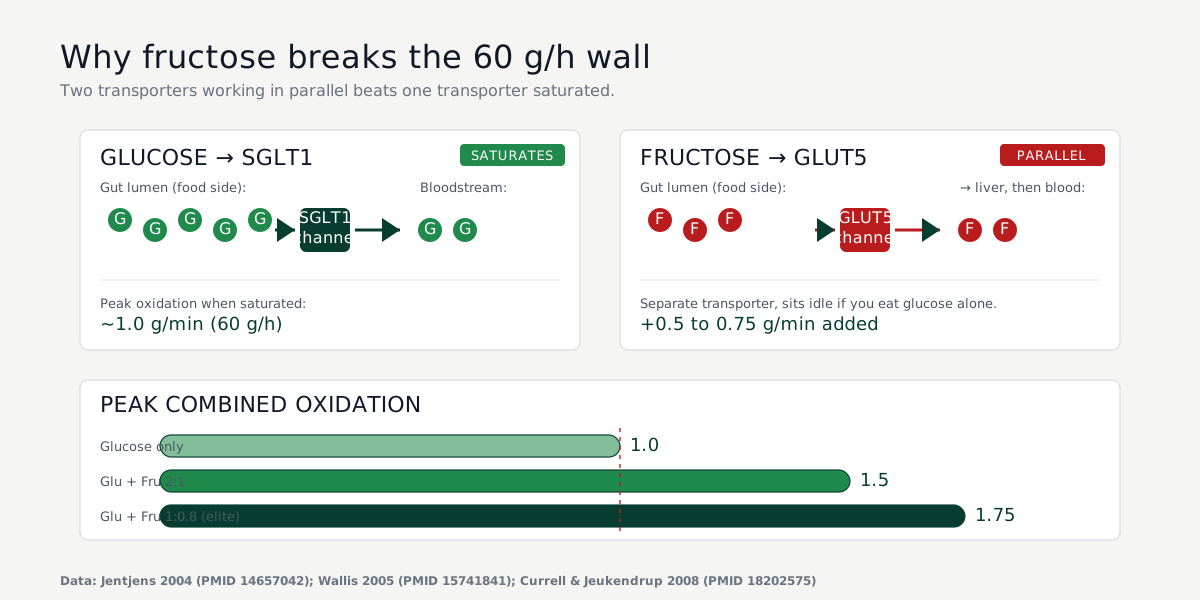
Fructose is a monosaccharide absorbed through the intestinal GLUT5 transporter, a separate pathway from the SGLT1 transporter that glucose uses. Paired with glucose or maltodextrin - usually at 2:1 - it lifts the absorbable carbohydrate ceiling from roughly 60 g/h to 90-120 g/h in trained athletes.
The honest caveat, up front
Before about 2005, the established ceiling for in-race carbohydrate oxidation was 1.0 to 1.1 grams per minute, or 60 to 66 g per hour. You could eat more, but it would sit in your gut, draw water in, and turn into GI distress. The wall was real, and it was the intestinal SGLT1 transporter saturating. Then Jeukendrup's Birmingham lab tried adding fructose alongside glucose. Fructose crosses the intestine through a separate transporter, GLUT5, which sits idle in a glucose-only meal. With both transporters working in parallel, total carbohydrate absorption could push to 1.5 grams per minute, and in elite-tier studies, 1.75 grams per minute. That is how 90 g/h and 120 g/h became real numbers for trained endurance athletes, and that is why every premium endurance product now lists both maltodextrin and fructose on the label.
Our race-day fueling planner at planner.nutrifinder.it computes your race-day carb total and recommends products that hit it. For events over 2.5 hours and targets over 60 g/h, those products almost always contain fructose. The rest of this guide is the why.
What it is and how it's absorbed
Fructose is a monosaccharide, a single-sugar unit. In the gut it crosses the enterocyte (intestinal absorptive cell) via the GLUT5 facilitative transporter, which is biochemically separate from the SGLT1 transporter that handles glucose, galactose, and the cleaved products of maltose, sucrose, maltodextrin, and starch.
Once absorbed, fructose travels in the portal vein to the liver, where most of it is converted to glucose, lactate, or stored as hepatic glycogen before re-entering systemic circulation. This first-pass hepatic step is why fructose alone produces a lower peripheral glucose spike than glucose, and why its oxidation kinetics during exercise lag a few minutes behind glucose. It is also why pure fructose alone, with no glucose, is a poor primary fuel: the liver bottlenecks the rate of usable glucose production.
The multi-transportable carbohydrate story
This is the load-bearing science behind every gel ratio you see on the market today. The original glucose-alone ceiling is on display in two foundational papers:
- Jentjens and Jeukendrup 2005 (Br J Nutr): cyclists fed 108 g/h glucose plateaued at peak exogenous oxidation of 0.83 g/min. Switching to 72 g glucose + 36 g fructose per hour (a 2:1 ratio at the same total grams) pushed peak oxidation to 1.26 g/min, a 45 percent increase from the same total dose.
- Wallis et al. 2005 (Med Sci Sports Exerc): maltodextrin alone topped out at 1.06 g/min; maltodextrin + fructose reached 1.50 g/min.
Subsequent work pushed the ceiling further. Jentjens et al. (2004, J Appl Physiol) reached 1.75 g/min, ~105 g/h using a glucose + fructose + sucrose triple stack at very high total doses. This is the ceiling cited in modern elite-tier protocols.
The performance translation is in Currell and Jeukendrup 2008: after 2 hours of steady-state cycling, athletes who took glucose + fructose during the ride completed a subsequent 1-hour time trial 8 percent faster than athletes who took the same total carbohydrate as glucose alone. Same calories, different transporters, very different output.
The mechanism is summarized in Jeukendrup's 2010 review: combining transporters yields oxidation increases of up to 65 percent versus glucose only, with benefit concentrated in events lasting 3 hours or more.
Why 2:1, and when 1:0.8 makes sense
Studies have tested ratios from glucose-heavy (2:1) to fructose-heavy (1:1 and beyond). The pattern that emerged:
- 2:1 glucose:fructose loads SGLT1 toward saturation while keeping fructose below the GLUT5 malabsorption threshold for most athletes. This is the most-replicated, most-tolerated combination across recreational and competitive endurance athletes.
- 1:0.8 glucose:fructose (i.e. ~1.25:1, slightly more fructose) was tested by O'Brien et al. and Rowlands et al. 2015 in elite athletes at high total intakes (~100-120 g/h). At those rates, the slight increase in fructose fraction further raises total oxidation toward 1.7 g/min and gives modest performance benefit. Below the 90 g/h threshold the 1:0.8 ratio offers no real advantage over 2:1.
In a typical 30 g endurance gel hitting the 2:1 target: ~20 g maltodextrin + ~10 g fructose. In a 100 g/L drink at the elite 1:0.8 ratio: ~55 g maltodextrin + ~45 g fructose per litre.
GI tolerance: the part most athletes get wrong
The conventional wisdom is that fructose is hard on the gut. It is, in two specific scenarios:
1. Pure fructose, at rest, in big doses. Hydrogen-breath studies show 30 to 50 percent of healthy adults malabsorb 50 g of free fructose in a single sitting at rest, producing bloating, cramping, and osmotic diarrhea. This is a real phenomenon and it shows up in pre-race meal planning.
2. The wrong ratio. Pure fructose in an endurance drink (no glucose) gets you all the malabsorption with none of the GLUT5-SGLT1 cooperative absorption that helps glucose+fructose mixtures clear faster. Don't do this.
What changes during exercise:
- Sympathetic nervous redistribution shifts blood away from the gut, slowing transit and reducing the osmotic-load problem
- The gut adapts: progressive training raises tolerated carbohydrate intake (see our gut-training guide)
- The 2:1 ratio specifically reduces unabsorbed glucose (which would osmose water) by recruiting GLUT5
Net result: an athlete who blows up on 50 g of pure fructose at rest can typically tolerate 30 g of fructose per hour as part of a 90 g/h glucose+fructose load mid-race, after a few weeks of progressive gut training.
The hardest evidence on the GI distress question is Pfeiffer et al. 2012, an observational study of 221 endurance athletes at Ironman, Ironman 70.3, marathon, and 100-150 km cycling events. Severe GI symptoms peaked at Ironman (31 percent of athletes), correlated positively with total carbohydrate intake rate, and were significantly attenuated by multi-transportable carb formulations vs glucose-only.
Modern formulations
Maurten hydrogel. Alginate + pectin matrix encapsulating a 2:1 glucose+fructose blend. Marketing claim: reduces GI distress further by altering gastric transit. The independent evidence is thin: Baur et al. 2019 found no performance or GI advantage versus an isocaloric non-hydrogel control. Sutehall et al. 2018 lays out the proposed mechanism honestly. Treat the hydrogel claim as plausible but not yet established.
1:0.8 elite formulations. Maurten Drink Mix 320, Precision Fuel 90, SiS Beta Fuel reformulated, and others. Best-supported by O'Brien 2013 and Rowlands 2015 for athletes targeting 100-120 g/h. Overkill if you're not consistently above 90 g/h.
Side effects and caveats
- Fructose malabsorption: ~30-50 percent prevalence at rest with single doses of 25-50 g. Exercise context tolerance is substantially higher but still individual. Test in training.
- Hereditary fructose intolerance (HFI): rare aldolase-B deficiency. Complete contraindication to any fructose intake. Diagnosed in childhood typically.
- Metabolic concerns around fructose: the literature linking high-fructose diets to NAFLD and insulin resistance applies to fructose consumed at rest, in large daily doses, over months to years. Exercise-window fructose is preferentially oxidized, not lipogenically stored, and the metabolic concerns do not extend to race-day or training-window intake.
- Pre-race meals: fructose in the pre-race meal carries the resting-state malabsorption risk. Stick to glucose-based carbs in the 1-3 hours before the gun; save fructose for in-race fueling.
Practical bottom line
The product-level decision tree is simple:
- Race under 2.5 hours, target under 60 g/h: maltodextrin alone is fine; the fructose ratio doesn't matter.
- Race over 2.5 hours, target 60-90 g/h: insist on a 2:1 maltodextrin:fructose product. The ratio is the marker of serious endurance design.
- Race over 3 hours, target 90-120 g/h, with a trained gut: a 1:0.8 product gives you the highest ceiling currently supported by the literature.
- Carrying GI problems forward from previous races: train the gut before changing the product. See the gut-training guide.
For our planner: the carb-per-hour target it computes assumes you can hit it. For most athletes that means a product list weighted toward glucose+fructose blends. The planner doesn't currently filter on carbohydrate composition (it filters on grams, sodium, caffeine), but selecting a 2:1 brand is a reliable default for any target above 60 g/h.
Frequently asked questions
Why do energy gels contain fructose?
Because fructose is absorbed through a second intestinal transporter (GLUT5) that runs in parallel with the glucose transporter (SGLT1). Glucose alone saturates at roughly 60 g/h; adding fructose pushes total carbohydrate absorption toward 90 g/h and beyond, which is why every premium endurance product lists both maltodextrin and fructose.
What does the 2:1 ratio on a gel mean?
Two parts glucose (usually as maltodextrin) to one part fructose. It is the most-replicated, best-tolerated combination in the literature: it loads the glucose transporter toward saturation while keeping fructose below the malabsorption threshold for most athletes. In a typical 30 g gel that is about 20 g maltodextrin and 10 g fructose.
Is fructose bad for my stomach during exercise?
Big doses of pure fructose at rest are: 30 to 50 percent of healthy adults malabsorb 50 g in a single sitting. During exercise, as part of a 2:1 glucose-fructose mix and after progressive gut training, most athletes tolerate around 30 g of fructose per hour within a 90 g/h total - and multi-transportable mixes actually reduced GI symptoms versus glucose-only in field studies.
When should I use a 1:0.8 glucose-to-fructose product?
Only if you are consistently targeting 90-120 g/h with a trained gut, typically in races over three hours. At those intakes the higher fructose fraction raises total oxidation toward 1.7 g/min; below 90 g/h it offers no real advantage over standard 2:1.
Should I eat fructose before a race?
No - the pre-race meal is where fructose carries its resting-state malabsorption risk. Stick to glucose-based carbs in the 1-3 hours before the gun and save fructose for in-race fueling, where exercise physiology and the 2:1 ratio work in its favour.
Do hydrogel gels like Maurten work better than normal 2:1 gels?
The 2:1 glucose-fructose blend inside them is well proven; the hydrogel delivery itself is not. The best independent trial found no performance or GI advantage for a hydrogel versus an isocaloric non-hydrogel control, so treat the hydrogel claim as plausible but not yet established.
Research and references
The numbers and protocols in this guide rest on the following peer-reviewed sources. Verify the dose, the side-effect profile, and the contraindications against the primary literature, not against any single source.
- Jentjens RLPG, Jeukendrup AE. 2005. British Journal of Nutrition. High rates of exogenous carbohydrate oxidation from a mixture of glucose and fructose ingested during prolonged cycling exercise. PMID 15946410
- Wallis GA, Rowlands DS, Shaw C, Jentjens RLPG, Jeukendrup AE. 2005. Medicine & Science in Sports & Exercise. Oxidation of combined ingestion of maltodextrins and fructose during exercise. PMID 15741841
- Jentjens RLPG, Moseley L, Waring RH, Harding LK, Jeukendrup AE. 2004. Journal of Applied Physiology. Oxidation of combined ingestion of glucose and fructose during exercise. PMID 14657042
- Currell K, Jeukendrup AE. 2008. Medicine & Science in Sports & Exercise. Superior endurance performance with ingestion of multiple transportable carbohydrates. PMID 18202575
- Jeukendrup AE. 2010. Current Opinion in Clinical Nutrition and Metabolic Care. Carbohydrate and exercise performance: the role of multiple transportable carbohydrates. PMID 20574242
- Burke LM, Hawley JA, Wong SHS, Jeukendrup AE. 2011. Journal of Sports Sciences. Carbohydrates for training and competition. PMID 21660838
- Pfeiffer B, Stellingwerff T, Hodgson AB, et al. 2012. Medicine & Science in Sports & Exercise. Nutritional intake and gastrointestinal problems during competitive endurance events. PMID 21775906
- Jeukendrup AE. 2014. Sports Medicine. A step towards personalized sports nutrition: carbohydrate intake during exercise. PMID 24791914
- Thomas DT, Erdman KA, Burke LM. 2016. Medicine & Science in Sports & Exercise. American College of Sports Medicine Joint Position Statement. Nutrition and Athletic Performance. PMID 26891166
- Rowlands DS, Houltham S, Musa-Veloso K, Brown F, Paulionis L, Bailey D. 2015. Sports Medicine. Fructose-glucose composite carbohydrates and endurance performance: critical review and future perspectives. PMID 26373645
- Sutehall S, Muniz-Pardos B, Bosch AN, Di Gianfrancesco A, Pitsiladis YP. 2018. Current Sports Medicine Reports. Sports drinks on the edge of a new era. PMID 29629968
- Baur DA, Toney HR, Saunders MJ, et al. 2019. European Journal of Applied Physiology. Carbohydrate hydrogel beverage provides no additional cycling performance benefit versus carbohydrate alone. PMID 31598781