
Guide
Maltodextrin for endurance athletes
Educational content, not medical advice. Athletes with diabetes, insulin resistance, fructose malabsorption, or dental concerns should adapt the protocols accordingly. Test all fueling combinations in training before racing them.
Maltodextrin is a short-chain glucose polymer made by partial enzymatic hydrolysis of starch, absorbed via the SGLT1 transporter and used as the workhorse carbohydrate in most endurance gels and drinks. It delivers dense, cheap, gut-friendly energy, but on its own it cannot push absorption past the roughly 60 g/h transporter ceiling.
The honest caveat, up front
Open any modern endurance gel and the first ingredient is usually maltodextrin. Open any modern sports drink and it's the same. There is a reason: no other carbohydrate matches it across the four dimensions that matter during racing - energy density, gastric emptying at high concentration, palatability, and cost per gram. Maltodextrin is the workhorse, not because the industry is lazy, but because the alternatives don't beat it. What it cannot do is push you past the 60 g/h ceiling alone. For that you need a second carbohydrate using a second intestinal transporter, which is the entire reason fructose ended up in every premium endurance product. This guide is the honest read on what maltodextrin does, what it doesn't, and where it sits in the modern fueling stack.
Our race-day fueling planner at planner.nutrifinder.it builds your race-day carb total around products containing maltodextrin (often paired with fructose). The rest of this guide is the chemistry and the math underneath that recommendation.
What it is
Maltodextrin is a short-chain glucose polymer produced by partial enzymatic hydrolysis of starch (corn, wheat, rice, or tapioca). The degree of hydrolysis is measured by dextrose equivalent (DE), typically 4 to 20 for sports-grade material. Higher DE means more cleavage, shorter chains, more free reducing ends, and sweeter taste; lower DE means longer chains and lower osmolality.
In the gut, brush-border maltase cleaves maltodextrin to free glucose, which then crosses the enterocyte via the SGLT1 transporter. Pharmacokinetically, maltodextrin is "delayed-release glucose": same final substrate, lower osmotic footprint per gram.
Why it dominates the endurance product market
Four reasons, in order of practical importance:
1. Low osmolality at high carbohydrate concentration. A 100 g/L glucose drink has an osmolality around 555 mOsm/kg. The same energy delivered as maltodextrin sits around 237 mOsm/kg. Vist and Maughan 1995 showed that the concentrated polymer emptied from the stomach with a half-time of 64 minutes, while the matched glucose solution took 130 minutes. Both osmolality and carbohydrate content influence gastric emptying of liquids in man, but the carbohydrate content appears to have greater influence than osmolality. This is the single most-important property: maltodextrin lets you pack high-density energy into a small-volume product without the gut paying for it.
2. Low sweetness. A DE-10 maltodextrin tastes ~10% as sweet as sucrose. Formulators can put 25 g of carbohydrate into a 60 mL gel sachet without making it sickly. Free glucose or sucrose at the same dose is unpleasant by hour two.
3. Solubility and clean handling. Dissolves cleanly at concentrations up to 70 percent w/w in commercial production. Doesn't crystallize like sucrose, doesn't grit out like glucose powder.
4. Cost. Cheaper per gram of usable carbohydrate than glucose, fructose, sucrose, isomaltulose, or HBCD. At the scale of a sports nutrition brand, this matters.
The oxidation rate ceiling: 60 g/h
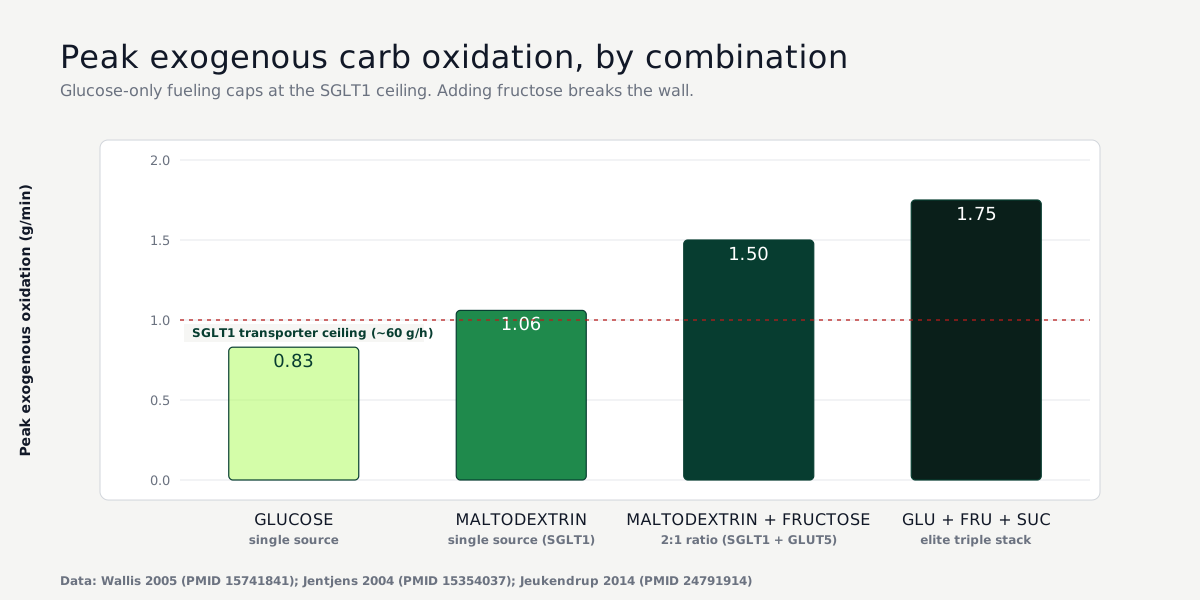
This is the load-bearing number in modern endurance nutrition. A single transportable carbohydrate (glucose, maltose, maltodextrin, sucrose-derived glucose, or starch) saturates the intestinal SGLT1 transporter at a peak exogenous oxidation rate of roughly 1.0 to 1.1 g per minute, or 60 to 66 g per hour. Past that point you can keep eating gels, but the carbohydrate sits in your gut, draws water in by osmosis, and turns into GI distress instead of fuel.
Jeukendrup is explicit in the 2014 Sports Medicine review: "A single carbohydrate source can be oxidized at rates up to approximately 60 g/h ... at such high ingestion rates [90 g/h] it must be a multiple transportable carbohydrate."
Direct evidence for maltodextrin specifically: Wallis et al. 2005 measured peak exogenous oxidation of 1.06 g/min on maltodextrin alone. The same study showed pairing maltodextrin with fructose pushed peak oxidation to 1.50 g/min, a 40 percent increase. Jentjens, Achten, and Jeukendrup 2004 layered glucose, fructose, and sucrose simultaneously and reached ~1.75 g/min, the highest oxidation rate documented in the field.
The mechanism: glucose enters the enterocyte via SGLT1; fructose uses GLUT5. Co-ingesting both recruits a parallel intestinal transporter, so total absorption can exceed the SGLT1 ceiling. There is no version of "more maltodextrin" that breaks this wall. The only way through is a different carbohydrate with a different transporter.
Maltodextrin vs alternatives
| Carbohydrate | Transporter | Osmolality (vs maltodextrin) | Practical verdict |
|---|---|---|---|
| Glucose / dextrose | SGLT1 | ~5-10× higher per equal energy | Same oxidation ceiling, worse GI tolerance and palatability at gel concentrations |
| Sucrose | Hydrolyzed at brush border to glucose + fructose | Higher than maltodextrin, lower than glucose | Acts as a built-in 1:1 multi-transportable carb; sweeter |
| Fructose alone | GLUT5 only | Comparable to glucose | Slow oxidation, GI distress above 25-30 g/h; useless as primary fuel |
| HBCD / Cluster Dextrin | SGLT1 (still glucose-derived) | Lower than DE-10 maltodextrin | Marginal osmolality and gastric-emptying advantage. Does NOT change the 60 g/h ceiling. 2-3× cost. See our cyclodextrin guide. |
Bottom line on alternatives: maltodextrin is rarely a bad pick. The product-design conversation isn't "should we replace maltodextrin?" - it's "what should we add to maltodextrin to push past 60 g/h?" The answer, almost universally, is fructose.
Practical doses for endurance
Lifted directly from the ACSM / Dietitians of Canada / Academy of Nutrition and Dietetics joint position stand (Thomas, Erdman, Burke 2016) and Jeukendrup's 2014 review:
| Race duration | Carb target | Maltodextrin alone enough? |
|---|---|---|
| Under 60 min | 0 to 30 g/h (mouth rinse can work) | Yes |
| 1 to 2 hours | up to 30 g/h | Yes |
| 2 to 3 hours | ~60 g/h | Yes (at the ceiling) |
| Over 2.5 hours | 90 g/h | No - needs fructose pairing |
| Ultra-endurance with trained gut | up to 120 g/h | No - multi-transportable required |
Composition for a 90 g/h target: ~60 g maltodextrin (or glucose) + ~30 g fructose per hour, the canonical 2:1 ratio. Currell and Jeukendrup 2008 showed glucose+fructose at 1.8 g/min produced an 8 percent faster time-trial finish vs isocaloric glucose alone.
For a typical 30 g endurance gel hitting the 2:1 target: ~20 g maltodextrin + ~10 g fructose. Many modern elite products tilt slightly more fructose-heavy (1:0.8 maltodextrin:fructose, supported by Rowlands et al. 2015), pushing the ceiling to 100-120 g/h.
Side effects and caveats
- GI distress above ~8 percent carbohydrate concentration in a drink. Murray et al. 1999 showed concentrated CHO beverages empty significantly slower than dilute drinks during cycling. Gels sidestep this by being chased with water; do not skip the chase.
- Glycemic index 85-105, higher than table sugar (~65). At rest this produces a sharp glucose and insulin spike. During exercise, working-muscle GLUT4 translocation clears glucose rapidly and the spike is blunted. Concerns about glycemic load apply to athletes taking gels outside training, not during racing.
- Dental caries with frequent gel use during long sessions. Rinse, don't sip-and-hold.
- No fibre, no micronutrients. Pure energy substrate. Not a meal replacement.
Practical bottom line
Maltodextrin is the right tool for what it does: dense, palatable, low-osmolality glucose delivery at low cost. If you race for under 2.5 hours, a maltodextrin-only product hitting 60 g/h is a complete answer. If you race longer, or target above 60 g/h for any duration, look for a product that explicitly pairs maltodextrin with fructose - the ratio (2:1 standard, 1:0.8 elite) on the label is your tell that the product is engineered for serious endurance work.
For the planner side: your race-day total carbohydrate target (computed from sport, duration, intensity, weight) is what matters most. The maltodextrin-vs-alternatives conversation is a second-order optimization. Get the gram total right first; pick the ratio second.
Research and references
The numbers and protocols in this guide rest on the following peer-reviewed sources. Verify the dose, the side-effect profile, and the contraindications against the primary literature, not against any single source.
- Vist GE, Maughan RJ. 1995. Journal of Physiology. The effect of osmolality and carbohydrate content on the rate of gastric emptying of liquids in man. PMID 7473216
- Jeukendrup AE. 2014. Sports Medicine. A step towards personalized sports nutrition: carbohydrate intake during exercise. PMID 24791914
- Wallis GA, Rowlands DS, Shaw C, Jentjens RLPG, Jeukendrup AE. 2005. Medicine & Science in Sports & Exercise. Oxidation of combined ingestion of maltodextrins and fructose during exercise. PMID 15741841
- Jentjens RLPG, Achten J, Jeukendrup AE. 2004. Medicine & Science in Sports & Exercise. High oxidation rates from combined carbohydrates ingested during exercise. PMID 15354037
- Jentjens RLPG, Moseley L, Waring RH, Harding LK, Jeukendrup AE. 2004. Journal of Applied Physiology. Oxidation of combined ingestion of glucose and fructose during exercise. PMID 14657042
- Currell K, Jeukendrup AE. 2008. Medicine & Science in Sports & Exercise. Superior endurance performance with ingestion of multiple transportable carbohydrates. PMID 18202575
- Furuyashiki T, Tanimoto H, Yokoyama Y, et al. 2014. Bioscience, Biotechnology, and Biochemistry. Effects of ingesting highly branched cyclic dextrin during endurance exercise on rating of perceived exertion and blood components associated with energy metabolism. PMID 25080121
- Thomas DT, Erdman KA, Burke LM. 2016. Medicine & Science in Sports & Exercise. American College of Sports Medicine Joint Position Statement. Nutrition and Athletic Performance. PMID 26891166
- Murray R, Bartoli W, Stofan J, Horn M, Eddy D. 1999. International Journal of Sport Nutrition. A comparison of the gastric emptying characteristics of selected sports drinks. PMID 10477362
- Rowlands DS, Houltham S, Musa-Veloso K, Brown F, Paulionis L, Bailey D. 2015. Sports Medicine. Fructose-glucose composite carbohydrates and endurance performance: critical review and future perspectives. PMID 26373645