
Guide
Sodium bicarbonate for endurance athletes
Educational content, not medical advice. Sodium bicarbonate is contraindicated in kidney disease, uncontrolled hypertension, congestive heart failure, and pregnancy. The GI symptoms can be severe; never debut a bicarb protocol on race day.
Sodium bicarbonate (baking soda, NaHCO3) is an extracellular buffer: roughly 0.3 g per kg taken 60-180 minutes pre-event raises blood bicarbonate and delays the acidosis that ends efforts in the 30-second to 12-minute window, worth about 1.7 percent performance. The cost is severe GI distress in about half of athletes at effective doses.
The honest caveat, up front
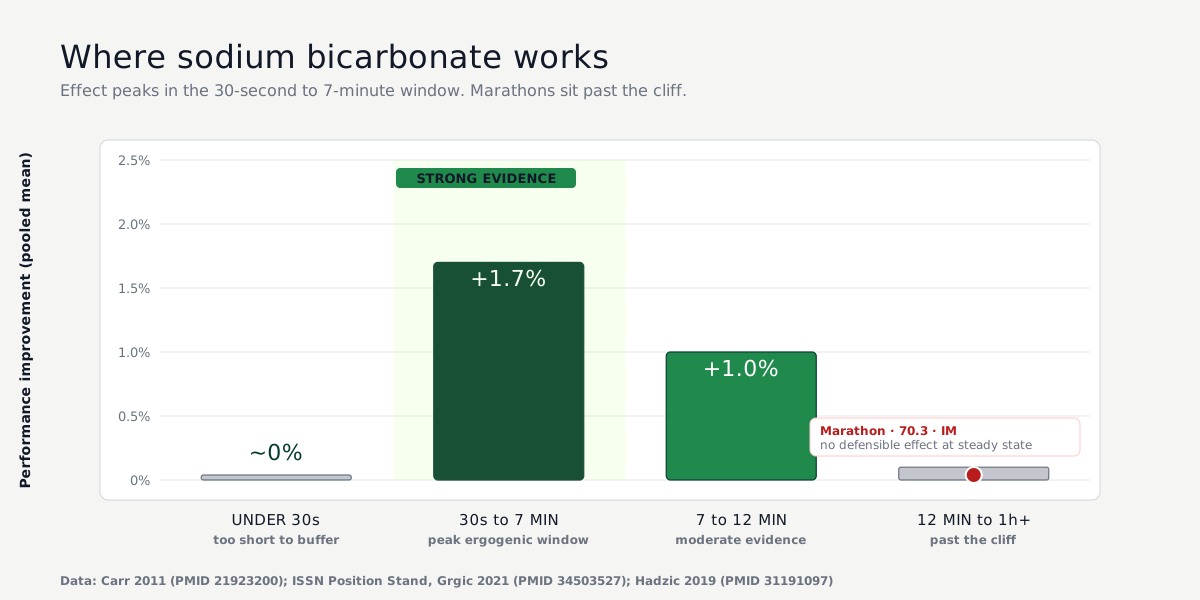
Sodium bicarbonate is one of the cheapest, oldest, and best-evidenced ergogenic aids in sports nutrition. The ISSN position stand (Grgic et al. 2021) gives it the highest tier of evidence quality for events in the 30-second to 12-minute window: roughly a 1.7 percent performance gain at a 0.3 g/kg dose taken 60-180 minutes pre-event. That number compares favorably with caffeine, with beta-alanine, with creatine for repeat-sprint work, and with nearly every legal pre-race supplement on the market for short, high-intensity efforts. So why does almost no marathoner take it? Because at the dose that works, about half of athletes get severe GI distress: nausea, bloating, urgency, diarrhea, vomiting. For a 6-hour Ironman that is not a tradeoff anyone makes. For a 2-hour marathon it's a maybe. For a 30-minute hill climb or a 90-second criterium attack it can be a game-changer. And as of 2023, the Maurten Bicarb System has changed the GI calculus in a way that's worth knowing about.
Our race-day fueling planner at planner.nutrifinder.it does not currently schedule sodium bicarbonate, because for most pure endurance events there's nothing to schedule. The rest of this guide is the honest read on when it earns its place and when it doesn't.
What it is and how it works
Sodium bicarbonate (NaHCO3) is baking soda - a cheap, ubiquitous alkaline salt. Taken orally 60-180 minutes before an event, it raises plasma bicarbonate concentration ([HCO3-]) and extracellular pH. The elevated extracellular buffer creates a steeper gradient that pulls hydrogen ions (H+) out of working muscle into the bloodstream, where they can be cleared. By delaying intramuscular acidosis, bicarbonate postpones the pH-driven contractile failure that ends short high-intensity efforts.
This mechanism is complementary, not redundant, with beta-alanine. Bicarbonate buffers H+ extracellularly (in blood). Beta-alanine raises carnosine which buffers H+ intracellularly (inside the muscle cell). The two work on opposite sides of the membrane, and the evidence supports additive effects when stacked (Saunders 2013, Curran-Bowen 2024). The duo is sometimes called "bicarb + BA stack" in performance literature; it's the closest thing to a proven legal ergogenic combination for short anaerobic efforts.
Where the evidence is strong
The duration cutoff is the headline, just like for beta-alanine. Carr, Hopkins & Gore 2011 ran a meta-analysis of 59 studies (188 observations) of NaHCO3 in high-intensity exercise. The pooled effect was ~1.7 percent improvement in mean power, concentrated in events lasting 30 seconds to 7 minutes. Hadzic et al. 2019 stratified 35 RCTs by event duration and confirmed that 4-minute and shorter efforts respond most consistently, with effects becoming inconsistent past 4 minutes.
The ISSN position stand (Grgic et al. 2021, the consensus document) summarizes the evidence-tiered windows:
| Event window | Evidence for bicarb |
|---|---|
| Under 30 seconds | No defensible effect (insufficient buffering window) |
| 30 seconds to 7 minutes | Strong evidence, ~1.7% gain at 0.3 g/kg |
| 7 to 12 minutes | Moderate evidence, smaller effect |
| Over 12 minutes continuous | Weak to no evidence in pooled data |
| Repeat-sprint and combat sports | Position stand explicitly endorses (judo, BJJ, intermittent team-sport drills) |
Real-world events that sit in the strong-evidence window:
- 800-3000 m running
- 200-1500 m swimming
- 4 km cycling TT, kilo, BMX
- Rowing 2 km
- Track sprint repeats
The endurance angle, honestly
For pure steady-state endurance racing (marathon, half-Ironman, full Ironman, century, ultra-distance at threshold or below), there is no defensible ergogenic claim. Carr 2011 found no significant effect past ~10-12 minutes in the pooled data. The mechanism doesn't apply: H+ accumulation is not rate-limiting at sub-threshold aerobic pace. Glycogen depletion, thermoregulation, GI tolerance, and hydration are.
But many "endurance" events embed 1-7 minute anaerobic surges where bicarb could matter:
- Cyclocross: constant 60-180 second efforts above threshold
- XC mountain biking: punchy climbs, technical descents requiring repeated all-out efforts
- Hilly road racing: categorized climbs of 3-7 minutes
- Criterium and breakaway racing: surge efforts, sprint finishes
- Track endurance (3 km, 5 km, 10 km on track)
For any of these, the Carr-Hopkins meta-analytic effect (~1.7%, possibly up to 2.5% in optimally responsive subjects) is meaningful at the pointy end of competition.
There is no published RCT specifically testing bicarbonate for marathon kick (the closing 1500 m of a 2:30 marathon, for example). The mechanism is plausibly applicable. The evidence is not yet there.
Dose and protocol
Acute (the standard protocol):
- Dose: 0.2 to 0.3 g/kg body weight of NaHCO3
- Timing: 60 to 180 minutes pre-event
- ISSN consensus allows up to 0.5 g/kg, but 0.3 g/kg is the most-replicated dose
For a 70 kg athlete at 0.3 g/kg: 21 g of NaHCO3, which contains about 5.7 g of sodium.
Chronic loading (newer protocol, less evidence):
- 0.4 to 0.5 g/kg per day, split into 3-4 doses
- Loaded for 3-7 days pre-event
- Raises baseline plasma [HCO3-]
- Avoids the acute race-day GI exposure
- Evidence promising but smaller body of work than the acute protocol
Individual response variability is enormous. Heibel et al. 2018 identified six modifiers: absolute change in plasma [HCO3-], timing of peak, exercise task, monocarboxylate transporter activity, training status, and side-effect profile. Peak plasma bicarbonate occurs 60-180 minutes post-ingestion and is highly individual. Test in training, ideally with a coach or sports scientist tracking your individual peak window.
The GI problem (the real blocker for endurance)
At 0.3 g/kg in standard powder or capsule form, approximately 50 percent of athletes report meaningful GI distress: nausea, bloating, urgency, diarrhea, vomiting. For a 90-minute pre-race window where you're trying to keep your last carb meal down, "you have a 50% chance of vomiting" is not a tradeoff most endurance athletes will make for a 1.7% performance gain.
Three mitigation strategies, in order of evidence:
1. Maurten Bicarb System (2023). Encapsulates NaHCO3 in hydrogel-coated mini-tablets that bypass stomach acid degradation and dissolve in the small intestine. Gough & Sparks 2024 (Sports Med Open) found peak plasma [HCO3-] reached 0.95 mmol/L higher and 38 minutes earlier vs equivalent capsule dose, with aggregated GI discomfort reduced by 79 arbitrary units - "almost eliminated" in the trial cohort. Independent replication is still thin but the mechanism is sound. ~€20-25 per dose; not cheap, but if you can keep it down, it works.
2. Split-dose with carbohydrate-containing meal. Take the total dose in 3-4 servings over 60-90 minutes, alongside a moderate carb meal. Reduces peak gastric NaHCO3 concentration. Older protocol, partially effective, free.
3. Sodium citrate substitute. Alternative alkalizing agent. Urwin et al. 2019 showed sodium citrate raises plasma [HCO3-] with milder GI symptoms but a weaker ergogenic signal. Useful for athletes who cannot tolerate bicarb at all.
Side effects beyond GI
- Sodium load: 0.3 g/kg NaHCO3 in a 70 kg athlete = ~5.7 g of sodium (NaHCO3 is 27% sodium by mass). Compounds with race-day sweat losses, can taste bitter, can prompt thirst. Flag for sodium-sensitive athletes and for hot-weather events where sodium budget matters.
- Transient blood pressure elevation: short-term, clinically insignificant in healthy adults.
- Contraindications: kidney disease (impaired excretion), uncontrolled hypertension, congestive heart failure, pregnancy.
The bicarb + beta-alanine stack
For athletes targeting 1-7 minute all-out efforts (which is the strong-evidence window for both supplements), the combination is well-evidenced. Saunders et al. 2013 demonstrated additive effects on upper-body intermittent performance. Curran-Bowen et al. 2024 showed the combination produced significant performance benefit (p=0.02) where neither alone reached significance in the same pool.
Protocol for serious 1-7 minute event athletes: load beta-alanine for 4-12 weeks pre-event (see our beta-alanine guide), then add acute sodium bicarbonate 90 minutes pre-event. For surge-heavy endurance racing (cyclocross, MTB, hilly road) the stack is equally applicable.
Practical bottom line
| Your event | Bicarb verdict |
|---|---|
| 800-3000 m run / 200-1500 m swim / 4 km TT / kilo / rowing 2 km | Yes, high-leverage. Test 0.3 g/kg + Maurten Bicarb System protocol in training. |
| Cyclocross, XC MTB, hilly criterium, surge-heavy road racing | Maybe, test in training. The anaerobic-surge windows compound across the race. |
| Track endurance (5 km, 10 km road) with strong closing kick | Maybe. Defensible n-of-1 trial. |
| Marathon kick (closing 1500 m of a 2:30 marathon) | Mechanistically plausible, evidence not yet there. |
| Pure steady-state long endurance (marathon at sub-threshold, 70.3, IM, century) | No. Save the budget for carbs and electrolytes. |
| Any event, never tried bicarb before | Do not debut on race day. Trial with Maurten Bicarb System at 90-120 min before a hard training session, log GI score and perceived effort. |
Research and references
The numbers and protocols in this guide rest on the following peer-reviewed sources. Verify the dose, the side-effect profile, and the contraindications against the primary literature, not against any single source.
- Grgic J, Pedisic Z, Saunders B, et al. 2021. Journal of the International Society of Sports Nutrition. International Society of Sports Nutrition position stand: sodium bicarbonate and exercise performance. PMID 34503527
- Carr AJ, Hopkins WG, Gore CJ. 2011. Sports Medicine. Effects of acute alkalosis and acidosis on performance: a meta-analysis. PMID 21923200
- Peart DJ, Siegler JC, Vince RV. 2012. Journal of Strength and Conditioning Research. Practical recommendations for coaches and athletes: a meta-analysis of sodium bicarbonate use for athletic performance. PMID 22505127
- Hadzic M, Eckstein ML, Schugardt M. 2019. Journal of Sports Science and Medicine. The impact of sodium bicarbonate on performance in response to exercise duration: a systematic review. PMID 31191097
- Heibel AB, Perim PHL, Oliveira LF, McNaughton LR, Saunders B. 2018. Frontiers in Nutrition. Time to optimize supplementation: modifying factors influencing individual responses to extracellular buffering agents. PMID 29868599
- Saunders B, Sale C, Harris RC, Sale C. 2013. Journal of the International Society of Sports Nutrition. Effect of sodium bicarbonate and beta-alanine on upper-body intermittent performance. PMID 23595205
- Curran-Bowen T, et al. 2024. Biology of Sport. Combined effects of sodium bicarbonate and beta-alanine supplementation on exercise performance: a meta-analysis. PMID 38952910
- Gough LA, Sparks SA. 2024. Sports Medicine - Open. Effects of a carbohydrate hydrogel system for delivery of sodium bicarbonate mini-tablets on acid-base buffering and gastrointestinal symptoms. PMID 38356036
- Urwin CS, Dwyer DB, Carr AJ. 2019. Journal of Human Kinetics. Sodium citrate as an ergogenic aid. PMID 30687422