
Guide
Electrolyte tabs vs powders, how to choose
Educational content, not medical advice. Individual tolerance and sodium needs vary; persistent cramps, dizziness, or any race-related medical concern should be reviewed by a sports dietitian or doctor.
Electrolyte tabs and powders are drink-mix products that replace the sodium (and secondarily potassium and magnesium) lost in sweat. Tabs are almost always near-zero-carb, hydration-only products; powders usually add carbohydrate and act as fuel too, which is the real dividing line between the formats.
The tabs-versus-powders question gets argued as if it were about taste or convenience. It is not. Once you look at what is actually in the sachets and tubes, the two formats split on one variable that decides everything else: carbohydrate. An electrolyte tab is almost always a pure hydration product, near zero calories. A powder is usually hydration plus fuel. Pick the wrong one and you either miss carbs you needed or swallow carbs you did not want. This guide is how to choose on the numbers, not the marketing.
If you want to filter as you read, both formats have their own catalogue: electrolyte tabs and electrolyte powders, each sortable by sodium, magnesium, potassium, and price.
Sodium is a wash, so stop choosing on it
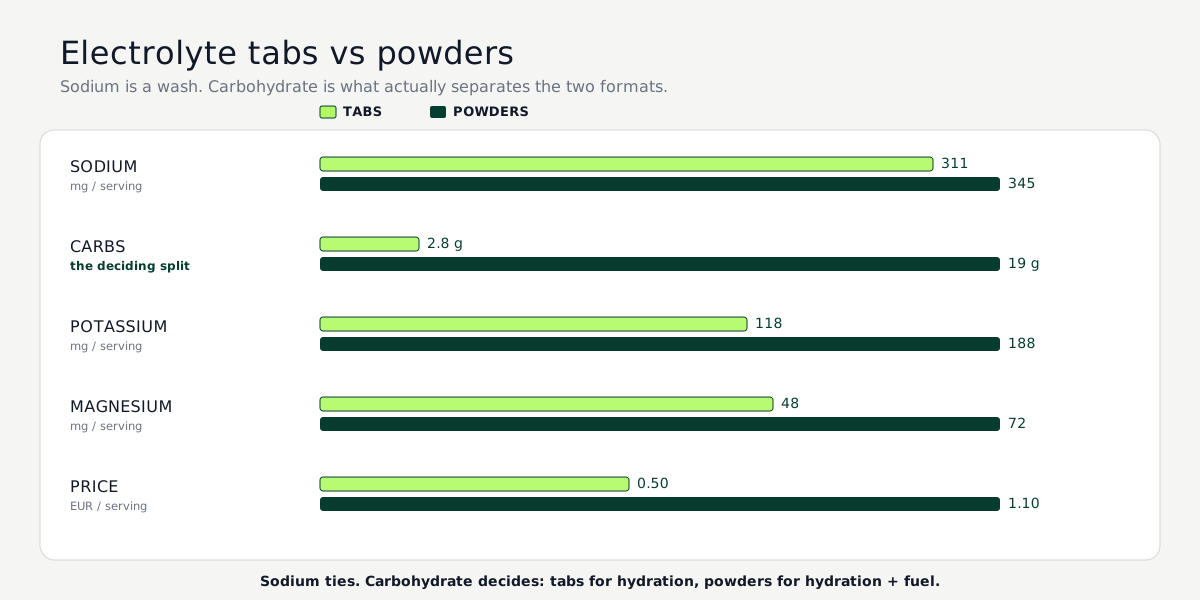
The headline number on every electrolyte product is sodium, and it is the reason most people reach for one. But across our catalogue the two formats land in almost the same place: tabs average about 310 mg of sodium per serving, powders about 345 mg, and both span from near zero to over 1,000 mg in the high-sodium endurance options. In other words, sodium does not tell tabs and powders apart. Whatever your sodium target is, you can hit it in either format.
What matters is that you know your number before you shop. Sodium need is driven by how much you sweat and how salty that sweat is, and the spread between athletes is enormous. The sweat and sodium guide walks through estimating it. Two guardrails worth stating plainly: chasing ever-higher sodium does not prevent cramps on its own, and drinking large volumes of low-sodium fluid is the classic route to exercise-associated hyponatremia. More is not safer; matched is safer.
Carbohydrate is the line that actually divides them
Here is the split that should drive your choice. In our catalogue, nearly all electrolyte tabs are effectively carb-free (29 of 33 sit under 2 g per serving), while most powders carry carbohydrate, averaging around 19 g per serving and climbing to the high 40s. That is not an accident of branding; it reflects what each format is for.
- Tabs are hydration, decoupled from fuel. You drop one in a bottle and get sodium and water with essentially no calories. That is exactly what you want when you are already fueling with gels or chews and just need to replace salt and fluid without doubling up on carbs.
- Powders are often a hydration-and-fuel hybrid. A carbohydrate powder gives you electrolytes and energy in the same bottle, which simplifies long efforts where carrying separate fuel is a hassle. The trade is less control: the carbs come whether you wanted them in that bottle or not.
The practical rule: if your carbs are already handled elsewhere, choose tabs and keep hydration calorie-free. If you want fuel and electrolytes in one bottle, choose a powder and count its carbs toward your hourly target. Do not let an electrolyte powder secretly push you over your carb plan; read its carbohydrate number the same way you would read a gel. See the carbs-per-hour guide for the target it has to fit inside.
Magnesium and potassium: powders have more headroom
Sodium does the heavy lifting in sweat replacement, but the other two electrolytes are where powders pull ahead. In the catalogue, powders average roughly 188 mg of potassium and 72 mg of magnesium per serving, against about 118 mg and 48 mg for tabs. Neither format is wrong, but if you are someone who specifically wants meaningful magnesium and potassium (longer events, a history of cramping, heavy sweat losses), powders give you more to work with. If you just need sodium and fluid, the tab's lighter mineral load is fine and keeps things simple.
If that headroom is what you are shopping for, the rankings make the spread concrete: powders by magnesium, powders by potassium, and the same two for tabs by magnesium and tabs by potassium.
Dose: fixed and foolproof, or flexible and fiddly
This is the logistics axis, and it is genuinely a preference call.
- Tabs are a fixed dose. One tab, one known amount of sodium, no measuring. They travel in a tube in a jersey pocket, dissolve in any bottle, and there is nothing to spill or scoop. The cost of that simplicity is rigidity: you get the dose the tab was built around, and adjusting means half-tabs or doubling up.
- Powders are flexible but need handling. You can scoop more or less to dial concentration to the conditions, which is powerful on a hot day or for a heavy sweater. The cost is a scoop, a bulkier container, and more room for error in the dark at an aid station.
If you value "drop it in and forget it," tabs win. If you value tuning your mix to the day, powders win.
Price: tabs are the cheaper habit
Electrolytes are something you use in training as well as racing, so cost per serving compounds. Tabs average about 0.50 EUR per serving in our catalogue; powders about 1.10 EUR, reflecting the extra carbohydrate and the larger serving. That does not make powders overpriced (you are buying fuel as well as electrolytes), but if you are after pure hydration, paying powder prices for carbs you do not want is the most common quiet waste in an endurance athlete's supplement bill. Sort either catalogue by price to see the spread.
Choose by use case
| Your situation | Format | Why |
|---|---|---|
| Fueling with gels/chews, just need salt + fluid | Tabs | Keeps hydration calorie-free, no double carbs |
| Want electrolytes and energy in one bottle | Powder | Hydration plus fuel, fewer things to carry |
| Hot day, heavy or salty sweater | Either, high-sodium | Match sodium to losses; powder if you also want to dial concentration |
| Everyday training hydration | Tabs | Cheapest per serving, simplest to use |
| Long course (4 h plus) | Powder, plus tabs as backup | Carbs in the bottle, tabs to top up sodium without more carbs |
A three-step buying process
- Get your sodium-per-hour number from the sweat and sodium guide. It applies to both formats equally.
- Decide hydration-only or hydration-plus-fuel. If your carbs are covered, filter electrolyte tabs to your sodium range. If you want fuel in the bottle, filter electrolyte powders and read the carbohydrate column as part of your hourly carb plan.
- Sort by price and check potassium and magnesium if cramping is your concern. Then test the product in training before you race it, exactly as you would a gel.
Get a plan for your race
The bands above are the general rules. To turn them into sodium, fluid, and carbohydrate targets for your specific race and conditions, open the NutriFinder planner. Enter your weight, sport, distance, and the heat; it returns the numbers, and you can fill them with tabs, powders, or a mix. The planner is free and needs no signup for the first plan.
Research and references
The thresholds in this guide rest on the following peer-reviewed sources. Verify dose, side-effect profile, and contraindications against the primary literature.
- Sawka MN, Burke LM, Eichner ER, Maughan RJ, Montain SJ, Stachenfeld NS. 2007. Medicine & Science in Sports & Exercise. American College of Sports Medicine position stand: Exercise and fluid replacement. PMID 17277604
- Hew-Butler T, Loi V, Pani A, Rosner MH. 2015. British Journal of Sports Medicine. Statement of the 3rd International Exercise-Associated Hyponatremia Consensus Development Conference. PMID 26227507
- Baker LB. 2017. Sports Medicine. Sweating rate and sweat sodium concentration in athletes: a review of methodology and intra/interindividual variability. PMID 28332116
- Shirreffs SM, Taylor AJ, Leiper JB, Maughan RJ. 1996. Medicine & Science in Sports & Exercise. Post-exercise rehydration in man: effects of volume consumed and drink sodium content. PMID 8897383
- Maughan RJ, Owen JH, Shirreffs SM, Leiper JB. 1994. European Journal of Applied Physiology. Post-exercise rehydration in man: effects of electrolyte addition to ingested fluids. PMID 8001531