
Guide
Heat adaptation for endurance runners
Educational content, not medical advice. Heat acclimation is contraindicated during active illness or fever; athletes with cardiovascular disease, pregnancy, or a history of exertional heat illness should consult a doctor before starting a heat protocol.
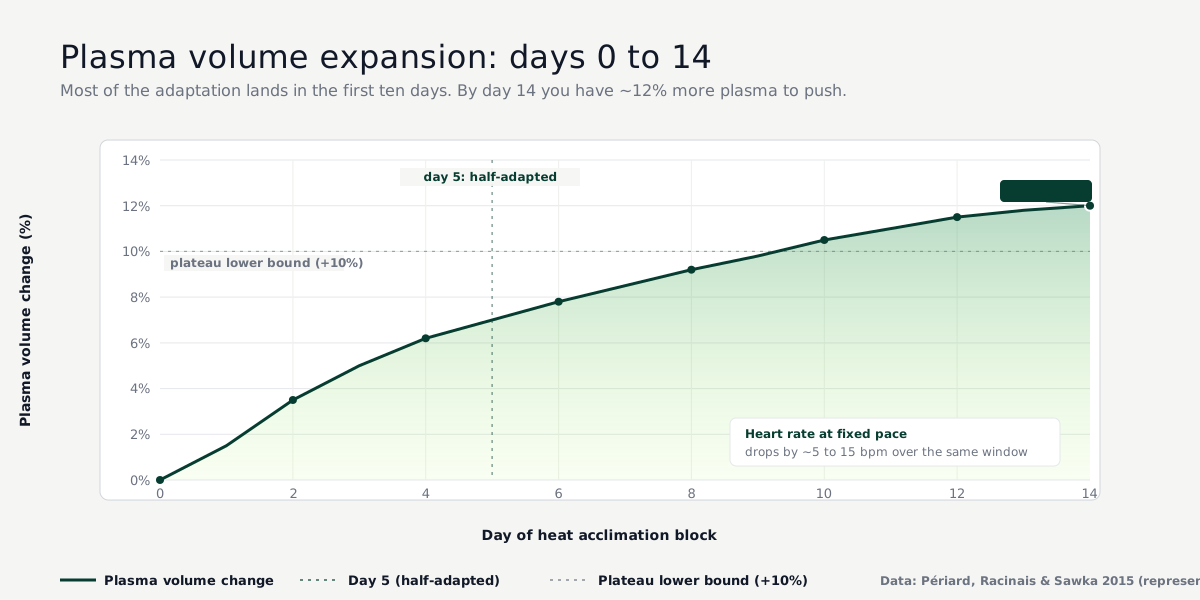
Heat acclimation is the physiological adaptation laid down by 10 to 14 days of deliberate training in the heat: plasma volume expands by roughly 12 percent and heart rate at a fixed workload drops by about 10 beats per minute, closing most of the pace gap between cool and hot conditions.
The honest caveat, up front
If it's 35°C outside and you went for a run yesterday and felt like you were dragging a tire uphill, you are not unfit. You are unacclimatized. There is a wide gap between the pace your fitness can produce in 12°C and the pace the same fitness can produce in 32°C, and that gap is mostly closed by a specific physiological adaptation that takes 10 to 14 days to lay down. Italian summers, Spanish summers, Greek summers, southern French summers: the race is hotter than your training was, every single year, and most amateur athletes show up on the start line with zero deliberate heat work done. This guide is the protocol.
Our race-day fueling planner at planner.nutrifinder.it already nudges hydration and sodium targets upward when you flag a hot race. The rest of this guide is the why behind that nudge, plus the protocol you should run before the start line, not on it.
Why heat ruins pace, in one diagram
When you run at a given intensity, your muscles need blood and your skin needs blood. In cool weather skin gets a small share and muscles get the rest. In hot weather the skin's share has to go up - that's how you dump heat - so the heart has to push more total volume to keep the muscle share intact. Heart rate climbs at the same pace. We call that cardiac drift, and in 35°C heat an untrained-for-heat athlete can see their heart rate climb 15 to 25 bpm over the course of a one-hour effort at fixed pace.
There's a second problem stacked on top. As you sweat, plasma volume falls. Less plasma means less stroke volume per beat, which means heart rate has to climb further to push the same cardiac output, which means even more thermal load, which means even more skin blood flow. The spiral is tight enough that by hour two of a hot race, a lot of athletes are running at threshold HR for marathon pace - and that's how the wheels come off.
A third, less obvious problem: gut blood flow drops in the heat for the same reason - blood is shunted to the skin. That's why GI distress is more common in hot races, and why your carb-per-hour ceiling drops by 10 to 20% above 28°C if you haven't trained your gut in the heat specifically. That's covered in our gut-training guide; heat acclimation makes the gut-training adaptation more durable.
What heat acclimation actually changes
Périard, Racinais & Sawka's 2015 review remains the cleanest summary of the adaptations. Over 10 to 14 days of consistent heat exposure, four things shift:
| Adaptation | Magnitude | What it does for you |
|---|---|---|
| Plasma volume expansion | +10 to 12% | More stroke volume per beat, lower HR at given pace, more thermal "buffer" |
| Earlier sweat onset | ~0.3 to 0.5°C lower core temp threshold | You start cooling sooner, so core temp climbs slower |
| Higher sweat rate | +10 to 20% | More evaporative cooling capacity (hydration ceiling matters more) |
| Lower sweat sodium | -20 to 50% | You lose less sodium per liter, so the same hydration plan replaces more of what you lost |
| Lower HR at fixed workload | ~5 to 10 bpm | Pace at a given HR comes back, RPE drops |
The headline number is the plasma volume one. Adding 350 to 500 mL of plasma to your circulating volume (depending on body size) is roughly the equivalent of carrying a small water bottle inside your veins, except your heart doesn't have to push it - it's already there at the start of every effort. That extra volume is what unlocks every other adaptation downstream.
The protocol: 10 to 14 days, 60 to 90 minutes daily
The simplest version of the evidence-based protocol is one I'll call continuous active heat acclimation, after the standard lab protocol used in most of the underlying studies (Lorenzo et al. 2010, Garrett et al. 2014):
- Sessions per day: 1
- Duration: 60 to 90 minutes
- Intensity: moderate, ~50 to 65% VO2max, or RPE 6 to 7 out of 10
- Environment: 32 to 40°C, ideally with some humidity (40 to 60%)
- Frequency: 5 to 7 days per week, for 10 to 14 consecutive days
- Hydration during: 400 to 800 mL/h, sodium 300 to 600 mg/L (see sweat-sodium guide)
If you live somewhere genuinely hot, this is "go for an easy run in the early afternoon." If you don't, you have three workable substitutes:
- Overdress. Layer up so you trap heat against your skin. A long-sleeve top plus a windbreaker over an already-warm day will get core temp into the heat-acclimation zone within 20 minutes. Less reliable than ambient heat, but free.
- Sauna after training. Stanley et al. (2015) and Scoon et al. (2007) both showed plasma volume expansion of 7 to 18% from 30 minutes of sauna (~85 to 90°C dry) immediately after normal training, performed 4 to 6 times per week for 10 to 14 days. This is the cleanest protocol for athletes who can't reliably train in heat: keep your normal training, add the sauna as a post-session top-up.
- Hot bath. Zurawlew et al. (2018) showed that a 40°C bath for 40 minutes after a 40-minute easy run produced HR and core-temp adaptations similar to ambient heat exposure within 6 days. Good fit for athletes with a tub but no sauna access.
The mistake to avoid is interval work in the heat. Hard intervals push core temp through dangerous territory fast and produce less adaptation per unit of strain than easy continuous work. Save the quality sessions for cooler parts of the day and use the heat for endurance volume.
Timeline relative to your A-race
The adaptation timeline is asymmetric in an important way: it builds in 10 to 14 days and decays in roughly 1 to 2 weeks of complete cessation. Daanen et al. (2011) showed that most of the adaptation is retained for 2 weeks if you continue 1 to 2 heat exposures per week as maintenance, and roughly half is retained at 4 weeks of complete cessation.
The practical pattern for a goal race:
- 3 weeks out (A-race minus 21 days): start the 10 to 14 day block. By day 5 you're already half-adapted. By day 14 the curve has plateaued.
- 2 weeks out (A-race minus 14 to 7 days): drop to 2 to 3 heat exposures per week as maintenance. These can be shorter (40 to 60 minutes) and lower intensity.
- Race week: 1 short heat exposure 4 to 5 days out, then taper the heat exposure with the rest of your taper. You do not need to feel "hot" the day before the race - the adaptation is in the plasma volume and the sweat glands, not in your immediate thermal state.
This slots in alongside the broader pre-race window covered in our race-day timeline guide. The carb-load, the gut-trained nutrition plan, and the heat-adapted physiology compound: each one is a 1 to 3% performance edge on its own, all three together are a different race.
What to track
You don't need a lab. Three numbers, taken at the same time of day under similar conditions:
- Resting morning HR. Will drift down 3 to 8 bpm over the protocol as plasma volume expands.
- HR at a fixed easy pace (e.g., a 5 km loop you run every other day). Will drift down 5 to 15 bpm over the protocol.
- Bodyweight before and after each heat session. The delta is your sweat loss for that session (subtract any fluid taken in). Over the protocol, expect sweat loss per session to rise by 10 to 20%, not fall. That's not a problem - it's the adaptation working. Adjust your in-session hydration upward to match.
If you have a more involved setup (chest strap + GPS, or a sports lab nearby), the gold-standard signal is lower core temp at the same workload, but resting HR and fixed-pace HR cover 90% of what you need to know.
How heat status changes your race-day hydration plan
This is the part that flows through to our sweat-sodium guide. A heat-adapted athlete sweats more per hour but loses less sodium per liter. Net effect: you need more total fluid on race day than an unadapted version of yourself would, but each litre of that fluid is replacing less sodium than it would have. The planner's hydration model assumes you've done the work to be adapted. If you haven't, two things break: you drink to your computed target and end up over-hydrated (because your unacclimatized sweat rate is lower than the model expects), and your sweat is saltier so the sodium target undershoots.
Practical rule for an unacclimatized athlete heading into a hot race anyway: cap fluid at 600 mL/h regardless of what the planner says, and pre-load with 500 mg of sodium 60 to 90 minutes before the gun. It won't be optimal. It will keep you on your feet.
Heat racing raises both halves of the problem, fluid and sodium, so it is worth picking products on the second one deliberately: electrolyte tabs ranked by sodium and powders ranked by sodium are the shortest route to the saltier end of the catalogue.
When not to acclimate
A few specific cases where the protocol is the wrong move:
- Active illness or fever. Your thermoregulation is already disrupted. Wait until you're symptom-free for 48 hours.
- Within 72 hours of a hard race or key workout. Heat acclimation sessions are an additional stressor; stack them on rest days or easy days, not adjacent to your hardest work.
- The first time you've ever done it, two weeks before a goal race. The adaptation works, but the first 3 to 5 days are unpleasant and most athletes underperform their easy sessions. Don't introduce it inside a taper. Schedule the block earlier.
- No way to monitor. If you can't access fluids, can't bail out, or are training alone in genuinely dangerous heat (>38°C with high humidity), the safety margin is too thin. Use the sauna or hot-bath protocol instead.
The bottom line
If your A-race is in July or August, in Italy or Spain or Greece or anywhere south of the Alps, the single highest-leverage thing you can add to your training this month is 10 to 14 days of deliberate heat exposure. The protocol is well-defined, the adaptations are large (~12% plasma volume expansion, 5 to 15 bpm HR reduction at fixed pace, 20 to 50% sweat sodium reduction), and the half-life is long enough that one focused block 2 to 3 weeks out covers race day. Skipping it doesn't make you slower in the abstract - it makes you slower in the specific conditions you'll race in. That's the version that costs PRs.
Plug your race weather and weight into the NutriFinder planner and it'll give you a hydration and sodium plan that assumes you've done the heat work. Then go do the heat work.
Research and references
The numbers and protocols in this guide rest on the following peer-reviewed sources. Verify the dose, the side-effect profile, and the contraindications against the primary literature, not against any single source.
- Périard JD, Racinais S, Sawka MN. 2015. Scandinavian Journal of Medicine & Science in Sports. Adaptations and mechanisms of human heat acclimation: applications for competitive athletes and sports. PMID 25943654
- Lorenzo S, Halliwill JR, Sawka MN, Minson CT. 2010. Journal of Applied Physiology. Heat acclimation improves exercise performance. PMID 20724560
- Garrett AT, Goosens NG, Rehrer NJ, et al. 2014. American Journal of Human Biology. Short-term heat acclimation is effective and may be enhanced rather than impaired by dehydration. PMID 24469986
- Stanley J, Halliday A, D'Auria S, Buchheit M, Leicht AS. 2015. European Journal of Applied Physiology. Effect of sauna-based heat acclimation on plasma volume and heart rate variability. PMID 25432420
- Scoon GS, Hopkins WG, Mayhew S, Cotter JD. 2007. Journal of Science and Medicine in Sport. Effect of post-exercise sauna bathing on the endurance performance of competitive male runners. PMID 16877041
- Zurawlew MJ, Mee JA, Walsh NP. 2018. Frontiers in Physiology. Post-exercise hot water immersion elicits heat acclimation adaptations in endurance trained and recreationally active individuals. PMID 30618833
- Daanen HAM, Jonkman AG, Layden JD, Linnane DM, Weller AS. 2011. International Journal of Sports Medicine. Optimising the acquisition and retention of heat acclimation. PMID 22052034