
Guide
Caffeine for endurance, by dose and timing
Educational content, not medical advice. Individual sensitivity varies; pregnant athletes and those with cardiovascular conditions or anxiety disorders should consult a doctor before using caffeine for performance.
Caffeine is the best-evidenced legal ergogenic aid in endurance sport: at 3 to 6 mg per kg of bodyweight, taken 45 to 60 minutes before it is needed, it reduces perceived effort and improves performance by roughly 2 to 4 percent. The effective dose scales with the athlete's bodyweight, not with the product.
The honest caveat, up front
Caffeine is one of the few endurance ergogenics with strong evidence behind it (3-6 mg/kg, 45-60 minutes before start - Guest et al., ISSN 2021). But ~50% of athletes are genetic slow metabolizers who see little or no benefit, and a smaller subset see jitters or GI distress at high doses. Test your full caffeine protocol in at least two hard training sessions before race day. If you drink coffee daily, you do not need to taper - habitual users still benefit on race day (Pickering & Kiely 2018).
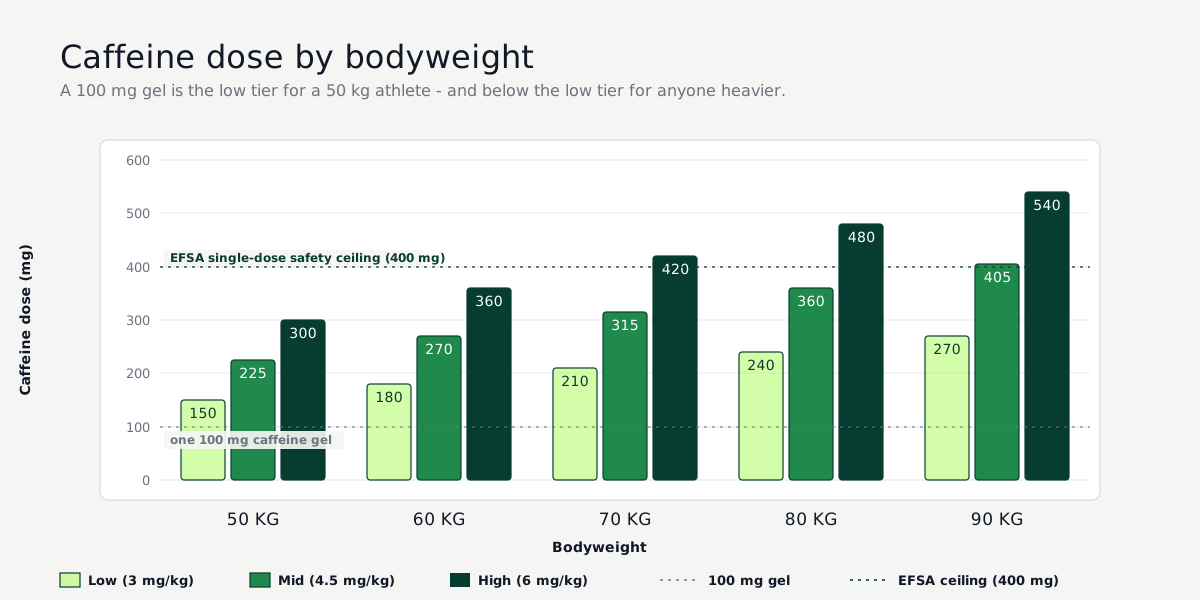
Ask ten endurance athletes how much caffeine they took on race day and most will answer in gels: "I had two caffeinated ones." That's a useful number for shopping and a useless one for performance. Caffeine dose is per kilogram of bodyweight, not per gel. A 100 mg caffeinated gel is roughly half a dose for a 75 kg athlete at the mid tier of the proven ergogenic band, and a full overdose for a 50 kg athlete at the high tier. The product label tells you what's in the wrapper. It does not tell you what's right for your race.
Our race-day fueling planner at planner.nutrifinder.it does the maths from your weight and event and schedules the caffeine windows automatically. The rest of this guide is the why behind the doses and the timing it picks.
The dose is per kilogram, not per gel
The IOC consensus on dietary supplements and the ACSM joint position stand both publish the same ergogenic range for caffeine: 3 to 6 mg per kg of bodyweight, taken before or during exercise. Below 2 mg/kg the effect is small and noisy. Above 9 mg/kg the side-effect load (jitters, GI distress, focus loss, elevated heart rate) tends to outweigh the benefit. The sweet spot is narrow, and it scales with the size of the athlete.
| Bodyweight | Low tier (3 mg/kg) | Mid tier (4-5 mg/kg) | High tier (6 mg/kg) |
|---|---|---|---|
| 50 kg | 150 mg | 200-250 mg | 300 mg |
| 60 kg | 180 mg | 240-300 mg | 360 mg |
| 70 kg | 210 mg | 280-350 mg | 420 mg |
| 80 kg | 240 mg | 320-400 mg | 480 mg |
| 90 kg | 270 mg | 360-450 mg | 540 mg |
Read across one row. The same athlete moves through 150 mg to 300 mg as they shift from "I want a small lift" to "I want everything caffeine can do for me." Then read down a column. A single 100 mg caffeinated gel under-doses a 75 kg athlete at the mid tier by a factor of three. The same gel over-doses a 50 kg athlete at the high tier by zero, but a second one (200 mg total) sails past the ergogenic band into diminishing-returns territory.
The practical implication is that you should size your race-day caffeine to your bodyweight first, then pick the products that hit that number. Most caffeinated gels in the market sit at 50, 75, or 100 mg per serving. A 70 kg athlete targeting the mid tier (~300 mg) needs three 100 mg gels across the race, or one 100 mg plus three 75 mg drink doses, or some other combination that lands near the number. Counting gels is fine. Just count them in milligrams.
To do that you need the per-serving numbers in front of you: gels ranked by caffeine lists them highest first, and chews ranked by caffeine covers the same ground if you prefer chewing to swallowing gel.
Onset: the 45-60 minute window
Caffeine taken orally hits plasma peak at 45 to 60 minutes. Gels and drink mixes are slightly faster than capsules or coffee because the gut absorbs liquids and gels more quickly than tablets, but the difference is small (maybe 10-15 minutes) and the curve is broad enough that most athletes can treat all four forms as roughly equivalent for timing.
This 45-60 minute lag is what most race-day caffeine mistakes come from. "I feel tired at hour 2, let me take caffeine." By the time the dose lands you're at hour 3 and the bad patch was already over. The rule is to take the caffeine for when you need it, not when you feel like it, working backwards 45 minutes from the moment that matters.
Two practical patterns:
- Events under 2 hours (5K up to half marathon): single dose, 30 to 45 minutes before the gun. Peak lands somewhere between minute 0 and minute 30, holds through the meaningful portion of the race, and you're done. No mid-race fuss with sticky wrappers and a sloshing gut.
- Events 2 to 4 hours (marathon, 70.3): split-dose. A smaller pre-race dose (1-2 mg/kg) 30-45 minutes pre-start, then a 50-100 mg top-up timed 45 minutes before the back-half push you care about. For a marathon, that's typically a top-up around minute 90-120, which puts peak effect around minute 135-165 - right in the bonk window.
For the pre-race window specifically, this slots into the broader timeline laid out in our race-day timeline guide. Caffeine is one input alongside the breakfast carbs, the fluid pre-load, and the warm-up.
Mid-race top-ups for long events
Caffeine's plasma half-life is roughly 5 hours in most adults. That sounds long, but it cuts both ways. A 200 mg pre-race dose is still ~100 mg in your system 5 hours later, which carries you cleanly through a half-marathon and most of a marathon. It does not carry you through an Ironman, a long ultra, or the back half of a slower marathon, because the effective concentration in the last 60-90 minutes has decayed well below the ergogenic threshold.
The fix is a split-dose protocol:
- Pre-race: 1.5 to 2 mg/kg, 30-45 minutes before the gun.
- Mid-race top-up: 50 to 100 mg, timed 45 minutes before a critical segment (a marathon's final 10 km, an Ironman's run leg, the last 20 km of an ultra-trail climb).
- Final dose for ultras: at least 6 hours before the planned sleep window. More on this below.
For a 70 kg athlete running a 3:45 marathon, that might look like 140 mg at -30 minutes, then a 75 mg caffeinated gel at minute 90. Total: 215 mg, roughly 3 mg/kg, weighted toward the back half where the legs are gone and perceived effort is the limiter.
Pair the caffeine dose with carbs, don't substitute it. The two work on different mechanisms - carbs fuel the muscle, caffeine reduces perceived effort and spares glycogen by nudging fat oxidation - and the gains stack. See the carbs-per-hour guide for the carb half of the same conversation.
The late-race sleep tradeoff
This is the part nobody warns you about until your first ultra. Caffeine taken in the last 6 hours of a long event wrecks the post-race sleep that drives recovery. And in a 12+ hour event, the temptation to caffeinate through the back third is enormous.
The maths is unforgiving. A 200 mg dose at hour 14 of a 16-hour ultra is still ~100 mg in your system at hour 19 (5 hours later) and ~50 mg at hour 24. If you cross the line at hour 16, eat, shower, and try to sleep at hour 18, you're trying to sleep on the equivalent of a strong cup of coffee. Most athletes don't, lose the night, and start a sleep deficit that drags recovery out by 48-72 hours.
Concrete cutoff guidance:
- Marathon, 70.3, sub-4 hour events: take whatever you want during the race. You'll finish with hours of daylight ahead of bedtime and the half-life works in your favour.
- Full Ironman (9-15 hours): last caffeine dose 6 hours before planned sleep. If you're aiming to sleep at 23:00 and finishing around 19:00, your last dose should be by 17:00.
- Ultras with night sections: pre-plan the cutoff. If you've been awake for 30 hours, a small dose to get to the finish is rational. If you finish at 02:00 and need to sleep at 04:00, that dose costs you the entire next day.
The point is to decide the cutoff time before the race, written on the same plan as your carb and sodium targets. In the back half of an ultra, your decision-making is degraded; pre-committed rules are how you avoid the bad call. Sleep is the part of recovery no shake can buy back, which is why the recovery nutrition guide treats your caffeine cutoff as a recovery decision, not just a race-day one.
Forms: gel vs drink mix vs pill vs coffee
The form matters less than the dose, but it matters a little. Here's the side-by-side.
| Form | Onset to peak | Dose precision | GI risk | Best use |
|---|---|---|---|---|
| Caffeine gel | 30-45 min | High (label dose) | Low | Mid-race top-ups, paired with carbs |
| Drink mix | 30-45 min | High (label dose) | Low | Pre-race dose, easy to sip through warm-up |
| Caffeine pill | 45-60 min | Very high | Lowest | Pre-race dose, GI-sensitive athletes |
| Coffee | 45-60 min | Low (variable) | Moderate (acid, volume) | Habit-driven only, not race-day strategy |
The unexpected answer here is that coffee is the worst race-day form. Dose varies wildly between a 60 mg drip cup and a 200 mg triple espresso; the volume of fluid fills your bladder right before the start; coffee acidity is GI-irritating for some athletes; and brewing it on race morning at an unfamiliar venue is one more thing to get wrong. If coffee is part of your normal morning routine, drink your normal cup; don't try to deliver your race caffeine dose with it.
Gels and drink mixes are the workhorses on race day because the label dose is exact and the format slots into the carb-fueling cadence already running. A 100 mg caffeinated gel at minute 90 is one swallow, one wrapper, no extra logistics. Pills are the most precise dose-wise but the slowest to absorb and easiest to forget in a kit bag.
Sensitivity: the CYP1A2 story without overstating it
Caffeine is metabolized primarily by the CYP1A2 liver enzyme, and there's real population variation in how fast different people clear it. Roughly half the population are "fast metabolizers" (the AA genotype variant); the rest are "slow" (AC or CC). Fast metabolizers clear caffeine in something like 4-5 hours and tend to respond cleanly to ergogenic doses. Slow metabolizers clear it more like 6-8 hours and can be more prone to side effects (jitters, sleep disruption) at the same dose per kilogram.
This is real, but it's been oversold by direct-to-consumer genetic tests. You don't need a swab kit to know which one you are. The behavioural signal is reliable:
- If a 4 PM espresso doesn't affect your sleep, you're probably a fast metabolizer. Use the standard 3-6 mg/kg band and the standard 6-hour pre-sleep cutoff.
- If a single morning coffee leaves you wired into the evening, you're probably a slow metabolizer. Treat your race dose at the lower end of the band (3-4 mg/kg) and extend the pre-sleep cutoff to 8-10 hours.
- If caffeine makes you anxious or wrecks your gut at small doses, you may be a slow metabolizer or you may just be sensitive. Either way, the protocol is the same: stay at the floor of the band, and consider whether caffeine should be in your race plan at all. A separate possibility worth ruling out: your gut may simply be undertrained for race-pace ingestion of anything, caffeine included - the gut-training guide walks through how to test that before blaming the caffeine.
There is no performance penalty for skipping caffeine if your physiology doesn't tolerate it. The 2-4% performance gain is real but it's not the difference between finishing and not.
The race-week taper that actually works
Habitual caffeine users develop tolerance. The kick from a 3 mg/kg dose on race day is smaller for an athlete who drinks three coffees daily than for one who drinks none. The well-supported countermeasure is a partial caffeine taper in the week leading into an A-race.
The taper that works in practice:
- Days -7 to -4: drop to about half your normal intake. If you usually drink three coffees, drop to one or two.
- Days -3 to -1: drop to about one cup per day, in the morning only.
- Race morning: skip your normal coffee unless it's part of your race-morning routine you've practiced.
The point is to restore some receptor sensitivity without going cold turkey. Full caffeine withdrawal is worse than no taper at all, because the withdrawal headache and brain fog you carry into the race wipe out any sensitivity gain. The diminishing-returns research is consistent on this: a 3-7 day partial reduction restores most of the ergogenic response; zero days makes no difference; complete cessation introduces withdrawal symptoms that hurt the race.
Three myths worth killing
Myth one: caffeine is a diuretic, it'll dehydrate you. This is the most persistent piece of bad advice in endurance sport. The diuretic effect of caffeine is real for caffeine-naive people taking very high doses; it disappears almost entirely in habitual users at ergogenic doses. The reviewed literature on fluid balance during exercise is clear: at 3-6 mg/kg, caffeine has no meaningful impact on hydration status, sweat rate, or urine output during sustained exercise. Treat your fluid plan from the sweat-sodium guide without a caffeine adjustment.
Myth two: caffeine "adds energy." Caffeine is not a fuel. It contributes zero usable calories to the working muscle. What it does is reduce perceived effort and modestly spare muscle glycogen by tilting substrate use toward fat oxidation. The carbs you need on race day are still the carbs you need on race day; caffeine does not substitute for them. An athlete who replaces gels with caffeine pills in a marathon will bonk on schedule.
Myth three: more is better. The dose-response curve plateaus around 6 mg/kg and turns sharply negative past 9 mg/kg. At the high end you trade the 2-4% performance gain for jitters, elevated heart rate, GI distress, and impaired fine motor control - none of which help you run faster. The athletes who get the most from caffeine are the ones who treat it as a precision instrument inside the 3-6 mg/kg band, not a dial they turn to eleven.
How to read the caffeine variant on NutriFinder
Our gel catalogue collapses each product's caffeine variants into their own row. When a SKU appears with a caffeine chip on its product card, it means that specific listing is the caffeinated version of the base gel - same carb load, same flavour family, with caffeine layered on top. Filter the catalogue to "caffeinated" to see only the rows that contribute to your race-day caffeine dose; the gel's caffeine content in milligrams is shown on the detail view.
Most caffeinated gels in the catalogue land in the 50-100 mg range. The planner uses your bodyweight, event length, and target finish time to schedule the right number of caffeinated gels at the right intervals, working backwards from the ergogenic band in the table above and the timing rules in this guide. You can override the schedule manually if you want to test a different protocol on a long training session before A-race.
Get a plan for your race
To turn the 3-6 mg/kg band into a specific list of caffeinated gels at specific minute-marks for your race, open the NutriFinder planner. Enter your bodyweight, sport, distance, and target time; the planner returns the carb target, the sodium target, the fluid target, and the caffeine schedule on a single timeline. Free, no signup for the first plan. The planner runs on the exact bands and reference values cited in this guide, no black box.
Research and references
The numbers and protocols in this guide rest on the following peer-reviewed sources. Verify the dose, the side-effect profile, and the contraindications against the primary literature, not against any single source.
- Guest NS, VanDusseldorp TA, Nelson MT, et al. 2021. Journal of the International Society of Sports Nutrition. International society of sports nutrition position stand: caffeine and exercise performance. PMID 33388079
- Pickering C, Kiely J. 2018. Sports Medicine. Are the current guidelines on caffeine use in sport optimal for everyone? Inter-individual variation in caffeine ergogenicity, and a move towards personalised sports nutrition. PMID 28853006
- Spriet LL. 2014. Sports Medicine. Exercise and sport performance with low doses of caffeine. PMID 25355191
- Maughan RJ, Burke LM, Dvorak J, et al. 2018. British Journal of Sports Medicine. IOC consensus statement: dietary supplements and the high-performance athlete. PMID 29589768
- Thomas DT, Erdman KA, Burke LM. 2016. Medicine & Science in Sports & Exercise. American College of Sports Medicine Joint Position Statement. Nutrition and Athletic Performance. PMID 26891166