
Guide
Inside the race-day planner, a deep look at v1.2
Educational content, not medical advice. The planner is a starting point built on population averages; individual sweat, sodium, and gut tolerance vary widely. Persistent cramps, dizziness, or any race-related medical concern should be reviewed by a sports dietitian or doctor.
Most fueling advice hands you a band and wishes you luck: "take 60 to 90 grams of carbs per hour." That is correct and nearly useless, because the number you actually need depends on your bodyweight, your event, your target time, the heat, and what your gut can hold. The NutriFinder planner is a free web tool that collapses that band into a single plan for one specific race: a carb target, a sodium target, a fluid target, and a minute-by-minute timeline of which product to take and when. The first plan needs no signup.
This guide is a deep look under the hood, current as of v1.2 (released 2026-06-29). It covers what the planner computes and why, then walks two real use cases end to end with screenshots: a marathon runner and a long-course cyclist. If you want the short version of any single number, the topic guides go deeper on the science: carbs per hour, sweat and sodium, caffeine, and the race-day timeline. This guide is about the tool that stitches them together.
What the planner actually computes
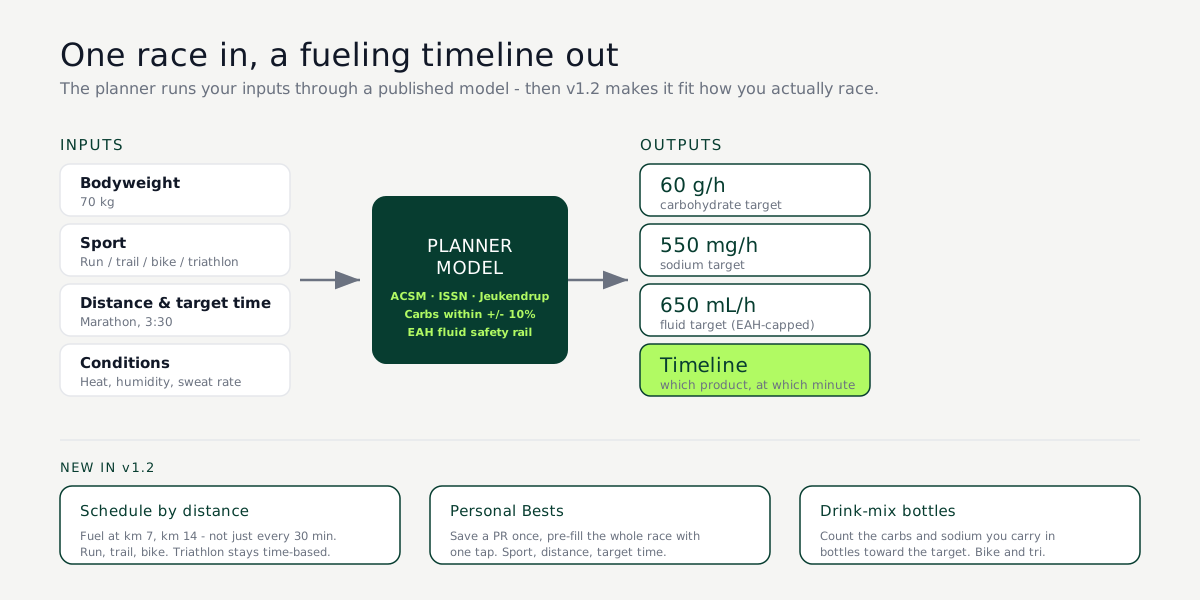
Open the planner, enter your weight, sport, distance, target time, and conditions, and it solves four coupled problems at once. None of the numbers are guessed; each traces back to published sports-nutrition research, and the changelog names the papers.
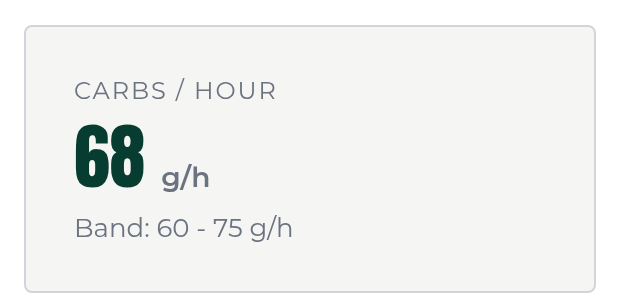
- Carbohydrate, in grams per hour. The target comes from a duration-and-experience band (short and hard races sit lower, long steady races higher), then gets nudged by sport: the bike leg of a triathlon is pushed up because GI tolerance is highest there, the run leg pulled down because that is where Ironman days unravel. The whole band is clamped to a sanity ceiling of 1.5 g of carb per kg of bodyweight per hour, so a 60 kg athlete is never told to eat like a 90 kg one.
- Sodium, in milligrams per hour. This is not a fixed number bolted on; it is derived: your estimated sweat rate multiplied by your sweat's sodium concentration. Both scale with bodyweight and sex, and you can pin them with a salty-or-low-sweater profile or a measured sweat test.
- Fluid, in millilitres per hour. Capped for safety (see the safety rails section below), never simply set to "drink more."
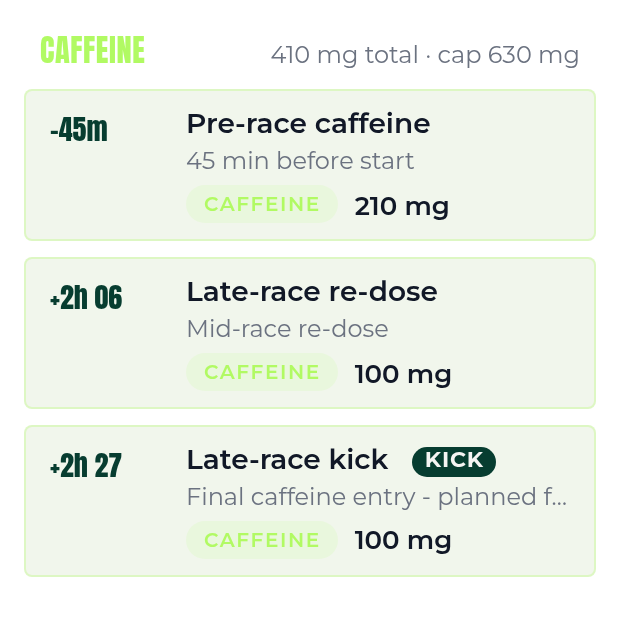
- Caffeine, timed. A pre-race dose lands 45 minutes before the gun, sized from your bodyweight and intent (off, standard 3 mg/kg, or high 5 mg/kg), halved if you flag yourself a slow metabolizer, and hard-capped at 9 mg/kg across the whole race. Mid-race re-doses are scheduled per sport.
Then it does the part a band cannot: it lays the carb target onto a timeline and fills each slot with a real product from the catalogue, respecting the accuracy promise it makes everywhere. The total carbs delivered land within plus or minus 10% of your target, every combination of sport, duration, weight, and target, guarded by a regression test that sweeps them all. Above 60 g/h it prefers glucose-fructose blends over glucose-only products, because a single transporter saturates around there; above 90 g/h it insists on a blend. And it stops scheduling intake in the final 25 minutes, because a gel taken that late oxidizes after you have crossed the line.
That is the engine. v1.2 did not change any of those promises. It changed how well the plan fits the way people actually race.
Use case one: a marathon, by the clock and by the kilometer
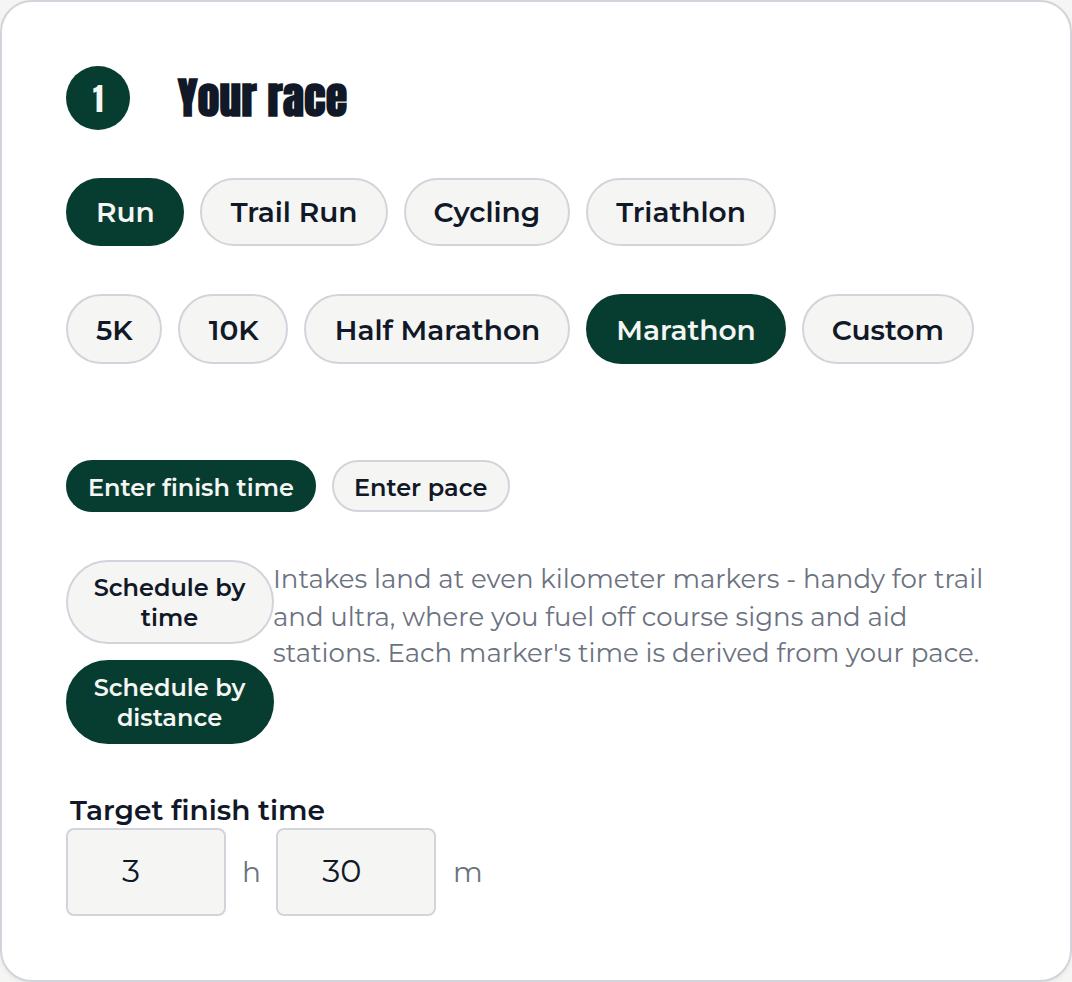
Take a 70 kg runner targeting a 3:30 marathon on a warm day. Enter weight, pick running, choose the marathon preset, set the target time and conditions, and the planner returns a per-interval plan: a carb target, a matched sodium and fluid target, and gels placed across the race with the running totals shown.
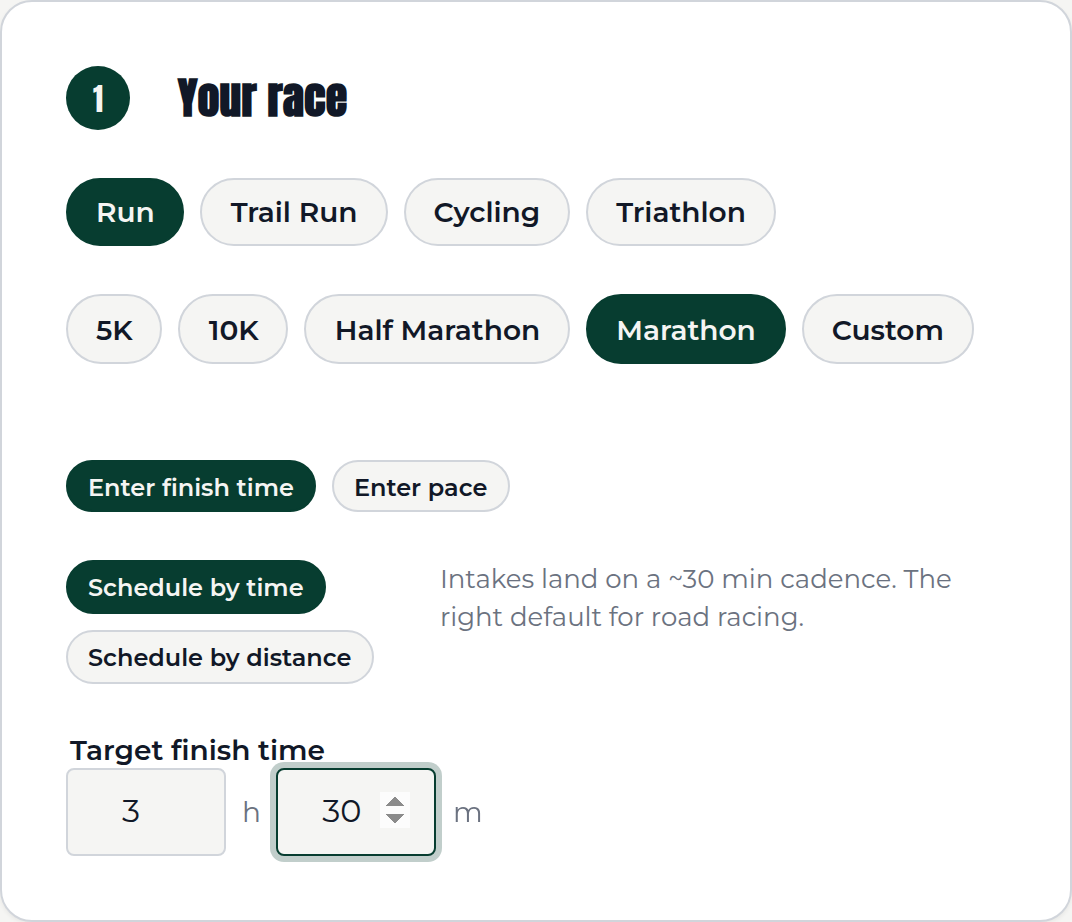
By default the timeline is time-based: intakes at a roughly 30-minute cadence, which is the right call for road racing where pace is steady. Every row names the product, the minute it belongs at, and the carbs and sodium it delivers, with a running total so you can see the plan converge on the target rather than trusting a black box.
Fuel by distance, not just the clock
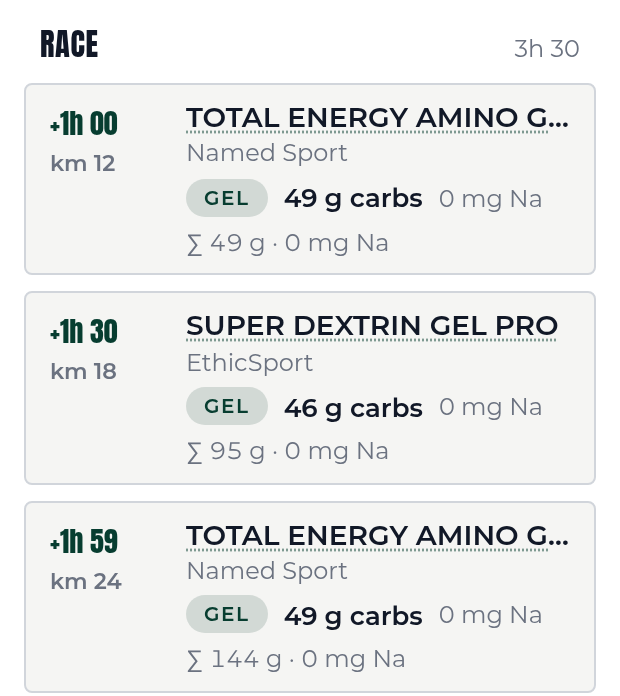
v1.2 added the option a trainer kept asking for: schedule by distance. Trail and ultra runners do not fuel off a watch, they fuel off course markers and aid stations, and when pace swings on rough terrain a fixed 30-minute clock drifts away from where the aid actually is. Toggle "schedule by distance" (offered for run, trail, and cycling when the race has a known distance) and the planner places intakes at even kilometer markers instead. In the marathon plan below it lands gels at km 12, 18, 24, 30, and 36 rather than on a fixed minute-30 clock.
Two things stay honest in distance mode. Each marker still shows a clock time, mapped back from your pace, so the timeline still reads as a schedule. And the carbs still land: total intake stays within the same plus-or-minus 10% of your hourly target. Only the carb intakes move to the course axis; caffeine timing and the hydration safety rails stay anchored to the clock, because those are about physiology, not geography. Triathlon is deliberately out of scope for this mode, because per-leg swim, bike, and run fueling does not collapse onto a single distance axis.
Skip the re-typing: Personal Bests
If you race the same distances often, re-entering your event every visit is friction. v1.2 adds a Personal Bests profile: logged-in athletes save a PR per sport and distance on the Personal Bests page (running, trail, cycling, triathlon, by preset distance or a custom one, with optional elevation and, for triathlon, swim/bike/run splits). Back on the planner, a "Pre-fill from a personal best" picker loads the sport, distance, and target time from a saved PR in one tap. Everything stays editable, and the plan recomputes through the normal path, so a returning athlete goes from "which race?" to "here is your plan" without touching the form. The rule is one PR per sport and distance, so the list stays a clean record of your bests rather than a pile of duplicates.
Use case two: a long bike, counting the carbs you carry
The runner's fuel is discrete: a gel is 25 grams and you take it or you don't. A cyclist's fuel is mostly dissolved in bottles, and until v1.2 the planner ignored it, so it would schedule a full gel timeline on top of the 60 grams of carb already sitting in your bidon. Double-counting in the wrong direction.
Drink-mix bottle accounting fixes that. For a bike or triathlon race, tell the planner which drink mix you carry, your bottle size (500, 750, or 1000 mL), and how many bottles. The picker only lists products we have a verified prepared-volume figure for (Maurten, SiS Beta Fuel, PowerBar, OTE, and more), and that catalogue is still filling in, so the list grows over time.
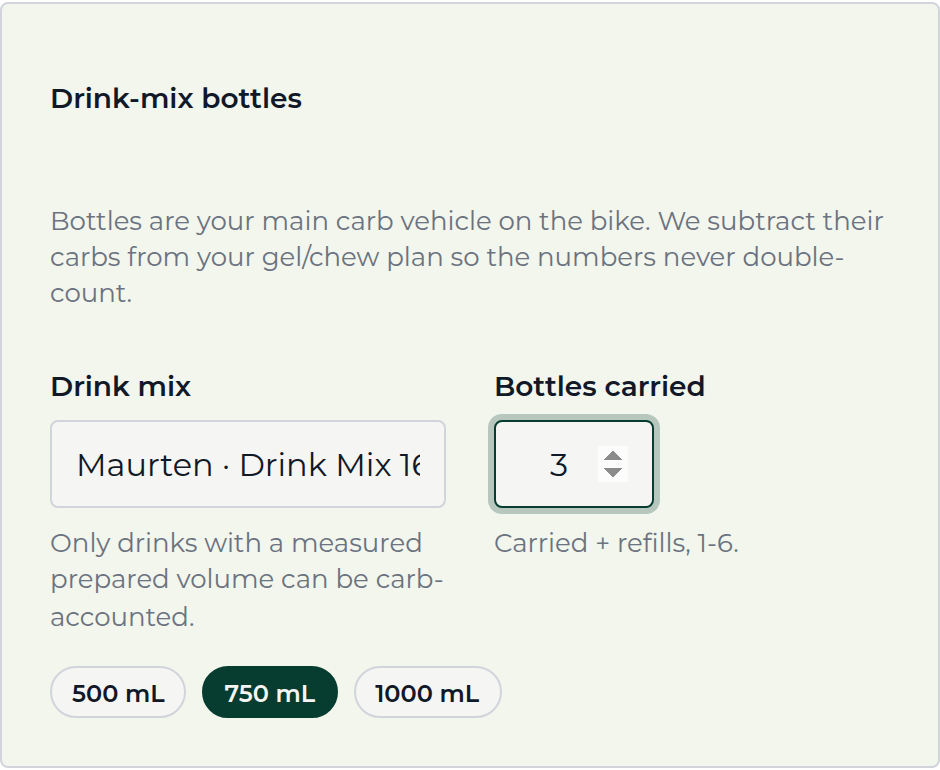
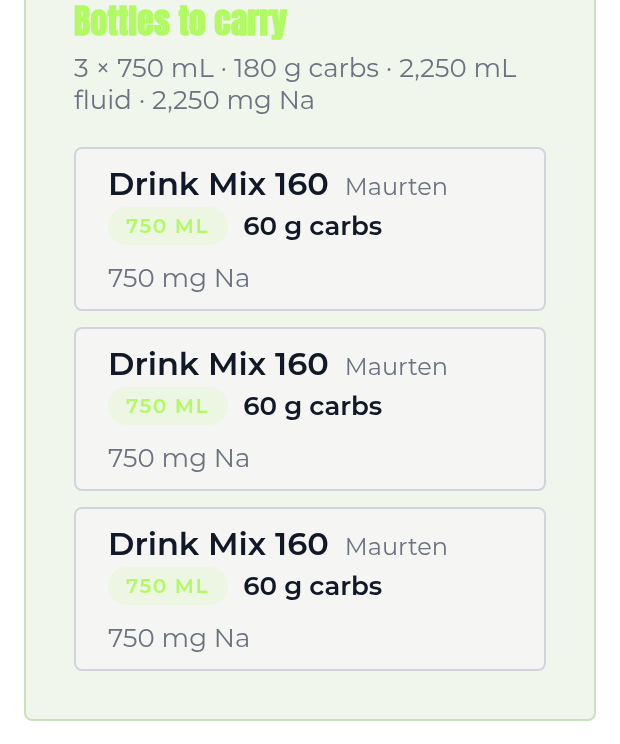
From there it works out the carbohydrate and sodium dissolved in those bottles and counts them toward your target, so the gel timeline only has to cover the gap. The concentrations are not guesses: the carbs-per-litre come from each product's recommended prepared volume per serving, so a Maurten 320 bottle and a lighter isotonic mix are each accounted for at their real strength. Take a 70 kg cyclist on a 160 km ride carrying three 750 mL bottles of Maurten Drink Mix 160: the planner pre-counts 180 g of carbohydrate and 2,250 mg of sodium from the bottles alone, and builds the rest of the plan around what is left of the 90 g/h target.
There is a safety rail here too. If the bottles imply drinking more than the planner's sustained fluid cap for your race duration, it flags it. Carrying carbs is good; being pushed into over-drinking to consume them is not.
The safety rails: where the planner says no
A fueling tool that only ever says "more" is dangerous. The planner's most important behavior is where it refuses.
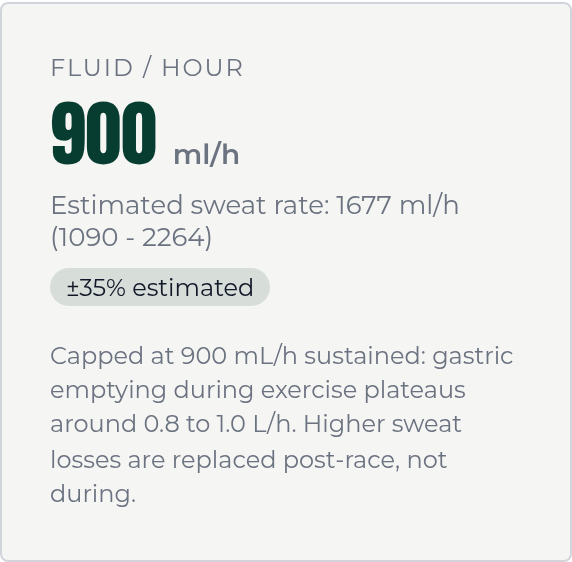
- The fluid cap. Recommended sustained fluid never exceeds the lower of your estimated sweat rate or 900 mL/h. That ceiling is deliberate: it sits near the practical gastric-emptying limit during exercise and inside exercise-associated hyponatremia (EAH) guidance. If you manually enter a sweat rate above 1500 mL/h, it stops recommending a number and shows a drink-to-thirst banner instead.
- Honesty about the sweat estimate. The single biggest source of error in any fueling plan is the sweat-rate guess, which can vary five-fold between similar athletes. So the planner shows a plus-or-minus 35% confidence band on an estimated sweat rate, and narrows it to plus-or-minus 10% only once you enter a measured number from a real sweat test. It tells you how much it does not know. The sweat and sodium guide covers how to measure yours in about 30 minutes.
- The gut-training callout. Ask for more than 60 g/h without ticking "I've done gut training" and the planner flags it, at any experience level. The band is not a permission slip; your gut has to be trained to hold it, which is what the gut-training guide is for.
- Cramps, stated correctly. Sodium prevents EAH, not cramps. Cramps are mostly neuromuscular fatigue from racing harder than you trained (Schwellnus et al. 2011), and the planner's copy says so rather than selling salt as insurance.
How to read your plan in three steps
- Check the three targets first. Carbs per hour, sodium per hour, fluid per hour. These are the plan. The timeline below them is just one way to hit them, and you can swap products freely as long as the totals hold.
- Look at the confidence band on fluid and sodium. If it is the wide estimated band, your hydration plan is a reasonable default, not a precision instrument. For anything over four hours, measure your sweat rate once and enter it.
- Respect the callouts. The gut-training flag, the glucose-fructose warning above 60 g/h, and the EAH banner are the planner disagreeing with your inputs on purpose. They are the most valuable output on the page.
Get a plan for your race
Everything above is the general shape. To turn it into your carb, sodium, fluid, and caffeine targets on a real timeline, open the NutriFinder planner. Enter your weight, the sport, the distance, and the conditions; add your bottles if you ride; toggle distance-based scheduling if you fuel off course markers. It returns the plan on one screen, and the first one is free with no signup. If you want the reasoning behind any single number it shows you, every target links back to the topic guide it came from, and the full planner changelog names the papers behind each release.
Research and references
The planner's targets rest on the following peer-reviewed sources. Verify dose, side-effect profile, and contraindications against the primary literature.
- Thomas DT, Erdman KA, Burke LM. 2016. Medicine & Science in Sports & Exercise. American College of Sports Medicine Joint Position Statement: Nutrition and Athletic Performance. PMID 26891166
- Jeukendrup AE. 2014. Sports Medicine. A step towards personalized sports nutrition: carbohydrate intake during exercise. PMID 24791914
- Jeukendrup AE. 2010. Current Opinion in Clinical Nutrition and Metabolic Care. Carbohydrate and exercise performance: the role of multiple transportable carbohydrates. PMID 20574242
- Burke LM, Hawley JA, Wong SHS, Jeukendrup AE. 2011. Journal of Sports Sciences. Carbohydrates for training and competition. PMID 21660838
- Sawka MN, Burke LM, Eichner ER, Maughan RJ, Montain SJ, Stachenfeld NS. 2007. Medicine & Science in Sports & Exercise. American College of Sports Medicine position stand: Exercise and fluid replacement. PMID 17277604
- Baker LB. 2017. Sports Medicine. Sweating rate and sweat sodium concentration in athletes: a review of methodology and intra/interindividual variability. PMID 28332116
- Schwellnus MP, Drew N, Collins M. 2011. British Journal of Sports Medicine. Increased running speed and previous cramps rather than dehydration or serum sodium changes predict exercise-associated muscle cramping: a prospective cohort study in 210 Ironman triathletes. PMID 21148567
- Pickering C, Kiely J. 2018. Sports Medicine. Are the current guidelines on caffeine use in sport optimal for everyone? Inter-individual variation in caffeine ergogenicity, and a move towards personalised sports nutrition. PMID 28853006