
Guide
Fueling by race distance
Educational content, not medical advice. Individual tolerance varies; persistent GI symptoms or any race-related medical concern should be reviewed by a sports dietitian or doctor.
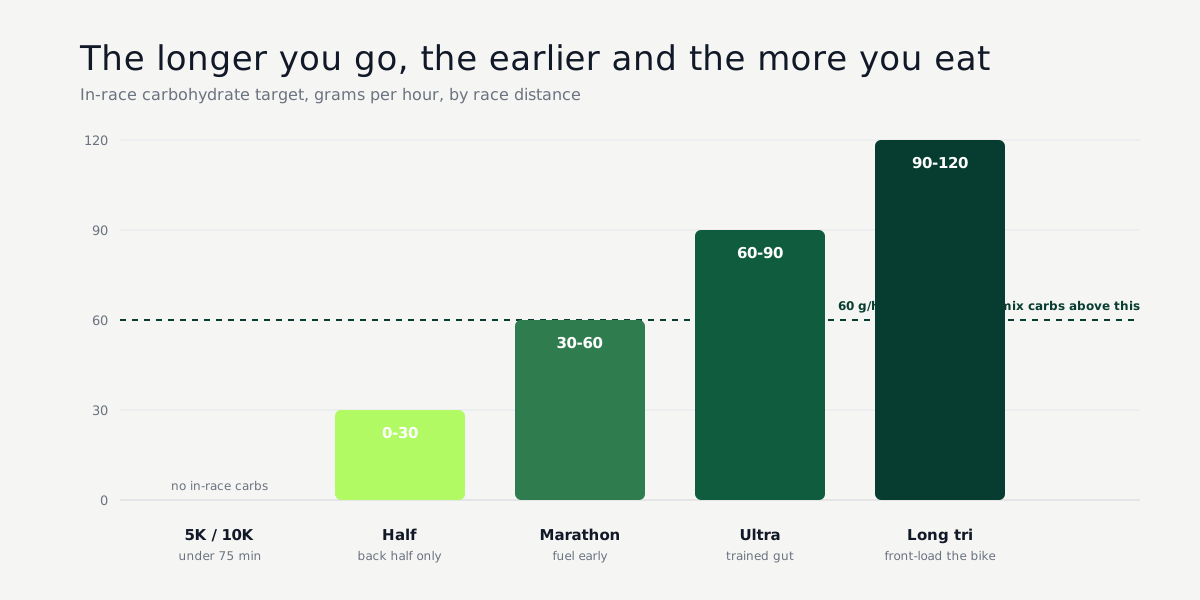
Race fueling is the practice of matching in-race carbohydrate intake to event duration. The body stores roughly 90 to 120 minutes of hard-effort glycogen, so races inside that window need no in-race carbs, while longer races progressively depend on 30 to 90+ g of carbs per hour.
Fueling advice tends to arrive as a single number, usually "60 grams of carbs per hour," as if a 10K and a hundred-miler were the same problem. They are not. Your body stores roughly 90 to 120 minutes of hard-effort carbohydrate as glycogen. What you do about that depends entirely on how long you plan to be out there. Under that window, stored fuel carries you and eating is mostly a waste of a good stomach. Past it, the race quietly stops being about your legs and starts being about whether you kept the tank topped up.
This guide walks up the distance ladder and tells you, for each one, the only three things that actually change: when carbs start to matter, how much to carry, and which format is worth its weight.
5K and 10K: fuel the day before, not during
For anything you will finish in under about 75 minutes, in-race carbohydrate does essentially nothing. You start with more glycogen than you can burn before the line, so a gel at kilometer 4 is a nice ritual and a placebo, not a performance lever. The real fueling for a 10K happens the day before and at breakfast: arrive with full glycogen and you are done.
The one proven exception is caffeine, which works independently of calories, and a carbohydrate mouth rinse: swilling a sports drink and spitting it out can nudge output on efforts under an hour, because the effect is a signal to the brain rather than fuel to the muscle. So for these distances, carry nothing, or at most a caffeinated option taken 45 to 60 minutes before the gun. Do not train yourself to depend on a mid-race gel you do not need.
What to carry: nothing, or one caffeinated gel pre-start. Bonk risk: effectively zero if you ate normally the day before.
Half marathon: the first distance where timing beats volume
The half is the crossover. Most runners finish between 80 minutes and a bit over two hours, which straddles the edge of the glycogen window. If you are quick, you can run it clean on stored fuel. If you are out there for two hours or more, the back third is where a modest top-up keeps your pace from sagging.
The mistake here is treating a half like a marathon and choking down four gels. You do not need them, and the extra sugar sloshing around is more likely to upset your gut than to help. Aim for 0 to 30 grams of carbs per hour, and take it in the second half, not from the start. One to two gels, or a few mouthfuls of a sports drink across the closing 5K, is plenty for most people.
What to carry: one or two energy gels, or a small sports drink if you prefer sipping. Bonk risk: low, but real in the final 5K for slower finishers who started on a light breakfast.
Marathon: fuel early or meet the wall
The marathon is the distance that made "hitting the wall" a phrase. Almost everyone runs it longer than their glycogen lasts, so this is the first race where fueling is not a marginal gain but the difference between a strong finish and a death march from 30K. The wall is simply glycogen running out with kilometers still to go, and the cruel part is that once you are empty, eating cannot dig you back out fast enough. So the whole game is starting before you need to.
Take carbs from around the 40 to 60 minute mark and keep a steady drip the rest of the way, targeting 30 to 60 grams per hour. For a four-hour marathoner that is roughly a gel every 30 to 40 minutes, or the equivalent in drink and chews. Treat that band as the conservative entry point: it is what a first-time marathoner should plan around, and trained runners who have done the gut work go higher and start earlier, which the marathon guide breaks down by finish time. Do not save your fuel for when you feel bad; by then it is too late. And do not improvise the amount on race day. The number you can absorb without gut trouble is trainable, which is the entire point of gut training, and it is worth rehearsing your exact marathon fueling on your long runs.
Format matters more here because you are carrying for two hours or more. Gels are the workhorse for their carb-to-weight ratio; a drink mix does double duty as fluid and fuel; energy chews suit people whose stomach rebels against gels. Most marathoners settle on a gel-plus-drink combination.
What to carry: four to seven gels, or a gel-and-drink mix that adds up to your hourly target. Bonk risk: high if you under-fuel or start late. This is the distance to get right.
Because it is the distance most people are actually training for, the marathon has its own full guide: marathon fueling, the complete plan works the numbers by finish time, turning an hourly rate into a total load and a gel count, and covers carb loading, the aid-station problem, and where to place caffeine.
Ultra and long-course triathlon: a moving picnic with a trained gut
Once you cross four or five hours, fueling becomes the primary event and your legs are almost a side character. At these durations you are trying to replace as much carbohydrate as your gut can physically absorb, which for a trained athlete tops out around 60 to 90 grams per hour, and up to 120 for the well-drilled few. Hitting the high end is impossible on glucose alone, because your gut's glucose transporters saturate near 60 grams per hour. You have to use a glucose-plus-fructose mix, which rides a second transporter and lets you absorb more without it sitting in your stomach. This is why the carbs-per-hour ceiling is a gut-training story, not a willpower one.
Two things separate a good ultra fueling plan from a bad one. First, variety and real food. Nobody wants their fortieth identical gel at hour seven; palate fatigue is real and it will stop you eating long before your stomach does. Rotate gels, drink mix, chews, energy bars, and actual food, and lean on savory and solid options as the hours pile up. Second, sodium and fluid, which over these timescales stop being an afterthought. Long events are where hyponatremia and cramping actually happen, so pair your carbs with an electrolyte strategy built from your own sweat rate, not a generic tablet count.
Past four hours the arithmetic changes shape, so the ultra has its own full guide too: ultra fueling, the deficit you manage works out why in-race carbohydrate only ever covers about half of what you burn, how the hourly rate falls while the total climbs to roughly 1,300 g for a 100-miler, how to build a rotation you can still stomach at hour twelve, and what to do when your stomach quits.
Long-course triathlon adds one wrinkle: the bike is your feeding window. You can eat properly on the bike in a way you cannot while running, so front-load the calories there and treat the run as damage limitation on a stomach you kept happy earlier. That gap between the two sports is bigger and more general than triathlon, and it has its own guide: cycling vs running fueling works out why the same athlete tolerates roughly 15 to 30 g of carbohydrate per hour more on the bike at every duration, and why a ride has to be planned from time and intensity rather than from distance.
What to carry: a rotating mix of formats built around a glucose-fructose base, plus a real electrolyte plan and some solid or savory food for the later hours. Bonk risk: certain if you wing it. The finish is decided by the plan you rehearsed, not the effort you summon.
Putting a number on your race
The pattern up the ladder is one sentence: short races run on yesterday's dinner, long races run on today's plan, and the marathon is where the switch flips. The further you go, the earlier you start eating and the more formats you need to keep eating at all.
The honest hard part is not knowing the target, it is turning it into a specific list: how many gels, how much drink mix, how much sodium, at what clock times, for your pace and your event. That arithmetic is exactly what the race-day fueling planner does, and it is worth doing before the day rather than discovering your number at kilometer 32. Build the plan, rehearse it on a long training session, and adjust from there. A finish line has never been reached by a fueling strategy invented mid-race.