
Guide
Ultra fueling, the deficit you manage
Educational content, not medical advice. Individual tolerance varies; persistent GI symptoms or any race-related medical concern should be reviewed by a sports dietitian or doctor.
Ultra fueling is the practice of covering an event lasting four hours or more, where the energy cost outruns what any gut can absorb. The aim is not to replace what you burn, which is impossible, but to hold 40-80 g of carbohydrate per hour for the whole event, keep sodium and fluid matched to your own sweat losses, and stay able to eat when everything has stopped tasting good.
Every shorter race is a fueling problem you can, in principle, solve. A 10K needs nothing. A marathon can be covered by arithmetic: a rate, a total, a number of gels. Past four hours that stops being true, and pretending otherwise is how people arrive at hour ten wondering why the plan that worked on paper is not working on them.
This guide is what changes when the clock, not the distance, becomes the variable. For where ultra sits relative to everything shorter, the fueling by race distance ladder is the overview; this page is the long end of it in full.
The gap you cannot close
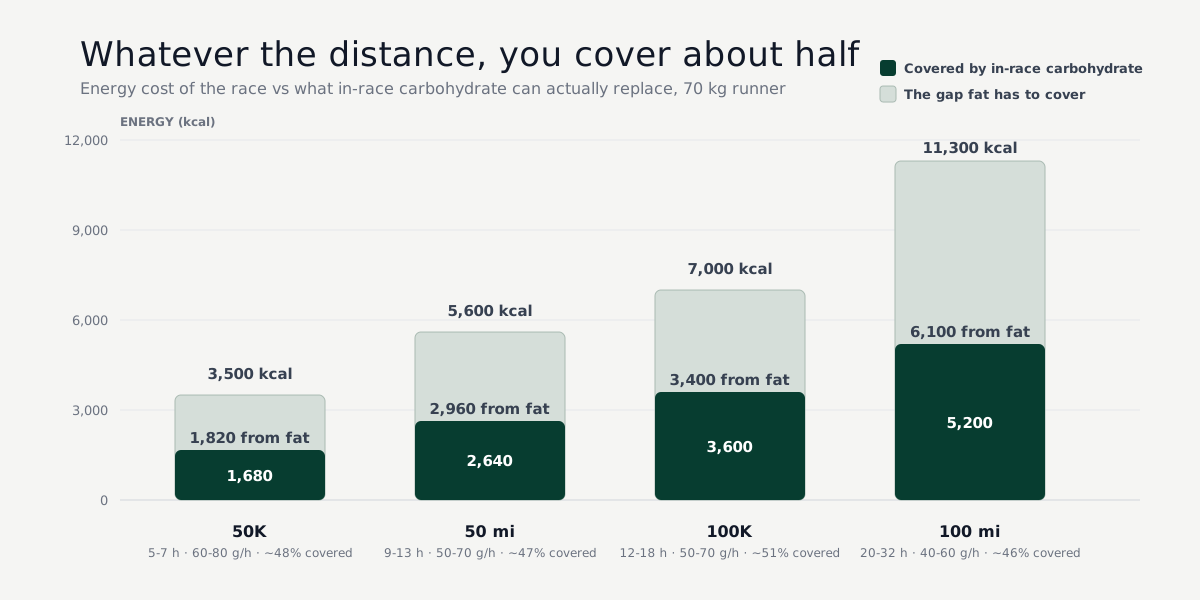
Running costs roughly 1 kcal per kilogram of bodyweight per kilometre, near enough for planning. For a 70 kg runner that is about 3,500 kcal for a 50K and about 11,300 kcal for a 100-miler, before you add a metre of climbing.
Now the other side. Your gut can absorb somewhere around 90-120 g of carbohydrate an hour at the very top end, gut-trained, on a glucose-fructose mix. That is 360-480 kcal an hour, against an hourly burn of 400-700. And nobody sustains the top end for a day. Put realistic race numbers into both columns and the same answer keeps falling out:
| Event | Typical duration | Target rate | Total in-race carbs | 30 g gels equivalent | Energy cost (70 kg) | Share covered |
|---|---|---|---|---|---|---|
| 50K | 5-7 h | 60-80 g/h | ~420 g | 14 | ~3,500 kcal | ~48% |
| 50 mi / 80K | 9-13 h | 50-70 g/h | ~660 g | 22 | ~5,600 kcal | ~47% |
| 100K | 12-18 h | 50-70 g/h | ~900 g | 30 | ~7,000 kcal | ~51% |
| 100 mi | 20-32 h | 40-60 g/h | ~1,300 g | 43 | ~11,300 kcal | ~46% |
Totals use the midpoint of each band, so read them as the centre of a range. Run your own version in the carbs-per-hour calculator with your goal time and your rate.
About half. It does not matter which distance you pick: the fraction of your energy cost that in-race carbohydrate covers barely moves, because the rate falls at almost exactly the pace the duration grows. The other half comes from fat, of which even a lean runner carries tens of thousands of kilocalories, and from the glycogen you loaded before the start.
Three things follow, and they are the whole guide:
- The deficit is planned, not failed. You are not trying to break even. You are trying to keep the deficit slow and boring enough that you can still run at hour eighteen.
- Pace is a fueling decision. Fat oxidation supplies that missing half only at moderate intensity. Go out at an effort your fat metabolism cannot support and you spend glycogen you cannot replace, which is why the classic ultra blow-up at hour six traces back to the first ninety minutes.
- Consistency beats peak rate. A runner who holds 50 g/h for twenty hours takes in 1,000 g. A runner who starts at 80 g/h, gets nauseous at hour five and takes almost nothing for the next three ends up behind, having also felt terrible.
Rate down, total up
The second counterintuitive thing in that table: your hourly number goes down as events get longer, while your total goes up enormously. A 100-miler asks for a lower rate than a marathon and roughly five times the total load.
The rate falls because you are eating for a day rather than for a morning, and because a stomach handles 70 g/h happily at hour two and grudgingly at hour fourteen. The total explodes because it is rate multiplied by a very large number of hours. This is why an ultra plan cannot be a shopping list scaled up from your marathon plan: 1,300 g of carbohydrate is 43 standard gels, and no one on earth wants their forty-third gel.
The real limit is ingestion, not absorption
In a marathon, the ceiling is the intestinal transporter: above about 60 g/h you need glucose plus fructose or the carbohydrate simply sits there. That ceiling still exists in an ultra, but you will almost never meet it, because a lower one arrives first.
The binding constraint in a long event is whether you can keep putting food in your mouth. Field studies of long endurance events find gastrointestinal complaints in a large majority of competitors, and they get more common the longer the race runs. Nausea, fullness, and the specific misery of not being able to face another sweet thing are what actually cap intake, not the transporter maths.
Two mechanisms are doing this. Gut blood flow drops when you run, so digestion slows, and the harder you run the more it slows. And palate fatigue: the flavour you loved at hour one becomes intolerable by hour eight, an effect strong enough to stop athletes eating even when their stomachs are fine.
So the ultra skill is not maximising a rate. It is engineering your plan so that eating stays possible. Everything below is that engineering.
Build a rotation, not a fuel
The plan is a rotation of formats and flavours, decided before the start and packed into your drop bags, rather than a single product multiplied out.
- Put the baseline in the bottle. Drink mix is fuel you were going to drink anyway, and it needs no decision from a tired brain. Across the 112 drink mixes we track, carbohydrate per serving runs from a few grams to 94 g, with several 90 g options; see drinks by carbs. Build your hourly baseline here and let the solids be the variable part.
- Use gels for the moments, not the hours. Gels are the fastest way to move 30 g and the easiest thing to take on a climb. Doses in the 366 gels we track run from 22 g up to a 90 g single sachet, and Precision Fuel & Hydration's PF 300 Flow Gel is a 300 g flask built precisely for events like this, where the point is to stop opening wrappers. Most carbs per gel ranks the shelf.
- Chew something. Chews run 15-44 g a pack and let you take 10 g at a time, which is exactly what you want when a whole gel is unappealing. Bars span 11-62 g of carbohydrate; the lean ones are race fuel and the dense ones are all-day food, a distinction the energy bar guide draws out in detail.
- Bring real and savoury food. Nothing in a catalogue fixes palate fatigue like a boiled potato with salt, a rice ball, broth, or a cheese sandwich at 2am. Sweet-only plans fail in a predictable way around hour eight. Plan the savoury option before you need it, because by the time you need it you will not be capable of inventing one.
On carb type, above 60 g/h you want a stated glucose-fructose blend. Of the 366 gels we track, 208 state enough to classify as glucose-fructose, 29 are clearly glucose-only, and 129 do not say enough to tell. If the wrapper will not name the ratio, assume single-source and cap that product at 60 g/h. The energy gel guide covers reading the label, and compare will put a shortlist side by side.
One more practical rule: rotate flavours deliberately. There are 93 distinct gel flavours in our catalogue, so there is no excuse for carrying nine identical ones. Alternate sweet with savoury, cold with warm, liquid with solid, and put the variety in the drop bags rather than in your pack.
Sodium and fluid over a whole day
Over four hours a sodium error is uncomfortable. Over twenty it is a medical event, in both directions.
Sweat sodium concentration varies several-fold between people, roughly 300-1,500 mg per litre, and sweat rates vary just as much, so a generic tablet count is worthless here. Work an example: a runner losing 0.7 L an hour with moderately salty sweat at 800 mg/L loses about 560 mg of sodium an hour, which is around 11,000 mg across a 20-hour race. Against the 39 electrolyte tabs we track, which average 347 mg of sodium and top out at 1,000 mg, that is a lot of tablets, which is the argument for carrying sodium in your drink mix and your food rather than exclusively in pills. Electrolyte powders reach 1,080 mg per serving; the sodium leaderboards rank both formats.
The rule is match, do not max. Overshooting fluid well past your sweat losses is how exercise-associated hyponatremia happens, and it is far more common in long events than in short ones precisely because there is time to drink that much. Drink to thirst plus a plan, weigh yourself before and after long training days, and get your own numbers from the sweat and sodium guide. If the race is hot, heat training changes both your sweat rate and your sodium losses, so do that work in advance rather than discovering it on the day.
Fuel to the aid stations, not to the clock
A 30-minute timer is a good marathon tool and a poor ultra one. Pace on trail swings with terrain, so a fixed clock drifts out of sync with where the food actually is, and in a long race the food is at aid stations and in drop bags.
Plan by course markers: what you carry between aid stations, what you eat at each one, what waits in each drop bag. That is also how the NutriFinder planner schedules trail and ultra plans, placing intakes at kilometre markers instead of minutes when you toggle schedule-by-distance.
Two habits worth building. Eat at the aid station, not after it, because that is where sitting down, chewing, and drinking something warm are actually possible. And write the plan down and put a copy in each drop bag, because the version of you at hour sixteen should be following instructions, not making decisions.
The night, caffeine, and the cutoff
If your race runs into the dark, caffeine stops being a simple performance question. It works: 3-6 mg per kg of bodyweight is worth a few percent, and a well-placed dose before a night section is one of the better tools you have. Of the gels we track, 240 of 366 are caffeine-free, which is what lets you place the dose deliberately instead of accumulating it by accident, and caffeinated ones run up to 150-200 mg in a single sachet.
The catch is the half-life, roughly five hours, so a dose late in a long race is still working when you are trying to sleep afterwards, and the sleep is a large part of your recovery. Decide the cutoff time before the race and write it on the plan next to your carb and sodium targets, because at hour twenty you will not make that call well. The caffeine guide has the full dosing picture and the sleep arithmetic, and the caffeine leaderboard shows which gels carry what.
When your stomach quits
It will happen at some point in your ultra career, so have the protocol ready.
- Slow down. Gut blood flow is what you took away and easing off for 10-20 minutes is what gives it back. This is the step people skip and the one that works.
- Cool down. Heat makes GI distress worse. Get water on your head and neck, get out of the sun, use the ice at the aid station.
- Go liquid and dilute. Small frequent sips of a weaker mix beat one more gel. Concentrated carbohydrate sitting in a stalled stomach is the problem, not the solution.
- Drop the target, do not abandon it. Cut to 20-30 g/h until things settle, then rebuild. Taking nothing for two hours costs you far more than a reduced rate.
- Change the flavour profile. Broth, salty crisps, plain water, anything that is not the sweet thing you have had eleven of.
If this happens every time rather than occasionally, it is a training problem, and gut training is the four-week progressive protocol that fixes it. Tolerance genuinely adapts to practice.
What about fat adaptation?
The obvious response to a chart that says "half your energy comes from fat" is to make yourself better at burning fat. It is a reasonable hypothesis and it has been tested.
Low-carbohydrate high-fat adaptation does what it says: keto-adapted ultra runners oxidise fat at strikingly high rates. But when performance was measured directly, the same adaptation impaired exercise economy and blunted the ability to go hard, so athletes used more oxygen for the same pace. You do not get faster by getting better at the slow fuel.
The practical read: you already burn plenty of fat at ultra intensity without doing anything special to your diet, and the higher-leverage intervention is training your gut to take in more carbohydrate, then keeping it running through the night. Spend the effort there.
Rehearse the eating, not just the running
Every number above is a hypothesis until you have executed it. Two or three long training days should be run at race-day fuel, race-day products, race-day intervals, ideally including a session that starts in the afternoon so you find out how your plan feels in the dark and how your stomach handles food at 11pm.
Back-to-back long days are the honest rehearsal for a 100: they show you what eating feels like when you are already tired, which is the actual condition of the second half of the race. Take notes on what you could not face, then remove it from the plan. The race-day timeline covers the pre-race clock, and the mental side of fueling covers the part where you have to eat something you no longer want.
After the finish
You have run a deficit for a day, so recovery is real work rather than a shake. Carbohydrate first, protein alongside, fluid with sodium in it, and sleep that your caffeine plan protected. The recovery nutrition guide has the ratios and the timing.
Get a plan for your race
To turn this into your numbers, open the NutriFinder planner: put in your event, its distance and elevation, your expected time and your bodyweight, and it returns carbohydrate, sodium and fluid scheduled by kilometre, with how many of each product to carry and where they land. Schedule by distance for trail and ultra so the plan lines up with the aid stations. The first plan is free with no signup.
Frequently asked questions
How many carbs per hour do you need for an ultramarathon?
Between 40 and 80 g/h, and the number falls as the event gets longer. A 50K at 5-7 hours supports 60-80 g/h, a 100K at 12-18 hours 50-70 g/h, and a 100-miler at 20-30 hours realistically 40-60 g/h. The limit is not absorption, it is how much you can keep swallowing hour after hour.
How many calories do you burn in a 100 mile race?
Roughly 11,000 kcal for a 70 kg runner on runnable terrain, and more on a mountain course. Running costs about 1 kcal per kg of bodyweight per kilometre, so 161 km comes to about 11,300 kcal before you add climbing.
Why can you not replace all the calories you burn in an ultra?
Because your gut tops out around 90-120 g of carbohydrate an hour, which is 360-480 kcal, and you burn 400-700 kcal an hour. Across every ultra distance the arithmetic lands in the same place, at roughly half of what you spend, so the remainder comes from fat and the job becomes managing the deficit rather than closing it.
What should you eat during an ultramarathon?
A rotation, not a product. Drink mix carries the baseline carbohydrate you were going to drink anyway, gels cover the climbs and the low moments, chews and bars give you something to chew, and real food, especially savoury food, keeps you eating when everything sweet has become repulsive. Plan the rotation in advance and put it in your drop bags.
How much sodium do you need in an ultra?
Work from your own sweat rate rather than a tablet count. A runner losing 0.7 L an hour with moderately salty sweat at 800 mg/L loses about 560 mg an hour, which is roughly 11,000 mg across a 20-hour race. Match that loss, do not try to beat it, because drinking far past your losses is how exercise-associated hyponatremia happens.
What do you do when your stomach shuts down in an ultra?
Slow down first. Gut blood flow is the thing you took away, and easing the pace for 10-20 minutes is what gives it back. Then cool down, switch from solids to small sips of dilute carbohydrate, and drop your hourly target until it settles. Trying to push the same rate through a rebelling stomach is how a bad patch becomes a DNF.
Should you go keto or fat-adapt for an ultra?
Fat adaptation does raise fat oxidation, but the trials that measured performance found it impairs exercise economy and blunts high intensity, so you go slower for the same oxygen cost. You already burn a great deal of fat at ultra pace without changing your diet. Train the gut to take more carbohydrate instead, which is the intervention with the better evidence behind it.
Research and references
The thresholds in this guide rest on the following peer-reviewed sources. Verify dose, side-effect profile, and contraindications against the primary literature.
- Jeukendrup AE. 2014. Sports Medicine. A step towards personalized sports nutrition: carbohydrate intake during exercise. PMID 24791914
- Burke LM, Hawley JA, Wong SHS, Jeukendrup AE. 2011. Journal of Sports Sciences. Carbohydrates for training and competition. PMID 21660838
- Thomas DT, Erdman KA, Burke LM. 2016. Medicine & Science in Sports & Exercise. ACSM Joint Position Statement: Nutrition and Athletic Performance. PMID 26891166
- Pfeiffer B, Stellingwerff T, Hodgson AB, et al. 2012. Medicine & Science in Sports & Exercise. Nutritional intake and gastrointestinal problems during competitive endurance events. PMID 21775906
- Jeukendrup AE. 2017. Sports Medicine. Training the gut for athletes. PMID 28332114
- Baker LB, Barnes KA, Anderson ML, et al. 2016. Sports Medicine. Sweating rate and sweat sodium concentration in athletes: a review of methodology and intra/interindividual variability. PMID 28332116
- Hew-Butler T, Loi V, Pani A, Rosner MH. 2015. British Journal of Sports Medicine. Statement of the 3rd International Exercise-Associated Hyponatremia Consensus Development Conference. PMID 26227507
- Volek JS, Freidenreich DJ, Saenz C, et al. 2016. Metabolism. Metabolic characteristics of keto-adapted ultra-endurance runners. PMID 26892521
- Burke LM, Ross ML, Garvican-Lewis LA, et al. 2017. Journal of Physiology. Low carbohydrate, high fat diet impairs exercise economy and negates the performance benefit from intensified training in elite race walkers. PMID 28012184
- Guest NS, VanDusseldorp TA, Nelson MT, et al. 2021. Journal of the International Society of Sports Nutrition. International society of sports nutrition position stand: caffeine and exercise performance. PMID 33388079