
Guide
Marathon fueling, the complete plan
Educational content, not medical advice. Individual tolerance varies; persistent GI symptoms or any race-related medical concern should be reviewed by a sports dietitian or doctor.
Marathon fueling is the practice of covering a 42.195 km race that lasts two to five hours with roughly 90-120 minutes of stored glycogen. The gap is closed by carb loading beforehand and by taking 45-90 g of carbohydrate per hour during the race, started within the first 40 minutes.
The marathon is the distance where fueling stops being an optimisation and becomes the thing that decides your result. Shorter races finish on the fuel you started with. Ultras are long enough that everyone accepts they have to eat. The marathon sits in the cruel middle: long enough to empty you, short enough that you are running too hard to be casual about eating, and popular enough that most of the people doing it have never worked out the arithmetic.
This guide is that arithmetic, organised by the only variable that really changes the answer: how long you are going to be out there. For the ladder across other distances, see fueling by race distance; this page is the marathon in full.
The wall is arithmetic, not character
Your body stores roughly 90-120 minutes of hard-effort carbohydrate as muscle and liver glycogen, call it 1,500-2,000 kcal for a trained runner. A marathon costs most runners somewhere near 2,500-3,000 kcal. Put those two numbers side by side and the famous wall stops being mysterious: at marathon intensity, the tank empties somewhere around 30-35 km, which is exactly where the race is decided and exactly where you see people walking.
That is the whole problem. It is not a pain threshold, it is not a mental event, and it does not respond to grit. It responds to carbohydrate. Everything below is about arriving at the start line with a full tank and then refilling it faster than you drain it.
Your finish time sets the whole plan
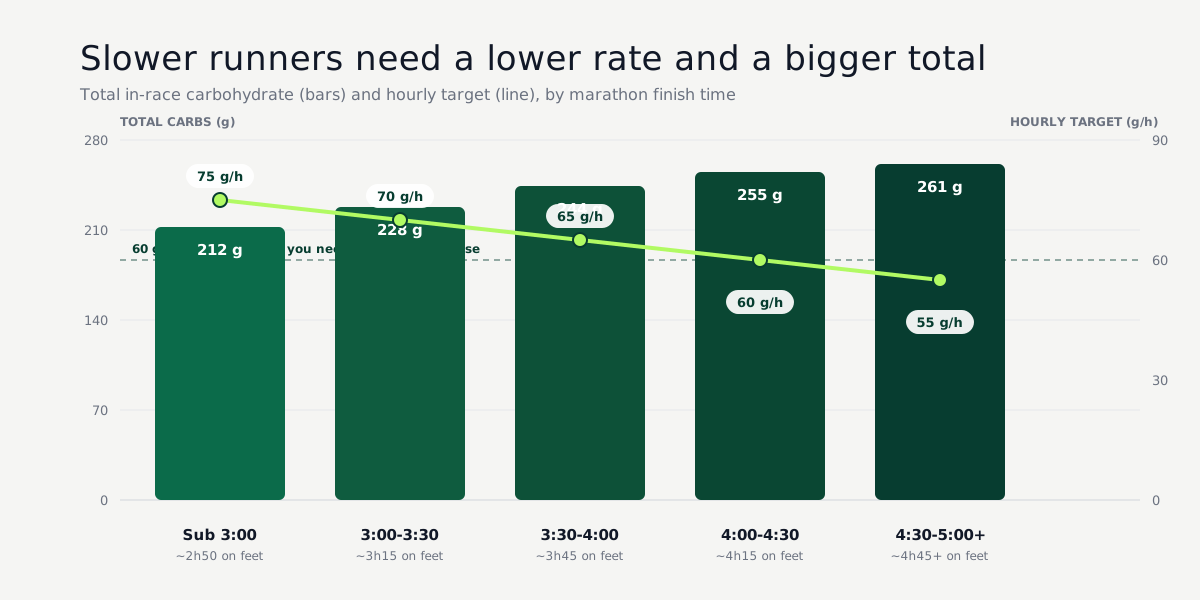
Two numbers matter: the rate you take carbs at, and the total you need across the race. They move in opposite directions, which is the single most misunderstood thing about marathon fueling.
Faster runners are out for less time but running at a higher intensity, which both burns fuel faster and leaves less blood flow for the gut, so they take a high rate for a short window. Slower runners have more forgiving digestion and more time to use it, so they take a lower rate for much longer. The result is that the slower you finish, the more total carbohydrate you need, even though your hourly number goes down.
| Finish time | Time on feet | Target rate | Total in-race carbs | 30 g gels equivalent |
|---|---|---|---|---|
| Sub 3:00 | ~2h50 | 60-90 g/h | ~212 g | 7 |
| 3:00-3:30 | ~3h15 | 60-80 g/h | ~228 g | 7-8 |
| 3:30-4:00 | ~3h45 | 60-75 g/h | ~244 g | 8 |
| 4:00-4:30 | ~4h15 | 50-70 g/h | ~255 g | 8-9 |
| 4:30-5:00+ | ~4h45+ | 45-60 g/h | ~261 g | 9 |
The totals use the midpoint of each band, so treat them as the centre of a range rather than a prescription. Run your own numbers in the carbs-per-hour calculator: put in your goal time and your rate and it returns the total to carry, or work backwards from the total you can stomach.
Two consequences fall straight out of this table. First, almost every marathon plan needs a glucose-fructose product, because anything above 60 g/h exceeds what glucose alone can be absorbed at. Second, nobody carries seven to nine gels comfortably, which is why real marathon plans mix formats rather than living on gels alone.
Carb loading: the highest-value 48 hours
Before you carry anything, fill the tank. The evidence here is old, strong, and routinely ignored: 8-12 g of carbohydrate per kg of bodyweight per day for the 36-48 hours before the race. For a 70 kg runner that is 560-840 g of carbohydrate a day.
Say that out loud, because it is much more than people think. It is not one pasta dinner. It is a deliberate two-day push where carbohydrate is the centre of every meal and most snacks, fat and fibre come down to make room, and you accept feeling slightly heavy and waterlogged. That heaviness is the point: glycogen is stored with water, so a couple of kilos on the scale on race morning is evidence the loading worked, not a problem to fix.
Two practical rules. Drop the fibre in the final 24 hours, because you want the fuel, not the residue, and a high-fibre load is how people end up queueing for a portaloo at 8am. And do not use the taper to diet: training volume falls, appetite often falls with it, and the runner who eats normally during taper week arrives underfilled.
Race morning
Eat 3-4 hours before the gun, at 1-4 g of carbohydrate per kg, low in fat and fibre, and made entirely of foods you have eaten before long runs. For most runners that is 100-250 g of carbohydrate: porridge, a bagel with honey, white toast and jam, a banana, plus whatever drink you have rehearsed.
In the final 60-90 minutes keep sipping and top up with 20-30 g of easy carbohydrate if your stomach is happy, then stop solids. The race-day timeline guide has the full clock, from the night before to the finish line, if you want the hour-by-hour version.
In the race: start early, then hold the rhythm
The most common marathon fueling mistake is not taking too little. It is starting too late.
Take your first carbs somewhere between 20 and 40 minutes in, while you still feel great and eating feels unnecessary. Carbohydrate takes 20-45 minutes to get from your hand to your working muscle, so anything you eat is fuel for the version of you that exists half an hour from now. If you wait until you feel empty at 30 km, the fuel arrives after the damage is done.
After that, work to a rhythm rather than to feel. Set a fixed interval (every 20 minutes for a 30 g gel at 90 g/h, every 25-30 minutes at 60-70 g/h), put it on your watch, and take the fuel whether or not you want it. The first-hour ramp in the carbs-per-hour guide covers why you build into the rate instead of front-loading it. In the last 20-30 minutes there is no point taking anything solid; it will not be absorbed before you finish.
What to actually carry
Nine gels is a lot of gels. Marathon plans work when they use the shape of the format:
- Dose up. Gel carb doses span a huge range, from 22 g in Science in Sport's GO Isotonic up to 60-61 g in Santa Madre's Unusual Gel 60CHO and Named Sport's TOTAL ENERGY CARBO GEL, with Precision Fuel & Hydration's PF 90 Gel carrying a full 90 g in one sachet. Two 60 g gels replace four 30 g ones and four pocket trips. The most carbs per gel leaderboard ranks the shelf by dose.
- Put carbohydrate in the bottle. Drink mix carries fuel you were going to drink anyway, and the drink mixes we track reach up to 94 g of carbohydrate per serving. On a hot day this is also how you keep sodium and carbs in one place. See drinks by carbs.
- Use chews for granularity. Chews run 15-44 g per pack and let you take 10 g at a time instead of committing to a whole gel, which is useful late in the race when a full sachet is unappealing.
On carb type, check the label rather than trusting the brand. Above 60 g/h you need a stated glucose-fructose blend, and of the 397 gels we track, 222 state enough to classify as glucose-fructose and only 29 are clearly glucose-only, but 146 do not say enough to tell. If the wrapper will not name the ratio, assume single-source and cap that product at 60 g/h. The energy gel guide covers how to read the five numbers that matter, and compare will put your shortlist side by side.
The aid-station problem
A marathon is the one distance where a stranger hands you fuel. That is a trap worth planning around.
You do not choose the brand a race puts on course, the concentration is often unpublished, and the cup arrives when the station arrives rather than when your watch says to eat. So: carry your own carbohydrate and treat on-course drink as fluid plus a bonus. Read the race website in advance for what is offered and where, and if you intend to use it, buy some and rehearse with it. Race day is the worst possible time to meet a new product, which is the same argument the gut training guide makes at length.
For fluid and sodium, work out your own numbers rather than drinking to a schedule someone else wrote. Sweat rates and sweat sodium concentrations vary several-fold between runners, so the honest answer is in the sweat and sodium guide. The two errors to avoid are equal and opposite: arriving dehydrated in the heat, and drinking so much plain water that you dilute your blood sodium. Match, do not max.
Caffeine, placed on purpose
Caffeine is the one legal ergogenic aid with an evidence base as solid as carbohydrate itself, worth roughly 2-4% at 3-6 mg per kg of bodyweight. In a marathon the question is not whether, it is when.
The part of the race that hurts is 30 km onward, and caffeine peaks 45-60 minutes after you take it, so the useful placement for most runners is 90 minutes to two hours in. Count your morning coffee toward the total, keep most of your gels caffeine-free so the dose lands where you chose rather than accumulating by accident, and know that caffeinated gels run as high as 150-200 mg each, which is a serious dose in one sachet. The caffeine guide has the full dosing picture and the caffeine leaderboard shows which gels carry what.
Rehearse it, then do not change it
Every number above is a plan, and a plan you have never executed is a hypothesis. Two long runs in the final six weeks should be run at race-day fueling, with race-day products, at race-day intervals, ideally at marathon effort and at the same time of morning as the race. That is where you find out that the gel you liked in the shop is unbearable at 32 km.
If your target rate is above what you currently tolerate, you have a training problem, not a shopping problem, and gut training is a 4-week progressive protocol that fixes it. Then, on race day, change nothing.
After the finish
Recovery starts in the first hour, and after a marathon it genuinely matters, because you have run yourself empty and the damage is real. Carbohydrate first and protein alongside it; the recovery nutrition guide has the ratios and the timing.
Get a plan for your race
To turn all of this into your numbers, open the NutriFinder planner: put in your marathon, your goal time, and your bodyweight, and it returns a carb, sodium, and fluid plan scheduled by kilometre, including how many of each product to carry and where they land. The first plan is free with no signup.
Frequently asked questions
How many gels do I need for a marathon?
Multiply your hourly carb target by your finish time, then divide by the carbs in one gel. A 3:45 finisher at 65 g/h needs about 244 g of carbohydrate, which is eight 30 g gels. Carry one more than the arithmetic says, because a dropped gel at 30 km is the one that matters.
How many carbs per hour do I need for a marathon?
Between 45 and 90 g/h, set mostly by how long you will be running. Sub-3:00 runners target 60-90 g/h, 3:30-4:00 runners 60-75 g/h, and 4:30-plus runners 45-60 g/h. Anything above 60 g/h has to come from a glucose-fructose product, because glucose alone saturates its intestinal transporter at roughly 60 g/h.
When should I start fueling in a marathon?
Take your first carbs between 20 and 40 minutes in, long before you feel like you need them. Fueling is topping up a tank that is already draining, not refilling one that has run dry. If you wait until you feel empty at 30 km, you are 45 minutes too late, because carbohydrate takes that long to reach the muscle.
Do I need to carb load before a marathon?
Yes, and it is the highest-value thing you do all week. Target 8-12 g of carbohydrate per kg of bodyweight per day for the 36-48 hours before the race, which for a 70 kg runner is 560-840 g a day. That is a deliberate, slightly uncomfortable amount of eating, not one big pasta dinner the night before.
What is the wall in a marathon?
Glycogen depletion. You store roughly 90-120 minutes of hard-effort carbohydrate, and a marathon takes two to five hours, so the tank runs out somewhere around 30-35 km unless you have been refilling it. The wall is not a mental event or a pain threshold, it is arithmetic, which is why fueling prevents it and grit does not.
Should I use the on-course drink or carry my own fuel?
Carry your own carbohydrate and treat on-course drink as fluid and a bonus. You do not get to choose the brand a race hands out, its concentration is often unknown, and race day is the worst possible time to meet a new product. Check the race website for what is offered, then rehearse with exactly that or plan around it.
When should I take caffeine during a marathon?
45-60 minutes before the part of the race that will hurt, which in a marathon means roughly 30 km, so most runners take a caffeinated gel somewhere between 90 minutes and two hours in. The effective dose is 3-6 mg per kg of bodyweight across the whole race, counting your morning coffee.
Research and references
The thresholds in this guide rest on the following peer-reviewed sources. Verify dose, side-effect profile, and contraindications against the primary literature.
- Jeukendrup AE. 2014. Sports Medicine. A step towards personalized sports nutrition: carbohydrate intake during exercise. PMID 24791914
- Jeukendrup AE. 2010. Current Opinion in Clinical Nutrition and Metabolic Care. Carbohydrate and exercise performance: the role of multiple transportable carbohydrates. PMID 20574242
- Burke LM, Hawley JA, Wong SHS, Jeukendrup AE. 2011. Journal of Sports Sciences. Carbohydrates for training and competition. PMID 21660838
- Thomas DT, Erdman KA, Burke LM. 2016. Medicine & Science in Sports & Exercise. ACSM Joint Position Statement: Nutrition and Athletic Performance. PMID 26891166
- Spriet LL. 2014. Sports Medicine. Exercise and sport performance with low doses of caffeine. PMID 25355191