
Guide
Cycling vs running fueling, why the same athlete eats differently
Educational content, not medical advice. Individual tolerance varies; persistent GI symptoms or any race-related medical concern should be reviewed by a sports dietitian or doctor.
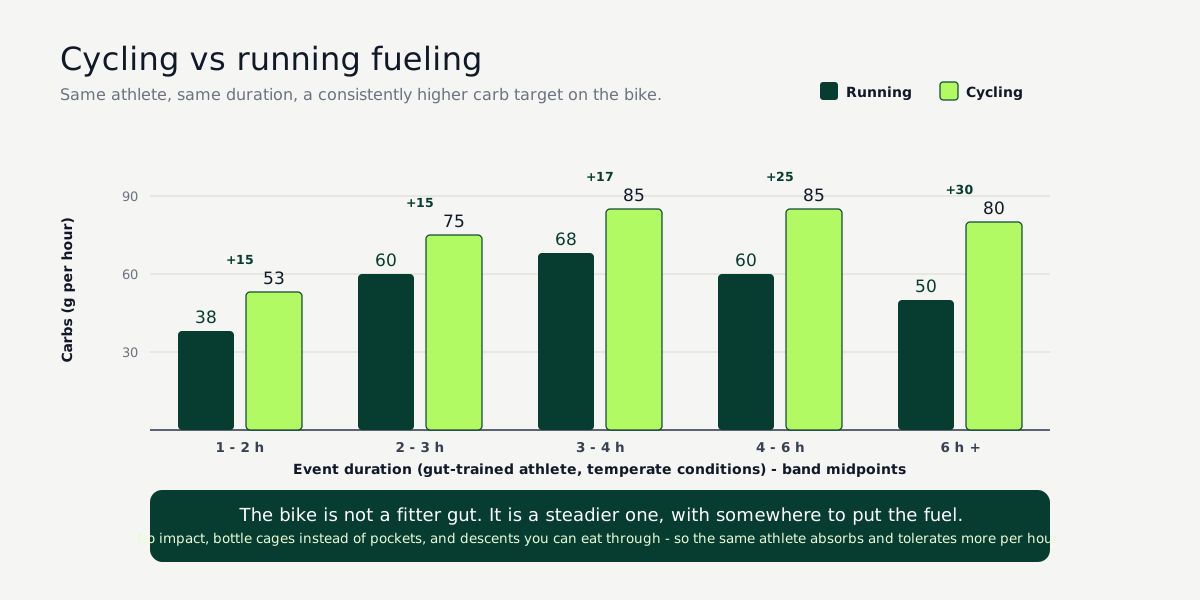
Cycling and running fueling differ less in what you eat than in how much of it you can get down. At a matched duration, most gut-trained athletes tolerate roughly 15 to 30 g of carbohydrate per hour more on the bike than on foot, because cycling removes the impact that upsets a running stomach, gives you somewhere to carry fuel, and provides moments when you are not working in which to eat.
Athletes who move between the two sports usually carry one fueling plan across both, and it fails in one direction or the other. Take your bike numbers to a marathon and your stomach will tell you about it by 30 km. Take your marathon numbers to a six-hour ride and you will arrive home hollow, having left 200 g of perfectly tolerable carbohydrate in the kitchen.
This guide is about the gap between the two, and what to do with it. It does not re-teach the rate itself: carbs per hour still owns that, sweat and sodium owns hydration maths, gut training owns the rehearsal, and fueling by race distance remains the ladder across every event length.
The three differences that do all the work
Nothing about a cyclist's gut is better than a runner's. It is the same organ having a much easier day, for three reasons.
A stable torso. Running is a series of controlled collisions, and each one shakes the contents of your stomach and drags on the mesenteric arteries feeding it. Multi-event studies of gastrointestinal complaints in endurance athletes consistently find the highest rates of serious symptoms in running events and the lowest in cycling, at intakes that are often higher on the bike. Seated on a bike, the torso barely moves, so the same volume sits far more comfortably.
Somewhere to put the fuel. A cyclist has two bottle cages, three jersey pockets and, if they want, a top-tube bag. A runner has whatever is strapped to their body and whatever the aid stations hand them. This sounds like logistics, but it decides physiology: it is the reason a cyclist can take their carbohydrate dissolved and a runner has to take it concentrated.
Moments when you are not working. Descents, freewheeling, sitting in a group, the flat before the next climb. Every ride contains windows where effort drops close to nothing and eating is trivially easy. Running has no coasting. Every minute of a marathon is worked, which is why running fuel has to go down in two seconds while breathing hard.
None of the three is about fitness, and that is the useful part: you do not need to train into the higher bike numbers so much as recognise that the bike already grants them.
What that means for the rate
Same athlete, gut-trained, temperate conditions. Take these as the centre of a band and adjust down for heat, for new product, or for an untrained gut.
| Duration | Running | Cycling | Notes |
|---|---|---|---|
| 1 - 2 h | 30-45 g/h | 45-60 g/h | Below 2 h a runner can nearly ignore fuel; a rider should not |
| 2 - 3 h | 55-65 g/h | 70-80 g/h | Both cross the 60 g/h line where a glucose-fructose mix matters |
| 3 - 4 h | 60-75 g/h | 80-90 g/h | Marathon territory on foot, a normal Sunday on the bike |
| 4 - 6 h | 50-70 g/h | 80-90 g/h | The gap widens: running rates start falling, cycling rates hold |
| 6 h + | 40-60 g/h | 70-90 g/h | Ingestion, not absorption, is the limit in both sports |
The shape matters more than any single cell. Running rates fall as events lengthen, because the longer you are on your feet the less your stomach will accept, a pattern the ultra fueling guide takes to its conclusion. Cycling rates hold, because the thing that degrades running tolerance was never present. That is why the gap starts near 15 g/h and finishes near 30.
Above 60 g/h in either sport you need a glucose-fructose product, since one transporter route saturates near that rate. Of the 134 drink mixes in our catalogue only 39 classify as glucose-fructose against 40 glucose-only, with the remaining 55 not stating enough on the label to tell, so check rather than assume. The drinks ranked by carbs per serving is the fastest way to see where the high-dose end sits, and choosing a sports drink covers the format question in full.
Run your own numbers through the carbs-per-hour calculator with your duration and target rate.
Runners plan from distance, cyclists have to plan from time
Here is the difference that catches people out, and it is not physiological at all.
Running costs about 1 kcal per kilogram of bodyweight per kilometre, and the figure barely moves with pace. That is a gift: a 70 kg runner knows a marathon will cost roughly 2,950 kcal before they have decided anything else, so distance and goal time are enough to plan from. The marathon fueling guide is built on exactly that arithmetic.
Cycling has no such constant. Energy cost tracks power output, and power is a choice you keep making, while aerodynamic drag rises with the cube of speed. A 100 km ride can be a 2.5-hour effort at 220 W or a 5-hour social day at 130 W, and the two differ by well over a thousand kilocalories on identical terrain. Add a group to draft in and the cost drops again without the distance changing at all.
So a cyclist plans from duration and intensity, and a plan expressed in kilometres is close to meaningless. Practically: estimate your ride time honestly, pick a rate from the table above, multiply, then work out how much of that total lives in your bottles and how much you have to carry as food. This is also why the NutriFinder planner asks a cyclist different questions than a runner, and why the planner deep dive walks a long bike through bottle accounting rather than a gel count.
The bike drinks its carbohydrate
Runners take fuel concentrated because they cannot carry volume. Cyclists can, and that changes the whole plan.
The catalogue makes the scale of it obvious. Drink mixes reach 94 g of carbohydrate in a single serving at the top end, and where we hold a verified prepared volume the strongest mixes land around 160 to 180 g per litre, with a cluster of high-carb products at 80 g made up into 500 mL. Two 750 mL bottles at 160 g/L is 240 g of carbohydrate, near enough three hours at 90 g/h, sitting in the frame with your hands free. There is no running equivalent, because there is no runner carrying a litre and a half.
Two caveats keep this honest.
Those mixes are deliberately hypertonic. At 160 g/L you are at roughly double the classic 6 to 8% isotonic concentration, which is a real and well-tolerated modern approach on the bike, but it is a carbohydrate delivery system rather than a drink. Run it as one carb bottle plus one water bottle and take your fluid from the second one, so your hydration is not hostage to your carbohydrate rate. That single habit prevents most of the "high-carb mix wrecked my stomach" stories.
The prepared strength has to be real. Carbs per litre only means something when you know the volume a serving is meant to be made up to, and we hold a verified prepared volume for 22 of the 134 mixes in the catalogue so far. For the rest, work it out from the label before race day rather than guessing at the roadside.
For the food half of the plan, the bike is where chewing is cheap. Catalogue bars run 11 to 62 g of carbohydrate each, and the ones that would be unmanageable at running pace are comfortable at endurance power. Choosing an energy bar has the lean-versus-dense trade, choosing energy chews covers dose granularity, and gels, which average 33 g across the 349 in our catalogue with carbohydrate data, are best saved for climbs and hard efforts where you want the fuel without the chewing.
Terrain is your feeding schedule
Runners fuel to a clock, in the 25 to 30 minute cadence the race-day timeline lays out. On the bike, a clock is the second-best instrument.
Fuel to the profile instead. Eat before a climb, not on it, because on a steep gradient your effort is high, your breathing is committed and your hands are busy. Drink on descents and in the group, where the cost of eating is near zero. Take a solid at the bottom of a valley and a gel two minutes before the gradient kicks. A rider who eats reactively, whenever they remember, will systematically end up eating at the worst moments, since the memorable moments are the hard ones.
One rule survives from running: stop heavy intake in the final 20 to 30 minutes, because carbohydrate taken inside that window does not reach your muscles in time.
Fluid and sodium: the bike hides your losses
Airflow over a moving rider evaporates sweat before it can drip, so you look dry while losing just as much. On a cold descent, thirst is suppressed on top of that. Both effects point the same way, and the consequence is that cyclists routinely under-drink on exactly the days they can most easily carry fluid.
The fix is measurement, not instinct: weigh yourself before and after a long ride in representative conditions, as sweat and sodium sets out, and plan against that number. Sodium works the same way in both sports, and the same match-your-losses caution applies. Drinking far past your losses is how exercise-associated hyponatremia happens, which is a genuine risk on long, slow, hot rides where bottles are plentiful.
The bike's advantage here is that sodium can ride along in the mix rather than as a separate tablet. Drink mixes in our catalogue carry a median of around 305 mg of sodium per serving and reach 1,180 mg, so a high-sodium mix can cover a salty sweater's losses without another product to remember. Drinks ranked by sodium shows the top of that range. On a hot day, read heat training alongside this, since heat degrades gastric emptying in both sports and pulls the bike numbers back toward the running ones.
Triathlon, where both rules apply in one day
Long-course triathlon is the case that makes all of the above concrete, because the same athlete gets both conditions in a single race.
The bike is your feeding window. It is the only leg where your gut is calm enough to sustain 70 to 90 g/h, and the run that follows is where Ironman days come apart. So take the day's carbohydrate on the bike deliberately, using bottles for the baseline, and plan the run at 60 to 75 g/h on whatever your stomach will still accept. Stop the heavy intake in the last 15 to 20 minutes of the bike leg so nothing is still sitting there at the dismount line, and rehearse the brick in training rather than discovering the transition on race day.
Get a plan for your race
To turn this into your numbers, open the NutriFinder planner. Enter the sport, the duration or distance, your bodyweight and the conditions, and it returns carbohydrate, sodium and fluid targets with a schedule and product quantities. For a bike or triathlon race, tell it which drink mix and how many bottles you carry and it counts the carbohydrate and sodium already dissolved in them, so the food plan only has to cover the gap. The first plan is free with no signup.
Frequently asked questions
Can you eat more on the bike than when running?
Yes, and by a consistent margin. At a matched duration most gut-trained athletes tolerate roughly 15 to 30 g of carbohydrate per hour more on the bike than on foot. The reason is mechanical rather than metabolic, since cycling removes the impact and torso jostling that drive most running gut trouble, gives you bottle cages instead of pockets, and hands you descents and freewheeling in which to actually eat.
How many carbs per hour should you take on a long bike ride?
Around 60 g/h for a two-hour ride, 75 to 90 g/h for anything from three hours upward, and 70 to 90 g/h on the bike leg of a long-course triathlon. Above 60 g/h you need a glucose-fructose product rather than a glucose-only one, because a single transporter route saturates near that rate.
Why can cyclists drink their carbohydrate when runners cannot?
Because a bike carries the weight and a runner's body has to. Two 750 mL bottles of a mix made up to 160 g per litre hold about 240 g of carbohydrate, close to three hours at 90 g/h, and they sit in the frame rather than on your back. Nobody runs a marathon carrying 1.5 litres, which is why running fuel stays concentrated and discrete.
Do you need different products for cycling and running?
The chemistry is the same, the format is not. On the bike, lean toward drink mix for the baseline plus bars and chews you have time to chew, and keep gels for the hard efforts. Running, gels and a light drink do almost all of the work, because anything needing teeth is difficult at race pace.
Why is planning a ride harder than planning a race on foot?
Because distance predicts energy cost when you run and does not when you ride. Running costs roughly 1 kcal per kg of bodyweight per kilometre no matter the pace, so distance and finish time give you the number. On a bike, cost is set by power output, so the same 100 km can be a 2.5-hour or a 5-hour day at wildly different energy costs. Plan a ride from duration and intensity, never from distance alone.
Do you sweat less on the bike?
Usually not, you just notice it less. Airflow over a moving rider evaporates sweat before it drips, so the visible signal disappears while the loss continues, and a cold descent suppresses thirst on top of that. Measure your sweat rate by weighing yourself before and after a ride rather than trusting how wet you feel.
How should you fuel the bike leg of a triathlon?
Front-load it deliberately. The bike is the only leg where your gut is calm enough to take 70 to 90 g/h, so take the day's carbohydrate there and treat the run as damage limitation on a stomach you kept happy. Stop the heavy intake in the last 15 to 20 minutes of the bike so nothing is still sitting in your stomach at the dismount line.
Research and references
The thresholds in this guide rest on the following peer-reviewed sources. Verify dose, side-effect profile, and contraindications against the primary literature.
- Jeukendrup AE. 2014. Sports Medicine. A step towards personalized sports nutrition: carbohydrate intake during exercise. PMID 24791914
- Pfeiffer B, Stellingwerff T, Hodgson AB, et al. 2012. Medicine & Science in Sports & Exercise. Nutritional intake and gastrointestinal problems during competitive endurance events. PMID 21775906
- Jeukendrup AE. 2017. Sports Medicine. Training the gut for athletes. PMID 28332114
- Burke LM, Hawley JA, Wong SHS, Jeukendrup AE. 2011. Journal of Sports Sciences. Carbohydrates for training and competition. PMID 21660838
- Thomas DT, Erdman KA, Burke LM. 2016. Medicine & Science in Sports & Exercise. ACSM Joint Position Statement: Nutrition and Athletic Performance. PMID 26891166
- Baker LB, Barnes KA, Anderson ML, et al. 2016. Sports Medicine. Sweating rate and sweat sodium concentration in athletes: a review of methodology and intra/interindividual variability. PMID 28332116
- Hew-Butler T, Loi V, Pani A, Rosner MH. 2015. British Journal of Sports Medicine. Statement of the 3rd International Exercise-Associated Hyponatremia Consensus Development Conference. PMID 26227507
- Guest NS, VanDusseldorp TA, Nelson MT, et al. 2021. Journal of the International Society of Sports Nutrition. International society of sports nutrition position stand: caffeine and exercise performance. PMID 33388079