
Guide
How to choose energy chews
Educational content, not medical advice. Individual tolerance varies; persistent GI symptoms or any race-related medical concern should be reviewed by a sports dietitian or doctor.
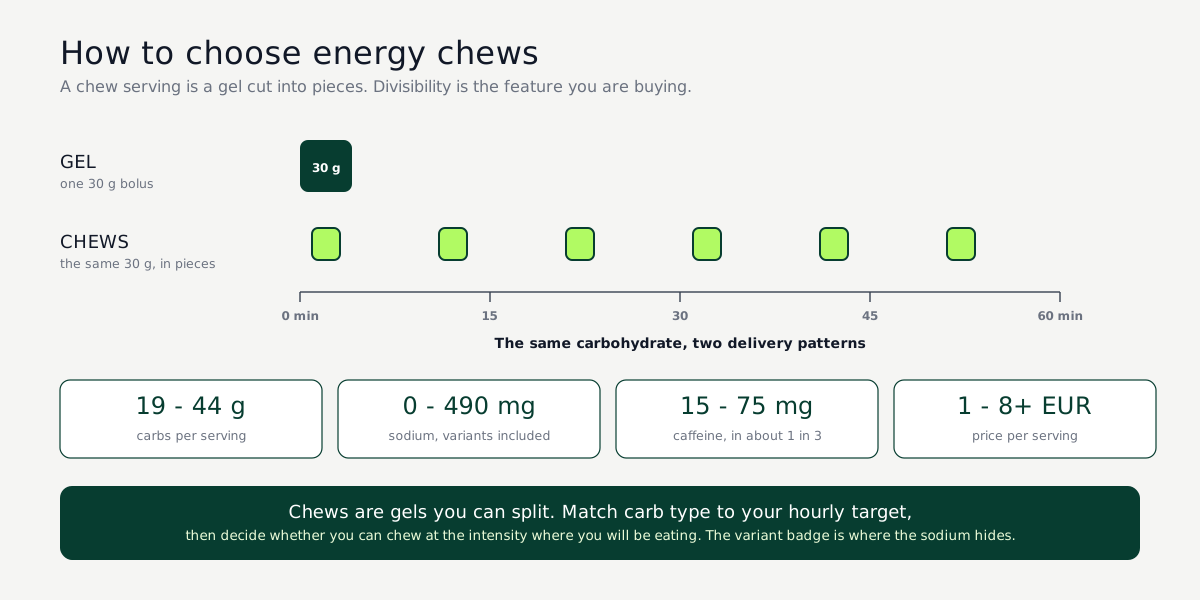
Energy chews are gummy-textured race fuel that delivers a gel-sized carbohydrate dose - roughly 19 to 44 g per serving - as several small pieces instead of a single bolus, so the same fuel can be spread out, halved, or stopped mid-serving.
Energy chews get sold as the friendlier gel, and for once the marketing is roughly right, but for a reason the packaging never states. Nutritionally, a chew serving is a gel: the same carbohydrate, often the same sodium and caffeine questions, read off the same label. The difference is mechanical. A gel is a bolus, one 20 to 40 g hit that arrives all at once. A chew serving is that same dose cut into pieces, and pieces can be spread out, halved, or stopped mid-serving. This guide is how to read a chew's numbers, and how to decide whether divisibility is worth it for your race.
If you want to filter as you read, the chews catalogue lists every energy chew we track, 19 products across 6 brands, sortable by carbs, sodium, caffeine, brand, and price. They average about 32 g of carb per serving, which is exactly gel territory.
The divisible dose is the real feature
Start with the reason to buy chews at all. Athletes who "cannot stomach gels" usually mean they cannot stomach a 30 g bolus landing at once. Chews solve exactly that: the serving is several pieces, so the same 30 g can trickle in over 20 minutes instead of arriving in one swallow. That makes chews the natural tool for steady, lower-intensity efforts, for long training days where you graze rather than dose, and for athletes rebuilding confidence after GI trouble. The gut-training guide covers why smaller, frequent doses are the gentler on-ramp.
The trade is chewing itself. A gel goes down in two seconds at threshold; a chew needs teeth and breathing room. Running hard, that matters. On the bike, or hiking the climbs of an ultra, it does not. Match the format to the intensity at which you will actually be eating, not the intensity on the box.
Carb type decides your ceiling, here too
Everything from the energy gel guide applies unchanged: single-source glucose saturates around 60 g of carb per hour, and a glucose-fructose blend is what pushes the ceiling toward 90 g/h. The chew shelf, though, is thinner on blends than the gel shelf. In our catalogue, Enervit's Carbo Chews line is the one classified as a 2:1 glucose-fructose blend (30 g per serving), while CLIF BLOKS and High 5's Energy Gummies are classified single-source, and several brands do not state their ratio at all. The rule is the same as ever: at or below 60 g/h, single-source chews are fine; above it, you need a verified glucose-fructose product, and if the label will not tell you the ratio, assume it is single-source. Find your hourly number in the carbs-per-hour guide before you shop, because it decides how much of the shelf is even eligible.
Dose per serving: 19 to 44 g, wider than you expect
Chew servings span from 19 g of carb (CLIF BLOKS SOURS) to 44 g (Veloforte's Mela and Mixed chews), with a practical middle ground at 30 g (Enervit Carbo Chews, Precision Fuel & Hydration's PF 30 Chew) and a lighter tier around 21 to 23 g (CLIF BLOKS, Gu Energy's chews, High 5 Energy Gummies). Because the serving divides, the dose number matters differently than it does for gels: a 44 g Veloforte serving is not one intimidating hit but a packet you eat across half an hour. What the number really sets is how much carb you carry per pocket. High-dose servings mean fewer packets for the same plan; the most carbs per serving leaderboard ranks the catalogue by exactly this.
Sodium: read the variant, not just the product name
Standard chews carry modest sodium, from 0 mg (Enervit, PF 30 Chew) up to 145 mg per serving (Veloforte's Amaro chews). But chews are also where dedicated high-sodium variants live: CLIF BLOKS has a variant at 490 mg of sodium per serving and High 5's Energy Gummies have one at 350 mg, several times their standard siblings. Same product name, very different job, so read the variant badge in the catalogue, not just the title. A high-sodium chew can genuinely stand in for an electrolyte product on a salty day. The usual accounting applies: work out your target with the sweat and sodium guide, count what your drink already carries, and do not stack a salty chew on top of a salty bottle by accident.
Caffeine: a third of the shelf, and one big number
Roughly a third of the chews we track carry caffeine, at 15 mg to 75 mg per serving. The spread is the point. At the bottom, Veloforte's Mixed chews (15 mg) and Gu Energy's chews (20 mg) are barely a placement decision. At the top, Veloforte's Amaro at 75 mg and the caffeinated CLIF BLOKS at 50 to 55 mg are real doses that belong where a caffeinated gel would go: timed 45 to 60 minutes before the hard part of the race, counted against your total budget. One chew-specific caution: because a serving divides, a caffeinated packet grazed absent-mindedly becomes an unplanned caffeine drip. Keep most of your chews caffeine-free and place the caffeinated ones deliberately. The caffeine guide has the dosing.
Price per gram of carb, as always
Chews run from about 1.00 to over 8.00 EUR per serving in the catalogue, and as with gels the sticker is misleading because the servings hold different amounts of carb. Per gram, High 5's Energy Gummies work out around 7.6 cents per gram of carb (1.60 EUR for 21 g), while CLIF BLOKS land near 11.9 cents (2.62 EUR for 22 g) and Enervit's Carbo Chews at about 9.8 cents (2.95 EUR for 30 g). Chews generally price at a small premium over the cheapest gels for the same carb, which is the divisibility tax. Decide whether it is worth it for you, then sort the chews catalogue by price and read it against the carb column.
Choose by use case
| Your situation | Chew choice | Why |
|---|---|---|
| Gel boluses upset your stomach | Any standard chew, eaten piecewise | Same carb, spread into small doses |
| Long bike or ultra, grazing all day | High-dose serving (40 g plus) | Fewer packets, steady trickle |
| Pushing past 60 g/h | Verified 2:1 glucose-fructose chews | Single-source saturates; blends raise the ceiling |
| Hot day, salty sweater | High-sodium variant (350 to 490 mg) | Fuel and meaningful sodium in one packet |
| Hard running race, fueling at speed | Gels instead, or chews only pre-start | Chewing at threshold is a real cost |
A four-step buying process
- Get your carb-per-hour number from the planner or the carbs-per-hour guide. At or below 60 g/h, any carb type works; above it, only verified glucose-fructose chews qualify.
- Decide bolus or graze. If you fuel at high intensity, be honest about whether you can chew there; the fueling-by-race-distance guide maps where each format fits across race lengths.
- Check sodium and caffeine against your plan, variants included, using the sweat-sodium guide so a salty chew does not double what your bottle already covers.
- Filter the chews catalogue to that shortlist, sort by price per gram, and put your top picks in compare. Then train on the winner before race day; a chew you have never raced is still an experiment.
Get a plan for your race
To turn this into carb, sodium, and fluid targets for your specific race, open the NutriFinder planner. Chews are a supported fuel type in its scheduling, so you can see exactly how many servings your race needs and where they land in the timeline. The first plan is free with no signup.
Research and references
The thresholds in this guide rest on the following peer-reviewed sources. Verify dose, side-effect profile, and contraindications against the primary literature.
- Jeukendrup AE. 2014. Sports Medicine. A step towards personalized sports nutrition: carbohydrate intake during exercise. PMID 24791914
- Jeukendrup AE. 2010. Current Opinion in Clinical Nutrition and Metabolic Care. Carbohydrate and exercise performance: the role of multiple transportable carbohydrates. PMID 20574242
- Burke LM, Hawley JA, Wong SHS, Jeukendrup AE. 2011. Journal of Sports Sciences. Carbohydrates for training and competition. PMID 21660838
- Thomas DT, Erdman KA, Burke LM. 2016. Medicine & Science in Sports & Exercise. ACSM Joint Position Statement: Nutrition and Athletic Performance. PMID 26891166
- Spriet LL. 2014. Sports Medicine. Exercise and sport performance with low doses of caffeine. PMID 25355191